LOGIN/Sign up

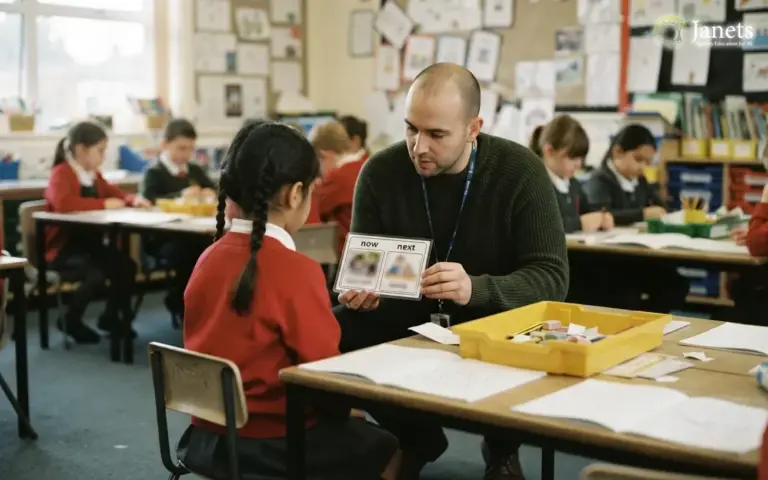
Most lists of autism classroom strategies tell you what to do: use visuals, give processing time, reduce sensory overload. Far fewer show you how to do it at 9.05 on a Tuesday, with 29 other pupils in the room and a lesson already under way.
This guide is written for teaching assistants who want practical tools they can use straight away. You will find a five-minute setup routine, visual supports you can make in minutes, words to use instead of common phrases, a step-by-step response to meltdowns, and three worked classroom scenarios. For the wider picture, including the law, roles in school and all 25 strategies by area of need, read our main guide on how to support a child with autism in the classroom.
What Are the Most Effective Autism Classroom Strategies?
The most effective autism classroom strategies make the day predictable, communication clear and the environment manageable for the senses. Visual supports, literal language, processing time, planned sensory breaks and calm responses to distress help most autistic pupils. They work best when used consistently by every adult and adjusted to the individual.
The Education Endowment Foundation’s Guide to Inclusive Teaching, published in July 2026, describes two complementary parts: universal approaches that help the whole class, and adaptations or additional support that some pupils also need. Most of the strategies below sit in the first group. They help autistic pupils most, but they make lessons clearer for everyone.
One caution from the same guidance is worth remembering: more adaptations do not automatically mean more learning. Choose a few strategies that remove the pupil’s biggest barriers, use them well and drop anything that is not helping.
Before the Lesson: A Five-Minute Set-Up Routine
A little preparation prevents a lot of distress. Before the pupil arrives, or during the first minutes of the day, run through this routine.
- Check the timetable for changes. Supply teacher, room change, assembly, fire drill or trip? If so, update the visual timetable and plan when you will tell the pupil.
- Prepare today’s visuals. Put the right symbols on the now and next board and write the first task’s steps on a sticky note or mini whiteboard.
- Do a quick sensory check. Is the pupil’s seat still away from the door, heater and noisy equipment? Are the blinds right? Is the calm space clear?
- Confirm the break signal. Make sure the pupil’s break card or agreed signal is on their desk and the teacher knows what it means today.
- Pre-teach one thing. Show the pupil one key word, one resource or the shape of the lesson (“First we listen, then we work in pairs, then we write”).
Agree this routine with the class teacher so it fits their lesson plan. It should take no more than five minutes once it becomes a habit.
Visual Supports You Can Make in Minutes
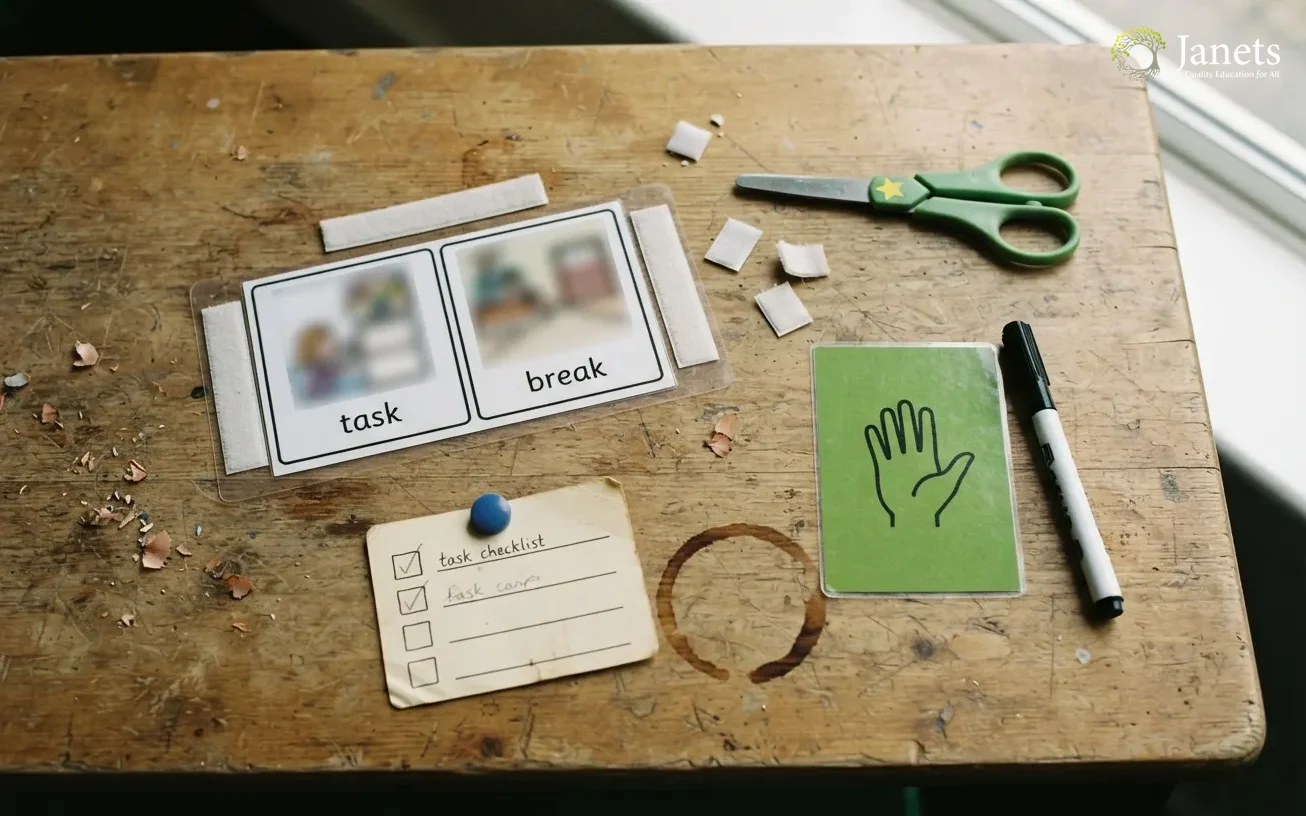
Visual supports work because they stay in place while spoken words disappear. You do not need expensive resources. A laminator, a whiteboard pen and some simple symbols go a long way.
Now and Next Boards
A board split into two halves: what we are doing now and what comes next. Use it for transitions and for tasks the pupil finds hard. “Now: reading. Next: Lego.” Keep “next” honest. If you promise a preferred activity, deliver it.
First-Then Language
The spoken version of a now and next board. “First shoes on, then playground.” Keep it short, use the same structure every time, and pair it with a visual if the pupil is anxious.
Task Checklists and Work Systems
Many autistic pupils need four questions answered before they can start: what do I do, how much do I do, how will I know I have finished, and what happens next? A simple numbered checklist, three questions on a card with a tick box each, or a “to do” and “finished” tray system answers all four.
Choice Boards
Offer two to four clear options as pictures or words. Choice reduces anxiety and builds independence, but too many options can overwhelm. Start with two.
Language That Works: What to Say Instead
Many autistic pupils process language literally and need more time to process it. Small changes in wording can make a big difference. The table below shows common phrases and better alternatives.
| Instead of | Try | Why it helps |
|---|---|---|
| “Can you sit down?” | “Sit on your chair, please.” | A question sounds optional; a clear instruction does not |
| “Pull your socks up.” | “Finish two more sentences.” | Removes the idiom and says exactly what is needed |
| “In a minute.” | “After the timer beeps.” | Gives a concrete, visible end point |
| “Stop shouting!” | “Use a quiet voice.” | Tells the pupil what to do, not only what to stop |
| “Do you understand?” | “Show me your first step.” | Checks understanding without relying on yes or no |
| “Who wants to answer?” | “Sam, after Leo, it’s your turn.” | Removes uncertainty about when to speak |
| “Let’s tidy up soon.” | “Two minutes, then tidy up.” | Gives a warning and a clear time |
| Long explanation during distress | “You’re safe. I’m here.” | Fewer words reduce overload |
Say the pupil’s name first, keep sentences short, and use the same words for the same routine every time.
How Much Processing Time Should You Give?
Give an autistic pupil as much processing time as they need, which is often longer than feels natural. A common rule of thumb is to wait around ten seconds after a question or instruction before speaking again. If you must repeat it, use exactly the same words rather than rephrasing, so the pupil does not have to start processing again.
Silence can feel uncomfortable for adults in a busy classroom. Try counting slowly in your head, looking at the task rather than the pupil, or quietly writing the instruction down while you wait.
Supporting Sensory Needs During the Lesson
Sensory differences are a core part of autism. The National Autistic Society describes how autistic people may be over-sensitive or under-sensitive to sounds, touch, tastes, smells, light and colours. In a classroom, you might see:
● Covering ears, flinching or leaving during noisy activities.
● Squinting or avoiding bright areas of the room.
● Seeking movement, such as rocking, spinning or tapping.
● Refusing certain textures, such as glue, paint or clothing labels.
Quick adjustments that help:
 92% OFF
Support autistic pupils with confidence
Practical SEN, autism, ADHD and dyslexia training for teaching assistants.
- SEN support training for TAs
- Mock and final exam, QLS certificate option
Plan movement before stillness. A short job, such as handing out books, before a long sitting task can help a pupil who seeks movement.
Offer a choice of tools. Ear defenders, a fidget or a cushion, agreed in the support plan.
Use planned sensory breaks. A short, timed break before overload is far more effective than a long recovery after it.
Adjust messy tasks. Gloves, a brush instead of fingers, or a different role in the activity can keep the pupil involved.
Meltdowns and Shutdowns: What to Do in the Moment
A meltdown is an intense, involuntary response to overwhelm. It can involve shouting, crying, running or lashing out. A shutdown looks quieter: the pupil may freeze, stop talking or appear to “switch off”. Neither is a tantrum or a choice, and neither responds to consequences in the moment.
When it happens:
- Stay calm and keep everyone safe. Move other pupils away if needed rather than moving the distressed pupil.
- Reduce talking. Use a few calm words, such as “You’re safe. I’m here.”
- Reduce sensory input. Lower lights or noise if you can, and give physical space.
- Offer the calm space or sensory tools the pupil already knows, without insisting.
- Wait. Recovery can take much longer than the visible meltdown.
- Reflect later. When the pupil is fully calm, perhaps the next day, think together about what happened using pictures or a simple timeline.
Afterwards, record the incident and share it with the teacher and SENCO. Patterns in time of day, lesson type or noise level often point to the next adjustment.
Making Break and Lunchtime Work
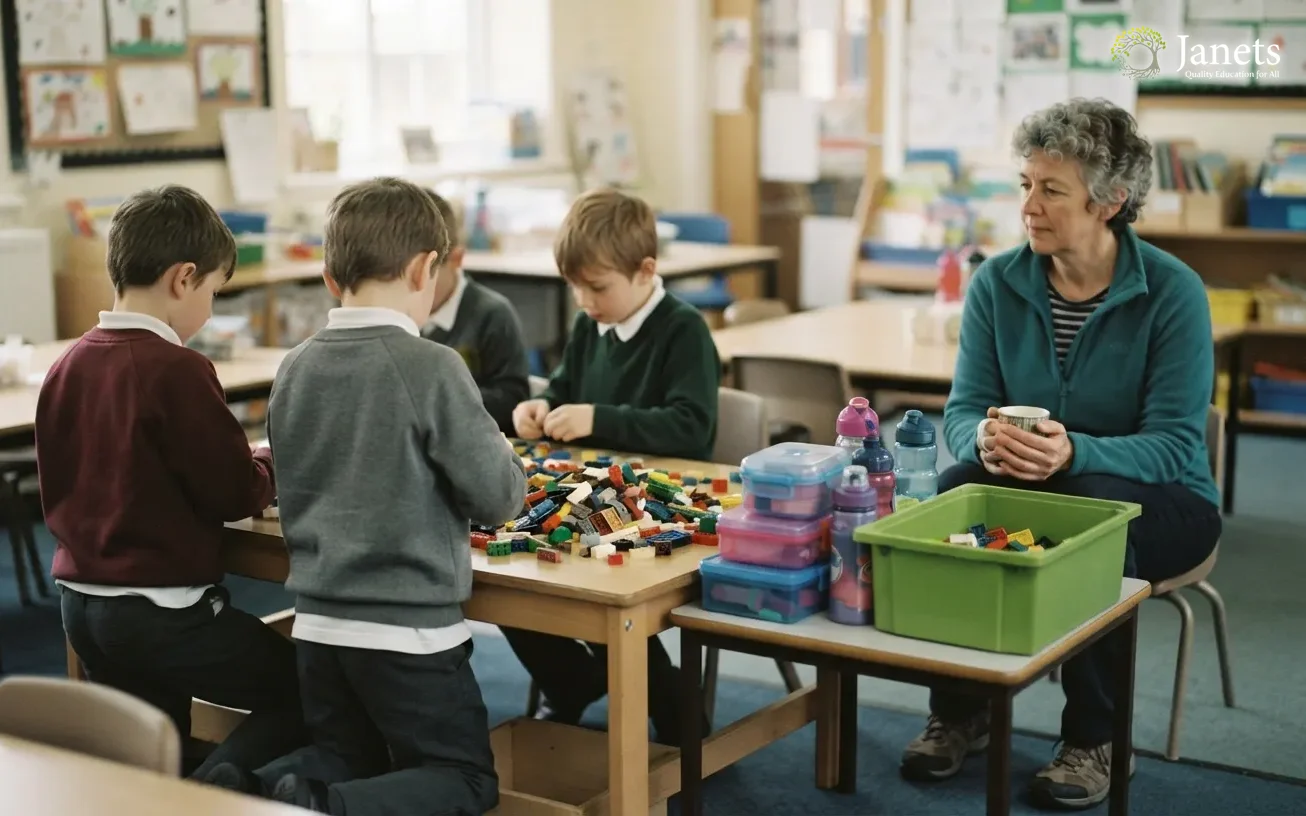
Unstructured time is often harder than lessons. Practical options include a lunchtime club with a clear activity, a quiet room or library pass, a job with a defined role, a visual map of where to go and a named adult the pupil can find. Before break, remind the pupil of their plan in one sentence: “At lunch you go to Lego club in Room 4.”
Three Classroom Scenarios
These short scenarios are illustrative examples based on common classroom situations, not real pupils. They show how the strategies fit together in practice.
Scenario 1: Year 2 carpet time. Leo, aged 6, rolls away from the group and hums loudly during the class story. The TA notices he is sitting at the busiest point of the carpet, beside the door. Next day, she gives him a fixed spot at the edge with a cushion, shows a first-then card (“First story, then drawing”) and lets him hold a small fidget. The humming reduces, and he answers a question about the story.
Scenario 2: Year 5 fire drill. Amira, aged 9, is very anxious about loud sudden noises. The school arranges a planned fire drill. The TA tells Amira in the morning, shows her the timetable slot, practises the route with her and lets her wear ear defenders. Amira lines up with her class. The school also plans what to do in an unplanned drill.
Scenario 3: Year 9 group work and masking. Josh, aged 14, seems fine in lessons but his parents report he is exhausted and distressed every evening. The TA notices he copies others in group work and rarely asks questions. With the SENCO, the school gives him a defined role in group tasks, a private check-in card and a quiet space at lunch. In a case like this, families often notice fewer evening meltdowns once school-day demands are better managed.
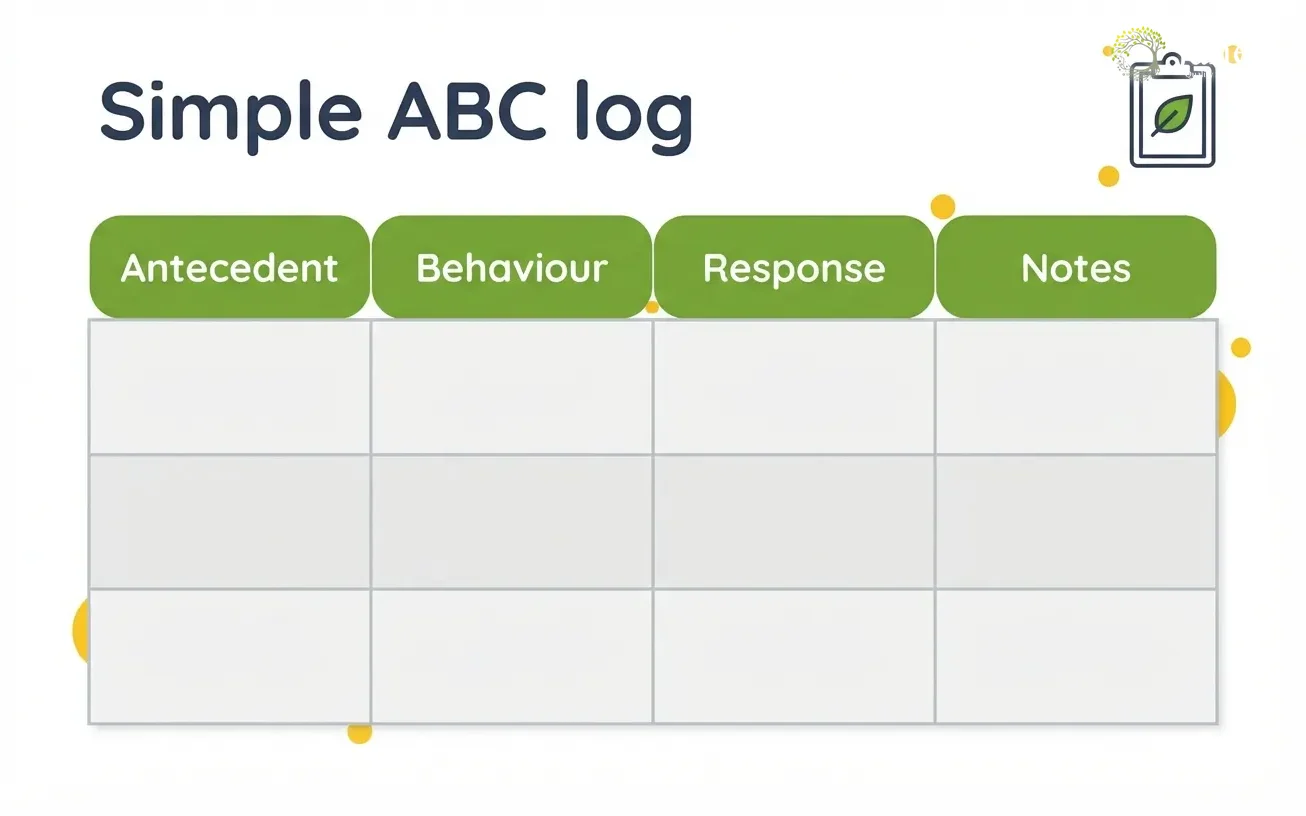
Recording What Works: A Simple ABC Log
Write a short note after any difficult moment and after good days too. The ABC format keeps it quick.
| Column | What to write | Example |
|---|---|---|
| Antecedent | What happened just before | Room change announced without warning |
| Behaviour | What you saw and heard, without judgement | Covered ears, left the room, sat under the stairs |
| Consequence or response | What adults did and what happened next | TA followed at a distance, offered ear defenders, pupil returned after 10 minutes |
| Notes | Patterns or ideas | Third time after an unannounced change; add changes to the morning timetable check |
Share logs with the teacher and SENCO regularly. They turn your observations into evidence for the pupil’s support plan.
Working Well With the Class Teacher
TAs make the biggest difference when they help the pupil access the teacher’s lesson rather than running a separate one alongside it. Three habits help:
A two-minute handover. Before the lesson, agree on the learning goal, the pupil’s likely sticking points and your role.
Scaffold, don’t do. Prompt, model and break tasks down, but let the pupil do the thinking. Fade support as soon as you can.
Feed back. Tell the teacher what worked, what did not and what the pupil achieved.
If you are building your skills in this role, our guide to becoming a classroom assistant explains what schools expect. If you are weighing up courses, our comparison of autism training for teaching assistants sets out the main routes.
Many autistic pupils also have ADHD, which can create competing needs: routine and novelty, stillness and movement. Our guide to ADHD strategies in the classroom shows how to balance them.
Learn More Strategies With a Structured Course
If you want to build on these tools, the TA, SEN, Autism, ADHD & Dyslexia course from Janets covers autism alongside SEN support, ADHD, dyslexia and the teaching assistant role. It is self-paced, online and open to beginners, with a CPD-accredited certificate when you pass the final assessment.
Frequently Asked Questions
What Are Some Examples of Classroom Accommodations for Students With Autism?
Common accommodations include a consistent seat away from noise, a visual timetable, written or pictorial instructions, agreed sensory tools such as ear defenders, planned movement breaks, a calm space, extra processing time and alternative ways to record work. The right mix depends on the pupil’s needs and should be written into their support plan.
What Is a Good Daily Routine for an Autistic Child at School?
A good routine has the same predictable start each day, such as a quiet entry, checking the visual timetable and a familiar first task. Lessons are broken into clear chunks with warnings before changes. Planned breaks, a structured lunchtime option and a calm end-of-day routine help the pupil leave school regulated.
How Can You Help a Non-Speaking Autistic Pupil in Class?
Use the pupil’s own communication system consistently, whether that is symbols, signing, a communication book or a speech-generating device. Model it yourself as you talk, offer choices visually and allow plenty of time to respond. Speech and language therapists can advise on the best approach for each pupil.
What Sensory Activities Help Autistic Pupils in School?
Helpful sensory activities include heavy work such as carrying books or stacking chairs, short movement breaks, chewing or fidget tools, quiet time with ear defenders and calming activities like squeezing putty. An occupational therapist can suggest a personalised sensory plan based on whether the pupil seeks or avoids sensory input.
What Are the Best Activities for Autistic Children in the Classroom?
The best activities are clearly structured, have a visible end point and connect to the pupil’s interests. Construction tasks, sorting and matching, visual problem-solving, computer-based learning and activities with defined group roles often work well. Avoid open-ended tasks without guidance, and always offer a way to opt out safely.