


Course Library View the full range of courses
-
Accounting (145 courses)
- Xero Accounting and Bookkeeping Online
- Sage 50 Accounting & Payroll
- Project Finance
- Financial Modelling Training
- Tax Accounting
- Introduction to VAT
- Accounting and Finance Course for Managers
- Internal Compliance Auditor
- Financial Statement Analysis
- Payroll Administrator Level 3 Diploma
- View all Accounting courses
-
Language (67 courses)
- British Sign Language (BSL) Level 1 & 2
- Speech and Language Therapy Diploma
- TEFL (TESOL) Course
- English Spelling, Punctuation, and Grammar
- Child & Adult Speech & Language Disorders Training
- Teaching English as Foreign Language (TEFL) Certificate
- Mastering Spanish Language
- French Course for Beginners
- German Course for Beginners
- Body Language and Gesture Training
- View all Language courses
-
Teaching & Education (37 courses)
- Teaching Assistant Complete Course (TA, SEN, Autism, ADHD & Dyslexia) – CPD Certified
- EYFS Teaching Assistant Training Course
- Advanced Diploma in Coaching and Mentoring
- Level 3 Diploma in Teaching and Classroom Management
- Remote Teaching
- SENCO – Special Educational Needs Coordination
- Teaching English as Foreign Language (TEFL)
- Life Coaching
- Phonics Teaching Diploma
- View all Teaching & Education courses
-
Health and Social Care (138 courses)
- Health and Social Care Management
- Paediatric Nursing Assistant
- Mental Health Awareness Training
- Emergency Medicine – Paramedicine
- Level 3 Diploma in Adult Care
- Paediatric First Aid Training
- Safeguarding Children Level 3
- Level 3 Diploma in Anatomy and Physiology of Human Body
- Play Therapy
- The Care Certificate Preparation – Standards (1 to 15)
- View all Health and Social Care courses
-
Management (539 courses)
- Office Admin, Secretarial and PA Diploma
- Estate Agent and Property Management Training
- Diploma in Data Analysis Fundamentals
- Advanced Diploma in Stress & Anxiety Management
- Good Manufacturing Practice (GMP)
- Property Development and Management Course
- Diploma in Hotel Management
- Supply Chain Management
- Quality Assurance (QA) Manager
- Compliance and Risk Management
- View all Management courses
-
IT & Software (123 courses)
- Coding with Python 3
- Search Engine Optimisation (SEO) Training
- Cyber Security
- Motion Graphics with After Effects
- CompTIA A+ Core 1 (220-1101) Course
- Machine Learning for Aspiring Data Scientists
- Next.js Web Dev: Master this Powerful React Framework
- Learn 2D Animation with Adobe Animate
- GDPR Challenges in Education
- View all IT & Software courses
-
Employability (1043 courses)
- Office Administrator Skills
- Presentation Skills
- Legal Secretary and Office Skills
- Hospitality Management
- Estate Agent Diploma
- Hairdressing and Barbering
- Diploma in UK Employment Law
- Diploma in Data Analysis Fundamentals
- Building Surveyor Training
- Emotional Intelligence Training
- View all Employability courses
-
Personal Development (1438 courses)
- Productivity Habits
- Minute Taking Course
- Presentation Skills
- Excel: Top 50 Microsoft Excel Formulas in 50 Minutes!
- Critical Thinking and Problem Solving Skills
- Time Management
- Self Esteem and Confidence Building Course
- Essential IT Skills
- Legal Secretary and Office Skills
- Personality Development
- View all Personal Development courses


Level 3 Diploma in Teaching and Classroom Management
104 Students (11 Reviews)
The Level 3 Diploma in Teaching and Classroom Management equips you to be an invaluable asset in any educational setting. Learn to manage classrooms, support teachers, and empower student success.

Course Curriculum
| Introduction to Teach Like a Champion | |||
| Introduction Teach Like a Champion | 00:10:00 | ||
| Classroom Management | |||
| How to Avoid Students Disrupting the Class | 00:11:00 | ||
| How to Stop Distruptions Once They Begin | 00:09:00 | ||
| Choosing an Appropriate Seating Arrangement | 00:03:00 | ||
| Choosing the Best Communication System for the Class | 00:09:00 | ||
| Planning | |||
| The Critical Importance of Planning | 00:08:00 | ||
| How to Plan an Effective Lesson | 00:09:00 | ||
| How to Plan an Effective Units | 00:06:00 | ||
| How to Plan for the Whole Semester | 00:04:00 | ||
| Assessments and Grading | |||
| Creating Effective Assessments | 00:08:00 | ||
| Efficient Grading Techniques | 00:06:00 | ||
| The Power of Formative Assessment | 00:09:00 | ||
| The Strengths and Weaknesses of Summative Assessment | 00:04:00 | ||
| Relationship Management | |||
| Developing Healthy Relationships with Students | 00:08:00 | ||
| Communicating Effectively with Parents | 00:05:00 | ||
| Managing Management, How to Deal with the Boss | 00:06:00 | ||
| Psychological Tools for the Champion Teacher | 00:05:00 | ||
| Conclusion | |||
| Review the Key Ideas of the Course | 00:06:00 | ||
| Mock Exam | |||
| Mock Exam- Level 3 Diploma in Teaching and Classroom Management | 00:20:00 | ||
| Final Exam | |||
| Final Exam- Level 3 Diploma in Teaching and Classroom Management | 00:20:00 | ||
| Order your Certificates & Transcripts | |||
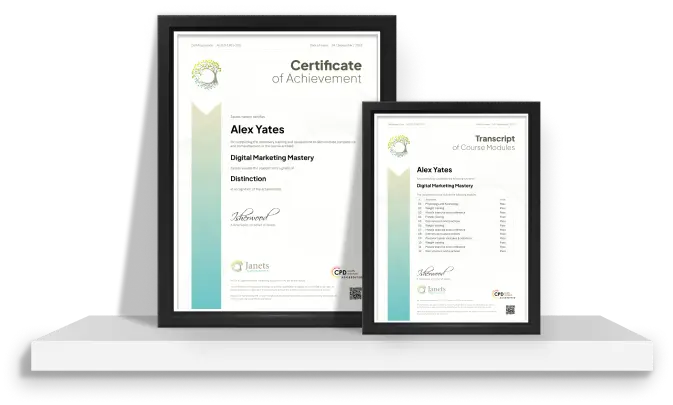
| Order Certificates & Transcripts / CPD QS | 00:00:00 | ||

Original price was: £319.£25Current price is: £25. ex Vat
SAVE 92% - OFFER ENDS IN

 ALL
COURSES FOR £49
ALL
COURSES FOR £49  14-Day Money-Back Guarantee
- Personal
- Team
Quantity:
Total:
50% discount for orders of 10+ courses
60% discount for orders of 50+ courses
70% discount for orders of 100+ courses
For more personalised package, contact us


Frequently asked questions
Can’t find the anwser you’re looking for ? Reach out to customer support team.
Classroom management in teaching refers to the techniques and strategies that teachers use to maintain an organized, disciplined, and productive learning environment. It involves managing student behavior, fostering a positive classroom culture, and ensuring that instructional activities run smoothly. Janets offers courses that include comprehensive training on effective classroom management strategies, helping teachers create conducive learning environments.
The four key aspects of classroom management are establishing clear expectations, developing consistent routines, implementing positive reinforcement, and managing disruptions effectively. These elements help create a structured and supportive classroom environment. Janets' courses cover these aspects in detail, providing practical techniques for teachers to implement in their classrooms.
Classroom management and effective teaching are closely related. Good classroom management creates a stable environment that allows for effective teaching and learning. When students understand expectations and routines, they are more likely to engage and participate in lessons, leading to better educational outcomes. Janets' courses emphasize the importance of integrating strong management practices with effective instructional strategies.
The 5 P's of classroom management are Planning, Preparation, Prevention, Procedures, and Positive reinforcement. These elements help teachers create a well-organized and positive classroom environment, enhancing student engagement and learning outcomes. Janets' training programs incorporate these principles, providing teachers with practical tools to manage their classrooms effectively.
The 4 C's of classroom management are Consistency, Clarity, Communication, and Care. These principles help teachers maintain a stable and supportive learning environment. Consistent rules, clear expectations, effective communication, and caring relationships are crucial for successful classroom management. Janets' courses provide strategies to implement these principles effectively in the classroom.
The three core concepts of classroom management are establishing rules and procedures, building positive relationships, and engaging students in meaningful learning activities. These concepts are fundamental to creating an effective classroom environment. Janets' courses cover these concepts extensively, ensuring teachers are equipped with the knowledge and skills to manage their classrooms successfully.
The aim of classroom management is to create a safe, orderly, and productive learning environment. Effective classroom management promotes student engagement, minimizes disruptions, and supports academic success. Janets' courses focus on equipping teachers with the strategies needed to achieve these goals, fostering a positive educational experience for all students.
Indicators of effective classroom management include a well-organized classroom, clear expectations, consistent routines, positive student behavior, high levels of student engagement, and minimal disruptions. Janets' courses teach teachers how to recognize and implement these indicators, ensuring a well-managed and productive classroom environment.
Teachers play a crucial role in classroom management as they set the tone, establish expectations, and create a positive learning environment. Effective teachers use a variety of strategies to manage student behavior, encourage engagement, and facilitate learning. Janets' courses provide comprehensive training on the essential role of teachers in classroom management, helping educators develop the skills needed to manage their classrooms effectively.
The five methods of teaching commonly used are: 1. Lecture: Delivering information through verbal instruction. 2. Discussion: Engaging students in conversations to explore ideas and concepts. 3. Demonstration: Showing students how to do something through practical examples. 4. Collaborative learning: Encouraging students to work together on projects or problem-solving activities. 5. Inquiry-based learning: Promoting critical thinking through questioning and exploration. Janets' courses cover these teaching methods, providing practical strategies for effective instruction.
The 3 C's of classroom management are Consistency, Cooperation, and Communication. These elements help establish a stable and collaborative classroom environment. Consistent rules, cooperative relationships, and effective communication are key to successful classroom management. Janets' courses teach these principles, helping teachers implement them effectively in their classrooms.
The major components of classroom management include establishing rules and procedures, maintaining a positive classroom environment, effective communication, student engagement, and behavior management. These components work together to create a conducive learning environment. Janets' courses provide in-depth training on these components, equipping teachers with the tools to manage their classrooms successfully.
The five factors affecting classroom management are: 1. Classroom environment: The physical setup and resources available. 2. Teacher behavior: The teacher's ability to manage and engage students. 3. Student behavior: The attitudes and behaviors of the students. 4. Instructional methods: The effectiveness of the teaching strategies used. 5. School policies: The support and guidelines provided by the school administration. Janets' courses address these factors, providing strategies to manage and optimize each aspect effectively.
The principle of classroom management is to create an environment that maximizes student learning and minimizes disruptions. This involves setting clear expectations, establishing routines, building positive relationships, and using proactive behavior management strategies. Janets' courses emphasize these principles, providing practical techniques for teachers to implement in their classrooms.
The types of classroom management include preventive, supportive, and corrective management. Preventive management involves setting up the classroom environment and establishing routines to prevent issues. Supportive management focuses on maintaining a positive and supportive atmosphere. Corrective management addresses behavior issues when they arise. Janets' courses cover all these types, providing comprehensive strategies for effective classroom management.