LOGIN/Sign up


Choosing autism training for teaching assistants used to be simple: a one-day course, a certificate and back to class. In 2026 the options are wider and the stakes are higher. Schools are under pressure to include more autistic pupils in mainstream classes, a new £200 million SEND training programme is rolling out, and three in four school leaders say they are struggling to recruit TAs, according to NFER research published in March 2026.
For you, that means two things. Schools increasingly expect TAs to arrive with some autism knowledge, and there are more ways than ever to get it. This guide compares the five main routes, from free training to regulated qualifications and apprenticeships, so you can choose the one that fits your role, budget and goals. It also gives you an eight-point checklist for judging any course and the red flags that should make you think twice.
What Autism Training Do Teaching Assistants Need?
There is no single mandatory autism qualification for teaching assistants in England. Most schools expect TAs to understand autism, support communication and sensory needs, and follow the pupil’s support plan. Many start with free or online CPD, then build towards a regulated qualification or apprenticeship if they want a specialist SEN role.
It helps to think about autism training in three layers:
- Awareness: what autism is, how it affects communication, sensory processing and anxiety, and how to avoid common misunderstandings.
- Practice: concrete classroom strategies such as visual supports, processing time, calm spaces and responding to meltdowns.
- Specialism: deeper knowledge for TAs who lead interventions, work one-to-one with complex needs or support other staff.
Every TA needs the first two layers. The third matters if you want to move into roles such as SEN TA, learning support assistant for a resourced provision, or higher level teaching assistant (HLTA).
This expectation is about to become formal. In January 2026, the Department for Education announced that the SEND Code of Practice will say all staff in every nursery, school and college should receive training on SEND and inclusion.
The Five Main Routes Compared
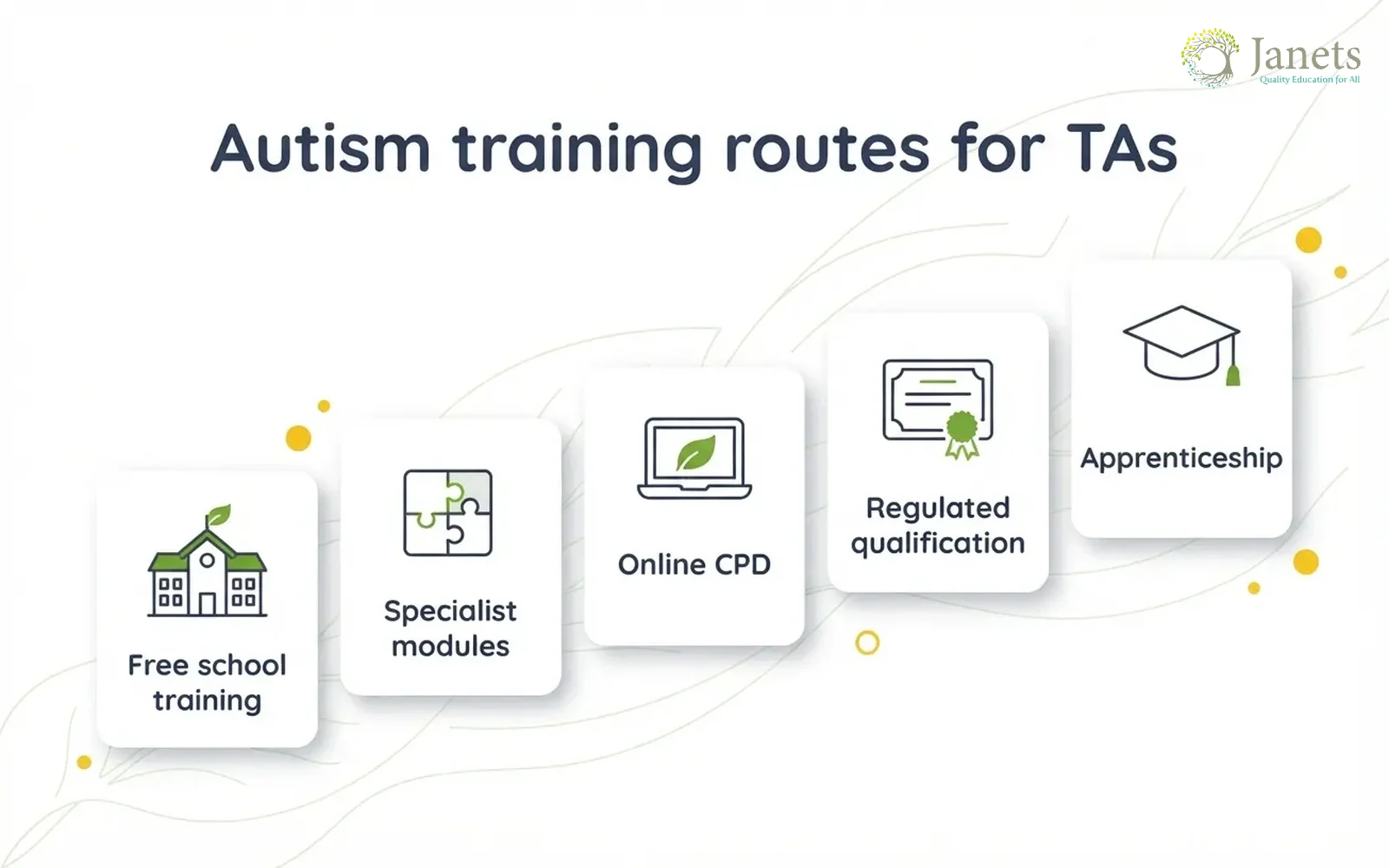
The table below gives a quick overview. Costs and durations are typical ranges at the time of writing and vary by provider and area.
| Route | Examples | Typical cost to you | Typical time | What you come away with | Best for |
|---|---|---|---|---|---|
| Free national training | DfE SEND and inclusion training materials (in-house) | Free | Short sessions across the year | Shared school-wide practice | Every TA, through their school |
| Free or low-cost specialist modules | Neuroinclusive Education Network modules, Anna Freud programme | Free to low cost, depending on area | Half a day to a few sessions | Practical, school-focused autism knowledge | TAs already working in schools |
| Online CPD course | Self-paced autism or SEN courses | Low | A few hours to a few weeks | CPD-accredited certificate and broad knowledge | Aspiring TAs, career changers, quick upskilling |
| Regulated qualification | NCFE CACHE Level 2 or Level 3 Certificate in Understanding Autism | Low to moderate; funding may be available | Typically several weeks to months | Ofqual-regulated qualification | TAs wanting a recognised credential |
| Apprenticeship | Level 3 Teaching Assistant (SEND pathway), Level 5 Specialist Teaching Assistant | Usually funded for the learner | Around 15 to 21 months | Apprenticeship certificate, sometimes HLTA status | Employed TAs aiming for specialist roles |
Route 1: Free National Training Through Your School
On 24 September 2026, the DfE published a free collection of SEND and inclusion training materials for mainstream schools, developed by Ambition Institute for teachers and teaching assistants. Schools can use them in staff meetings and training days, and more materials are due in early 2027.
The government has also said that new fully funded training courses for teachers, leaders and support staff will follow in September 2027, according to its press release on the start of the SEND training programme. If you already work in a school, ask your SENCO how the school is using these materials and whether TAs are included in every session.
Route 2: Free or Low-Cost Specialist Autism Modules
The Autism Education Trust, now the Neuroinclusive Education Network (NEN) and part of the National Autistic Society, runs modular training through licensed local partners. School-age modules include Making Sense of Autism, Good Autism Practice and Understanding Autism and Anxiety. Some local authority partners offer them free to schools, while others charge a modest fee, so check with your local partner.
Anna Freud’s Neurodiversity and Wellbeing in Schools programme, launched in February 2026, is free for state primary and secondary school staff. It combines workshops on supporting autistic and ADHD pupils with tailored mentoring and was co-produced with autistic and ADHD people.
These routes are excellent value, but they usually rely on your school booking or releasing you, and places can be limited.
Route 3: Online CPD Courses
Self-paced online courses suit people who want to learn now, at their own pace, whether or not they are already in a school. Good courses cover the TA role, SEN support, autism and related needs, and end with an assessment and a CPD-accredited certificate.
The key thing to understand is what the certificate means. CPD accreditation shows that a course has been checked against continuing professional development standards. It is not the same as an Ofqual-regulated qualification, and it does not license you to do anything. It is, however, useful evidence of learning on a CV and a strong foundation before a regulated qualification or apprenticeship.
Route 4: Regulated Autism Qualifications
The NCFE CACHE Level 2 Certificate in Understanding Autism (601/6330/6) and the NCFE CACHE Level 3 Certificate in Understanding Autism (603/1935/5) are regulated qualifications offered by colleges and training providers. They are usually assessed through written work against set learning outcomes.
They suit TAs who want a nationally recognised credential, and adult learners may be eligible for funding depending on their circumstances and location. Check the provider’s start dates, assessment method and support before enrolling.
Route 5: Apprenticeships
If you are employed in a school, an apprenticeship can turn your day job into a qualification. Some providers offer the Level 3 Teaching Assistant apprenticeship with a SEND pathway, typically over 15 to 18 months. For experienced TAs, the Level 5 Specialist Teaching Assistant apprenticeship includes specialisms such as SEND, usually lasts around 17 to 21 months and, with some providers, includes optional HLTA status. Providers typically ask for at least a year of school experience.
Apprenticeships are usually funded for the learner through the apprenticeship levy, but they need your employer’s agreement and protected off-the-job training time.
Want a flexible first step into SEN support?
Build autism, ADHD and dyslexia knowledge alongside the TA role, before you apply or while you work.
- TA role, SEN support, autism, ADHD and dyslexia in one course
- No previous experience needed, study at your own pace
- Online assessment and a CPD-accredited certificate
👥 109 students · 🎓 CPD-accredited certificate · 💻 100% online, self-paced
What to Look for in Autism Training: An 8-Point Checklist
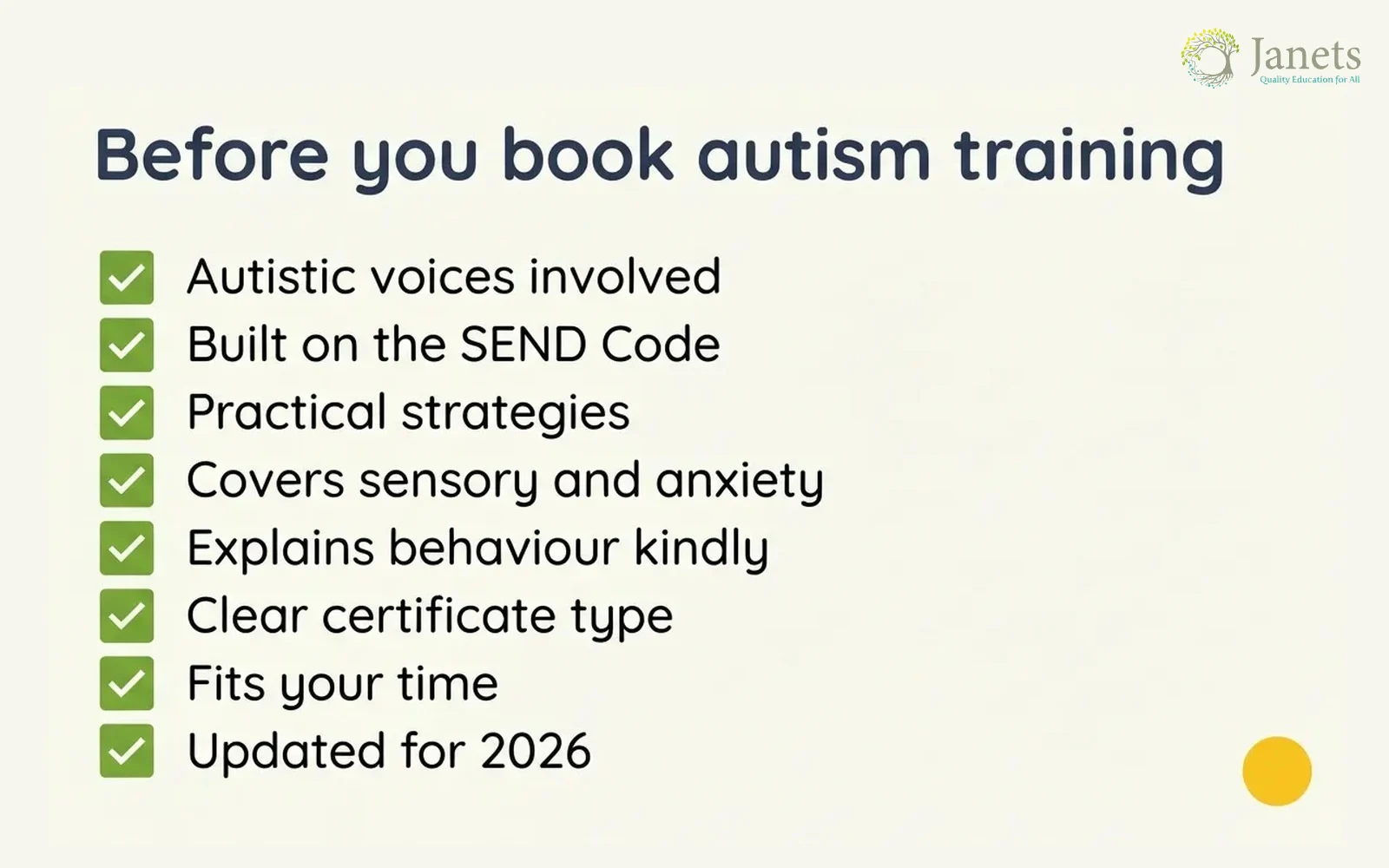
Whichever route you choose, these eight questions will help you separate genuinely useful training from box-ticking.
- Were autistic people involved? Look for training that is co-produced with, or reviewed by, autistic people. It is more likely to reflect real experience.
- Is it built on the UK framework? Good training refers to the SEND Code of Practice, SEN support, EHC plans and the graduated approach of assess, plan, do, review.
- Is it practical? You should leave with strategies you can use tomorrow, ideally with classroom examples or scenarios.
- Does it cover the less obvious areas? Sensory processing, anxiety, masking, autistic girls, and meltdowns versus shutdowns are essential, not optional extras.
- How does it describe behaviour? Training should focus on understanding the reasons behind behaviour and supporting the pupil, not on simply making behaviour stop.
- Is the certificate clearly explained? The provider should say plainly whether you get a CPD certificate, an endorsed certificate or an Ofqual-regulated qualification.
- Does the format fit your life? Consider total hours, deadlines, live sessions and whether you can study around work and family.
- Is it up to date? In 2026, good training should at least mention the white paper reforms, the new SEND training expectations and Ofsted’s inclusion focus.
Red Flags to Watch For
Be cautious if a course:
- talks about “curing”, “treating” or “recovering from” autism
- promises guaranteed jobs, pay rises or “qualified SEN TA” status
- blurs the difference between a CPD or endorsed certificate and a regulated qualification
- quotes a level number without explaining whether it describes an endorsed course or an Ofqual-regulated qualification
- has no information about who wrote the content or when it was last updated
None of these automatically make a course worthless, but they are signs to ask more questions before you pay.
Which Autism Training Route Is Right for You?
The right autism training route depends on whether you already work in a school, how much time you have and where you want your career to go. Aspiring TAs usually start with online CPD, working TAs add free school-based modules, and experienced TAs aiming for specialist roles move on to regulated qualifications or apprenticeships.
You want to become a TA but are not in a school yet. Start with an online CPD course covering the TA role, SEN and autism. It shows commitment on your CV and prepares you for interview questions about supporting pupils with additional needs. Our guide to teaching assistant interview questions shows the kind of SEN scenarios schools ask about.
You are a new TA in a mainstream class. Join every whole-school session using the DfE materials, ask about local NEN modules, and add a short online course to fill gaps quickly.
You support one autistic pupil one-to-one. Prioritise practical, pupil-focused training such as Good Autism Practice, and ask the SENCO for time to meet any visiting specialists who work with the pupil.
You are an experienced TA aiming for a specialist role. Consider a regulated Level 3 qualification or the Level 5 Specialist Teaching Assistant apprenticeship, which can open the door to HLTA and inclusion roles.
You are a parent or carer considering a career change. An online CPD course is a low-risk first step. It helps you support your own child and test whether school-based work is right for you.

How Do You Turn Autism Training Into Better Practice?
You turn autism training into better practice by choosing one strategy at a time, using it consistently for a few weeks and recording what changes. Share what you learn with the class teacher and SENCO, ask for feedback, and link each new skill to a real pupil’s support plan rather than keeping it in a certificate folder.
A simple routine helps:
- After each module, write down one thing you will try this week and with which pupil.
- Keep a short reflective log. Note the date, the strategy, what happened and what you would change.
- Talk to the teacher. The EEF’s Deployment of Teaching Assistants guidance stresses that TAs are most effective when they are prepared for their specific role and work in partnership with teachers.
- Ask for observation or coaching. Even ten minutes of feedback from the SENCO turns theory into habit.
For a ready-made set of strategies to practise, see our guide to autism classroom strategies teaching assistants can use today. For the bigger picture of supporting autistic pupils across a school, read our main guide on how to support a child with autism in the classroom.
Ongoing learning also strengthens your wider professional development. Our article on why CPD is important for teaching assistants explains how to plan and record it.
Does Autism Training Lead to Higher Pay?
Autism training does not automatically increase a TA’s pay, because pay depends on the school’s grading structure and your role. However, specialist knowledge can help you apply for SEN TA, learning support or HLTA posts, which are often graded higher. Training is strongest when it is backed by experience and evidence of impact.
When you apply for roles, describe what you did with your training, not just the certificate title. “After Good Autism Practice training, I introduced a now-and-next board that helped a Year 3 pupil start tasks independently,” tells a school far more than a list of courses.
Start Your Autism and SEN Training Today
If you want a flexible first step that covers more than autism alone, the TA, SEN, Autism, ADHD & Dyslexia course from Janets brings the teaching assistant role, SEN support, autism, ADHD and dyslexia together in one self-paced online course. It needs no previous experience, includes an online assessment and leads to a CPD-accredited certificate, with an optional endorsed certificate.
Ready to start your autism and SEN training?
One self-paced course that brings the TA role, SEN, autism, ADHD and dyslexia together.
- TA role, SEN support, autism, ADHD and dyslexia in one course
- No previous experience needed, study at your own pace
- Online assessment and a CPD-accredited certificate
👥 109 students · 🎓 CPD-accredited certificate · 💻 100% online, self-paced
Frequently Asked Questions
Is There Free Autism Training for Teaching Assistants?
Yes. The DfE’s SEND and inclusion training materials, published in September 2026, are free for schools to use with teachers and TAs. Some local partners of the Neuroinclusive Education Network offer autism modules free to schools, and Anna Freud’s Neurodiversity and Wellbeing in Schools programme is free for state school staff.
How Long Does Autism Training for a TA Take?
It depends on the route. A free awareness module may take half a day, and a self-paced online CPD course anywhere from a few hours to a few weeks. Regulated Level 2 or Level 3 certificates usually take several weeks to months, and apprenticeships typically last 15 to 21 months.
Do I Need a Qualification to Work as an SEN Teaching Assistant?
There is no single legal requirement for SEN teaching assistants in England, but many schools ask for a relevant Level 2 or Level 3 qualification, experience with children, or both. Autism and SEN training strengthens your application, especially for roles supporting pupils with EHC plans or in resourced provisions.
Is a CPD-Accredited Course the Same as an Accredited Qualification?
No. A CPD-accredited course has been checked against continuing professional development standards and gives you a certificate of learning. An Ofqual-regulated qualification, such as an NCFE CACHE certificate, has a qualification number and set assessment standards. Both have value, but they are not the same thing.
Can I Do Autism Training Without Working in a School?
Yes. Online CPD courses and many regulated autism qualifications are open to anyone, including parents, carers and career changers. Some routes, such as apprenticeships and school-booked modules, require you to be employed in an education setting, so check entry requirements first.