LOGIN/Sign up


You can get a BSL certificate online in the UK, but not every certificate is a regulated qualification. Some confirm course completion or professional development, while others demonstrate formally assessed British Sign Language skills.
If you’re starting to learn BSL, choosing the right certificate depends on your goals and whether you need formal recognition.
For beginners, Janets offers British Sign Language (BSL) Level 1 & 2 Training, a flexible online course with a CPD-accredited Certificate of Achievement available after successful assessment.
What Types of BSL Certificates Can You Get Online?
Online BSL courses offer different certificates depending on the provider, assessment requirements and type of training.
| Certificate type | What it demonstrates | Regulated qualification? |
|---|---|---|
| Course completion certificate | Completion of specified learning activities | Not automatically |
| CPD-accredited certificate | Completion of professional development training or assessment | Not automatically |
| Endorsed training certificate | Achievement associated with an endorsement scheme | Not automatically |
| Regulated BSL qualification | Achievement of a formally assessed qualification | Yes |
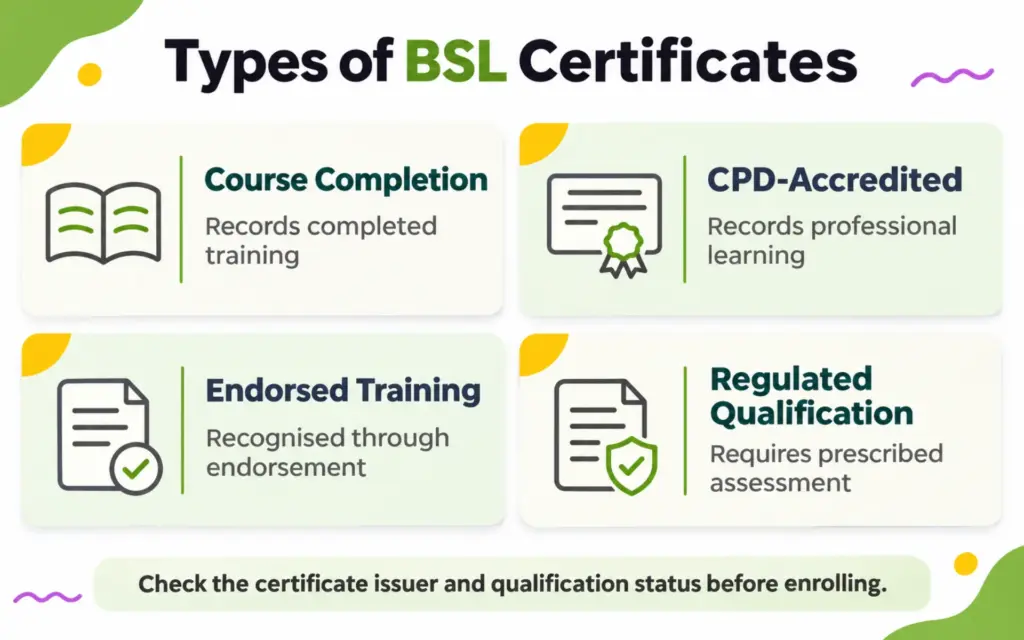
The main difference lies in who issues the certificate, what is assessed and whether the qualification is officially regulated.
BSL Course Completion Certificates
A BSL course completion certificate confirms that you have met a provider’s requirements.
These might include completing lessons, watching training videos, practising signs or passing a short assessment.
Such certificates can document introductory learning. However, completing a course does not automatically demonstrate independently assessed BSL proficiency.
Before enrolling, check what the certificate actually confirms.
CPD-Accredited BSL Certificates
CPD stands for Continuing Professional Development. It refers to learning activities that help professionals maintain and develop their knowledge and skills.
According to the CPD Certification Service, CPD can include training courses, workshops and online learning.
A CPD-accredited BSL certificate may provide useful evidence of additional training, particularly for people interested in improving workplace communication awareness.
However, CPD accreditation does not automatically make a course an Ofqual-regulated qualification.
Endorsed BSL Training Certificates
Some training providers offer certificates through external endorsement schemes.
For example, the Quality Licence Scheme (QLS) evaluates quality processes within the non-regulated training market.
Its official learner guidance confirms that QLS-endorsed training is not equivalent to an Ofqual-regulated qualification.
An endorsed Certificate of Achievement can document completed learning, but you should verify which endorsement applies to your chosen course.
Regulated BSL Qualifications
A regulated BSL qualification follows defined learning outcomes and assessment requirements established by a recognised awarding organisation.
For example, Signature offers regulated BSL qualifications requiring learners to demonstrate particular communication skills.
Regulatory status can also change. The Institute of British Sign Language (iBSL) surrendered its Ofqual recognition in 2023, so it should not be treated as a current awarding organisation. This is confirmed in Ofqual’s official announcement.
These distinctions matter because studying content labelled BSL Level 1 or Level 2 does not automatically mean you will receive a regulated qualification at that level.
Are Online BSL Certificates Recognised in the UK?
An online BSL certificate may be accepted by UK employers or education providers, but recognition depends on the specific credential and its intended purpose.
A certificate of professional development is not necessarily equivalent to a formally assessed qualification.
What Does a Recognised BSL Certificate Actually Mean?
Employers may value evidence of additional BSL learning, especially in education, care, customer service and other public-facing roles.
However, individual employers decide which training and qualifications meet their requirements.
A CPD certificate can demonstrate completed professional development without necessarily proving practical signing competence at a particular level.
Likewise, a course described as Level 1 does not automatically carry the same recognition as a regulated Level 1 qualification.
For more detail on educational equivalence and CV value, read our guide to what BSL Level 1 is equivalent to.
How to Check Whether a BSL Qualification Is Regulated
If formal recognition matters to you, verify the qualification before enrolling.
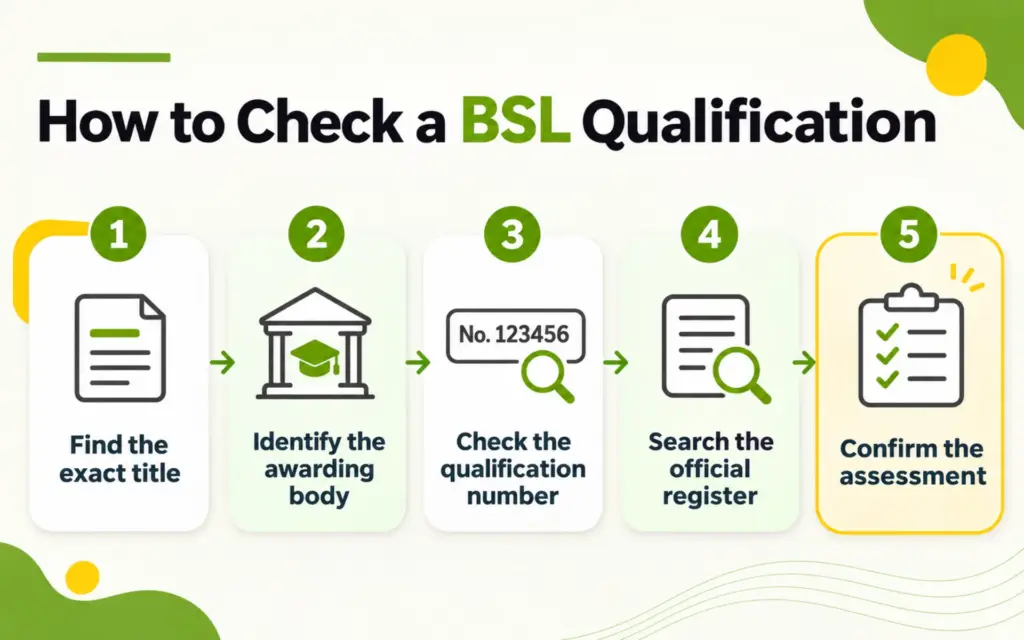
1. Find the exact qualification title.
2. Identify the awarding organisation.
3. Check its qualification number, where applicable.
4. Search the appropriate official register.
5. Confirm the assessment and certification requirements.
You can use GOV.UK’s Register of Regulated Qualifications to check regulated qualifications in England and Northern Ireland.
Wales and Scotland have separate regulatory arrangements and registers.
Practical tip: If a provider describes its course as accredited, ask which organisation provides the accreditation and whether the course awards a regulated qualification or a training certificate.
Do You Need an Exam to Get a BSL Certificate?
Assessment requirements vary between online BSL courses.
Some introductory programmes issue certificates after learners complete the required activities. Others include quizzes, assignments or final examinations.
Regulated BSL qualifications require assessments specified by the awarding organisation, which may involve demonstrating receptive and productive signing skills.
Studying online does not necessarily mean every formal assessment can be completed independently at home.
Before enrolling, check:
- Whether an examination or practical assessment is required.
- How and where assessments take place.
- Who evaluates your performance.
- Which certificate you receive after passing.
For a closer look at beginner-level learning and assessment, see our guide to BSL Level 1 content and exams.
How to Choose the Right BSL Certificate for Your Goals
The most suitable certificate depends on what you want to achieve.
Someone learning BSL for personal interest may not need the same credential as someone pursuing formal study or professional registration.
Swipe horizontally to view all columns.
| Your learning goal | Training or certificate to consider |
|---|---|
| Personal interest or beginner learning | Introductory BSL training with a completion certificate |
| Workplace communication awareness | Relevant BSL training with clear learning outcomes |
| Continuing professional development | Suitable CPD-accredited training |
| Formal education or progression | A regulated qualification meeting the relevant requirements |
If you’re unsure which learning level is appropriate, our comparison of BSL Level 1 vs Level 2 vs Level 3 explains the differences.
Before purchasing any course, confirm the certificate issuer, study format, assessment method and additional charges.
Remember that an introductory certificate does not qualify someone to work as a professional BSL interpreter. The National Registers of Communication Professionals working with Deaf and Deafblind People (NRCPD) sets out approved training routes for professional registration.
Choose a course that meets your present learning needs while considering any future qualification requirements.
Start Learning BSL Online with Janets

If your goal is to develop foundational BSL knowledge and document your learning, Janets offers a flexible online training option.
The British Sign Language (BSL) Level 1 & 2 Training course introduces:
• Fingerspelling and everyday signs.
• BSL vocabulary and sentence structures.
• Practical visual communication.
• Deaf awareness and communication techniques.
You can study at your own pace without previous BSL knowledge.
After successfully completing the final assessment, learners can obtain a CPD-accredited Certificate of Achievement.
The course currently lists a PDF certificate for £9.99 and a hard-copy certificate for £15.99, with certificate fees separate from enrolment.
This course provides online training and a CPD-accredited certificate, rather than an Ofqual-regulated BSL Level 1 or Level 2 qualification.
Explore the course details to decide whether its content, assessment and certification suit your learning goals.
Choose a BSL Certificate That Matches Your Goals
Getting a BSL certificate online can be a practical way to develop knowledge and record your learning.
However, completion certificates, CPD-accredited certificates and regulated BSL qualifications serve different purposes.
Before enrolling, consider what you want to achieve, how your knowledge will be assessed and whether the certificate meets your requirements.
The right choice is one that accurately reflects your learning and supports your next step.
Frequently Asked Questions
Can You Get a BSL Level 1 Certificate Online?
Yes. Online and remote BSL Level 1 learning options are available in the UK.
If you need a regulated qualification, confirm the awarding organisation and assessment arrangements. Completing an online course labelled Level 1 does not automatically award a formal Level 1 qualification.
Is a Digital BSL Certificate as Valid as a Printed One?
A digital certificate can provide the same evidence of achievement as a printed version when both represent the same credential.
Recognition depends on the issuer, authenticity and receiving organisation’s requirements, rather than whether the certificate is digital or printed.
How Much Does an Online BSL Certificate Cost?
Certificate fees vary between providers. Some courses include certification in the enrolment price, while others charge separately for PDF or printed certificates.
For a broader breakdown, see our guide to how much a BSL course costs in the UK.
Can You Put an Online BSL Certificate on Your CV?
Yes. You can list relevant completed BSL training on your CV, including the course title, provider and certificate type.
Describe the achievement accurately. A CPD-accredited training certificate should not be presented as a regulated qualification or proof of professional interpreting competence.