- Home
- Career Guide
- BSL Level 1 vs Level 2 vs Level 3: Which Should You Take?
BSL Level 1 vs Level 2 vs Level 3: Which Should You Take?

Choosing between BSL Level 1 vs Level 2 depends on your current signing skills and what you want to achieve. Level 1 introduces everyday British Sign Language (BSL), Level 2 develops longer conversations and Level 3 focuses on more complex communication.
If you’re starting from scratch, Janets’ British Sign Language (BSL) Level 1 & 2 Training offers a flexible way to learn essential signs, build everyday vocabulary and develop your communication skills at your own pace.
This guide compares BSL Levels 1, 2 and 3, including their difficulty, learning outcomes, study time and progression options, so you can choose a suitable course.
BSL Level 1 vs Level 2 vs Level 3: Key Differences at a Glance
Each BSL level builds on previous language skills. The main difference is how confidently and accurately learners can understand and communicate increasingly detailed information.
Swipe horizontally to view all columns.
| Feature | BSL Level 1 | BSL Level 2 | BSL Level 3 |
|---|---|---|---|
| Learning stage | Beginner | Developing | More advanced |
| Main focus | Basic everyday communication | Longer conversations | Complex communication |
| Vocabulary | Familiar everyday topics | Wider range of topics | More detailed and varied language |
| Grammar | Basic structures | More developed grammar | Greater grammatical accuracy |
| Communication | Short conversations | Extended discussions | Sustained conversations and presentations |
| Suitable for | New learners | Learners with basic BSL skills | Experienced signers |
| Difficulty | Introductory | Intermediate | More demanding |
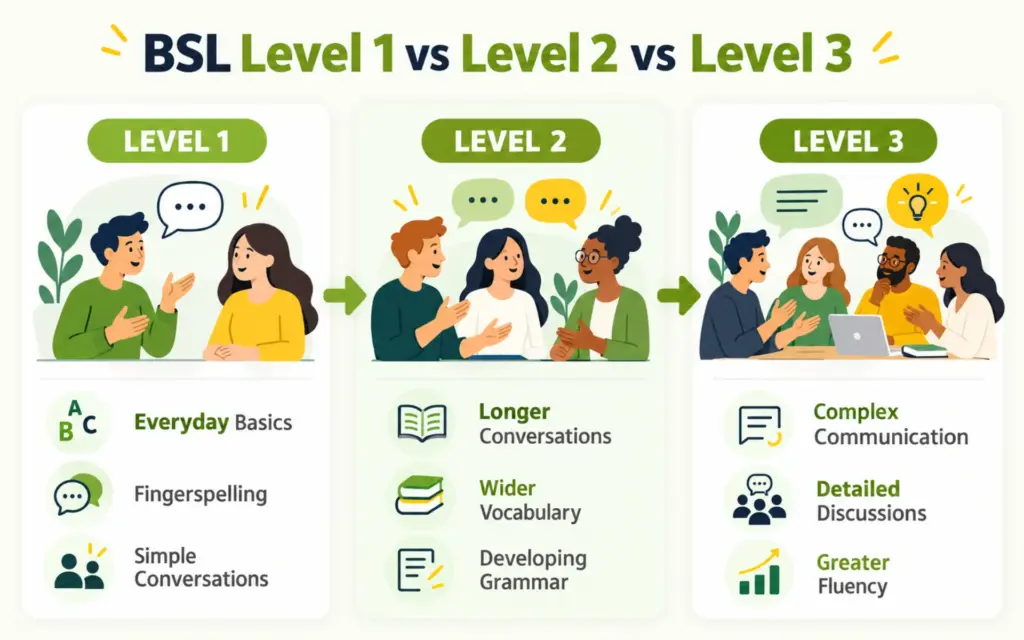
These differences reflect the general progression described in Signature’s BSL qualification specifications.
However, an online training course covering Level 1 or 2 topics is not necessarily the same as a formally assessed, regulated BSL qualification.
What Is the Difference Between BSL Level 1 and Level 2?
The biggest difference between BSL Level 1 and Level 2 is the complexity of communication. Level 1 teaches foundational signs and simple interactions, while Level 2 helps learners understand and express more detailed information.
BSL Level 1: Learning the Basics
BSL Level 1 introduces the essential language skills needed for everyday communication. It is suitable for people with little or no previous signing experience.
Learners typically develop skills in:
- Fingerspelling names and familiar words.
- Introducing themselves and other people.
- Asking and answering simple questions.
- Discussing family, hobbies, food and daily routines.
- Using basic handshapes, facial expressions and signs.
For example, a Level 1 learner might be able to introduce themselves, describe their family or ask for directions using familiar signs.
The goal is to develop a foundation for further communication, rather than advanced fluency.
For more information about beginner learning outcomes, assessments and course options, see our BSL Level 1 explained guide.
BSL Level 2: Developing Conversation Skills
BSL Level 2 builds on foundational signing knowledge and introduces more detailed communication.
Rather than relying mainly on short exchanges, learners develop the skills to participate in longer conversations, describe experiences and discuss a wider range of everyday situations.

Key areas include:
• Expanding vocabulary and grammatical knowledge.
• Understanding longer signed conversations.
• Expressing opinions, experiences and preferences.
• Improving receptive and productive signing skills.
• Communicating about familiar and less predictable situations.
For example, instead of simply signing where they work, a Level 2 learner might explain their daily responsibilities or discuss a recent experience.
Is BSL Level 2 Harder Than Level 1?
Yes. BSL Level 2 generally requires stronger vocabulary, grammatical understanding and conversational ability.
At Level 1, learners focus on understanding and producing relatively simple signed information. At Level 2, they must process longer exchanges and respond with greater accuracy.
Regular practice becomes more important because recognising individual signs is different from following a natural conversation.
However, learners who have developed a solid foundation at Level 1 can approach Level 2 as a manageable next stage of learning.
How Does BSL Level 3 Compare with Levels 1 and 2?
BSL Level 3 develops more advanced communication skills. Learners work towards understanding detailed information, expressing complex ideas and participating in sustained discussions.
Compared with Level 2, Level 3 places greater emphasis on grammatical accuracy, receptive skills and the ability to communicate across varied situations.
Formal Level 3 qualifications may involve presentations, conversations and assessments of signed information.
According to Signature, learners entering its Level 3 qualification need Level 1 and Level 2 qualifications or equivalent experience.
This makes Level 3 more appropriate for people who already have substantial BSL knowledge.
Important: Completing a Level 3 BSL language course does not automatically qualify someone to work as a professional BSL interpreter. Interpreting requires separate specialist training and relevant professional requirements.
Which BSL Level Should You Choose?
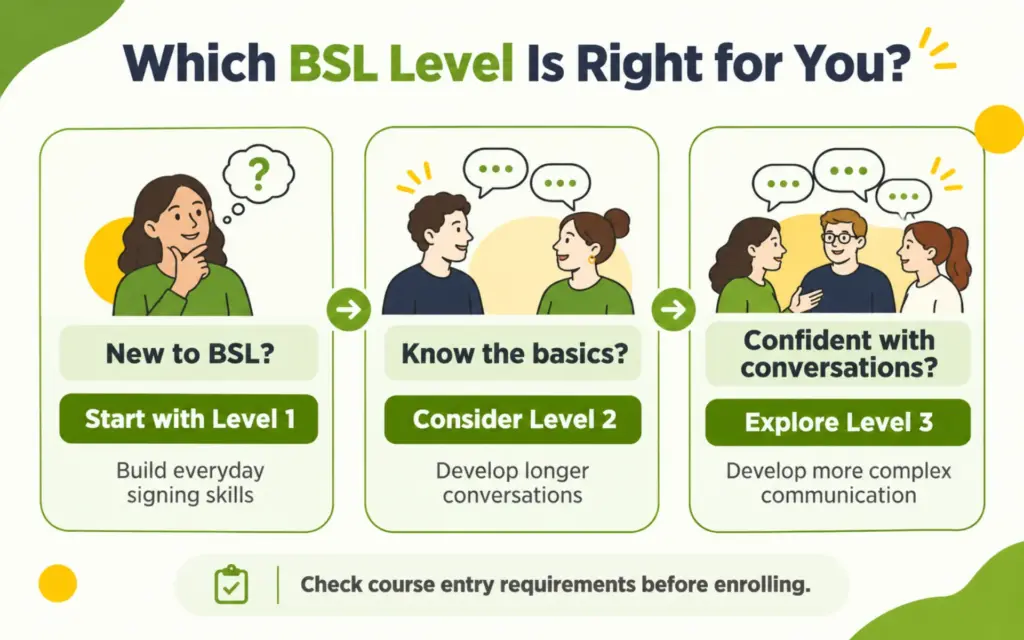
The best BSL course depends on your previous learning, confidence and reasons for studying.
Choose Level 1 If You’re a Complete Beginner
Level 1 is the appropriate starting point if you:
• Have no previous BSL experience.
• Want to communicate with Deaf friends or family members.
• Need basic signing skills for personal development.
• Want an introduction to BSL for a workplace setting.
It allows you to build knowledge progressively without assuming you already understand BSL grammar or vocabulary.
Consider Level 2 If You Already Know Basic BSL
Level 2 may be suitable if you can already introduce yourself, understand familiar signs and participate in simple conversations.
You might choose it because you want to communicate more naturally with Deaf people, develop your language skills for work or prepare for further BSL learning.
Before enrolling, check the entry requirements. Some introductory training programmes may be flexible, while formal qualifications can have specific requirements.
Consider Level 3 If You Have Stronger Signing Skills
Level 3 is worth exploring if you can follow longer signed conversations, communicate across familiar topics and express detailed information.
Ask yourself:
- Can I understand conversations without relying entirely on subtitles?
- Can I explain experiences and opinions through signing?
- Can I follow a discussion involving unfamiliar information?
These questions provide a useful personal check, but they are not a substitute for an official entry assessment.
How Long Does It Take to Learn BSL Levels 1, 2 and 3?
The time required depends on whether you are taking a formal qualification, attending live classes or completing an introductory online course.
For example, Signature publishes the following total qualification times:
Swipe horizontally to view all columns.
| Signature qualification | Guided learning | Total qualification time |
|---|---|---|
| BSL Level 1 | 64 hours | 90 hours |
| BSL Level 2 | 100 hours | 150 hours |
| BSL Level 3 | 150 hours | 250 hours |
Total qualification time includes guided teaching and additional independent study. It does not represent a fixed number of weeks.
Your progress will also depend on how often you practise signing and apply what you learn.
Course fees can vary depending on the provider, delivery method, assessment arrangements and qualification type. For a detailed breakdown, explore our guide to BSL course costs in the UK.
Can You Study BSL Level 1 and Level 2 Together Online?
Yes. Some online courses introduce foundational signing and then develop those skills through more advanced topics within one training programme.
This can be convenient for beginners who prefer structured, self-paced learning.
Janets offers British Sign Language (BSL) Level 1 & 2 Training, covering fingerspelling, everyday vocabulary, introductions, conversations and topics such as family, jobs and home life.

The course requires no previous BSL knowledge and includes approximately 9 hours and 23 minutes of learning content that can be studied at your own pace.
It may be a useful introduction for learners interested in developing BSL knowledge before exploring further training.
However, completing a combined online course does not automatically mean you have achieved two separate regulated BSL qualifications.
Always check the learning outcomes, assessment and certificate before enrolling.
Do BSL Level 1 and Level 2 Courses Give You Recognised Qualifications?
Not every BSL course leads to the same type of certificate.
A regulated BSL qualification involves an approved awarding organisation and specified assessment requirements. An online training course may instead provide a certificate of achievement for completing its learning programme.
For example, Janets’ BSL Level 1 & 2 Training offers a CPD-accredited Certificate of Achievement following successful completion of its final assessment. Certificate fees apply separately.
This should not be confused with a Signature Level 1 or Level 2 regulated qualification.
If you need a formal qualification for study or employment, check the exact award against the GOV.UK Register of Regulated Qualifications.
You can also explore our explanation of the different types of BSL certificates online before deciding which course meets your needs.
Frequently Asked Questions
Can You Take BSL Level 2 Without Level 1?
It depends on the course and awarding organisation. Signature specifies a Level 1 certificate for entry to its Level 2 qualification. Other training programmes may have different entry arrangements, so always check before enrolling.
Is BSL Level 2 Useful for Work?
Yes. Developing BSL skills can support communication in education, care, customer service and other public-facing roles. However, a Level 2 course alone does not qualify someone for professional interpreting or specialist communication roles.
What Is BSL Level 1 Equivalent To?
A regulated BSL Level 1 qualification sits at Level 1 of the relevant UK qualification framework. This indicates its level of difficulty, not that it is identical to every other qualification at that level.
See GOV.UK qualification levels and our guide to what BSL Level 1 is equivalent to for further information.
Get a FREE Course