- Home
- Career Guide
- 4 Best Way to Learn British Sign Language
4 Best Way to Learn British Sign Language
For many beginners, a structured online course or tutor-led class is a good starting point for learning British Sign Language (BSL). It gives you a clear learning path, and a tutor-led class can provide feedback.
Free videos, dictionaries and practice tools can help you try BSL or practise between lessons. The best route depends on your goal, budget and preferred way to study.
You do not have to choose just one route. You might begin with free resources, then join an online or local class when you want more guidance. If you need a formal qualification, check the course and awarding organisation carefully. An introductory course can build useful skills, but it does not automatically count as a regulated qualification.
Looking for a structured online option?
Janets’ British Sign Language (BSL) Level 1 & 2 Training is one course beginners can consider. The guide explains what it covers and what to check about its certificate later on.
What are the best ways to learn BSL?
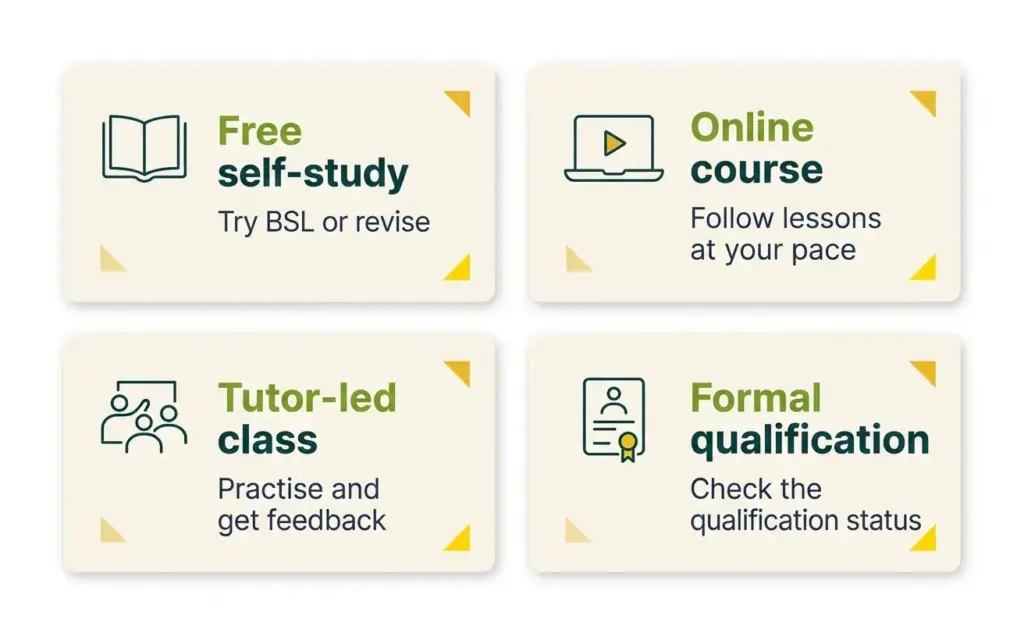
There are four common ways to begin: free self-study, structured online courses, tutor-led classes and formal qualification courses. The right option depends on how much guidance you want, how you prefer to study and what you need your learning to show.
| Learning route | Best suited to | Main benefit | Check before starting |
|---|---|---|---|
| Free self-study | Trying BSL or practising between lessons | Flexible and often free | Whether the resource teaches BSL and gives a clear sequence |
| Structured online course | Learners who want a planned course they can fit around other commitments | Set lessons and flexible study | Course content, feedback, certificate and qualification status |
| Tutor-led class | Learners who want interaction and correction | Guided practice and feedback | Tutor experience, schedule, location and total cost |
| Formal qualification course | Learners who need a specific qualification | A named qualification and assessment | Awarding organisation, qualification number and regulated status |
Free self-study resources
Free videos, BSL dictionaries, fingerspelling tools and printable resources can help you try basic signs and practise at your own pace. They are useful if you want to see whether BSL interests you or to revise material from a class.
The main limit is that a collection of signs is not always a complete learning path. A dictionary may show one sign, for example, but not teach you how to use it in a conversation or correct your hand position. Choose sources that show signs clearly and identify them as BSL.
Structured online courses
An online course can provide an order to follow, from basic signs to short exchanges and more complex topics. Video lessons let you pause and replay demonstrations, while self-paced study can suit people balancing learning with work or family life.
Online study works best when you practise actively. Watch a sign, try it yourself, then revisit the lesson to check your movement and facial expression. A course can give you structure, but check whether it offers feedback or only recorded material and assessments.
Tutor-led classes, in person or online
A tutor-led class gives you time to practise with other learners and ask questions. A teacher can watch you sign, point out habits that may affect meaning and help you try short conversations.
In-person classes can make group practice and turn-taking easier. Live online classes can offer more flexibility if there is no suitable course nearby. Check the class format, tutor’s experience, lesson schedule and full cost, including any assessment or certificate fees.
Formal BSL qualification courses
Some learners need a named qualification for further study, work or a personal goal. In that case, check the exact qualification and awarding organisation. Course titles can use “Level 1” or “Level 2”, but the wording alone does not tell you whether a qualification is regulated.
If you need a regulated qualification, use the official GOV.UK register of regulated qualifications to check the qualification. The register covers England and Northern Ireland; GOV.UK directs learners in Wales and Scotland to their separate qualification services.
Which BSL learning route suits your goal?
Your reason for learning can help you decide where to begin. Think about what you want to communicate, how much structure you need and whether you need a formal qualification.
Learning for personal interest or communication
If you are learning for personal interest or to communicate with someone you know, start with a beginner route that feels manageable. You could use a structured course or local class, then practise regularly with suitable videos and tools.
BSL can also help you connect with Deaf people and learn more about Deaf culture. Janets’ article on the benefits of learning British Sign Language in the UK covers that topic in more detail.
Learning as a family of a Deaf child
Families may be able to access local support, family sign-language sessions or a structured BSL course. These options can have different aims: family sessions may focus on signs and phrases used at home, while a course may follow a broader curriculum.
Ask your child’s Teacher of the Deaf, local service or deaf children’s society what is available in your area. The National Deaf Children’s Society’s guidance on learning BSL as a family explains ways families can look for local support. Provision and funding vary, so check what applies to your circumstances.
Learning for care, NHS, police or education work
BSL may help staff begin simple everyday interactions, such as greeting someone or asking a basic question. The level of communication a job requires depends on the role and employer, so check workplace training and accessibility procedures.
A beginner course does not make someone an interpreter. For complex or formal communication, such as a detailed appointment or safeguarding discussion, follow the relevant service’s procedures for arranging communication support. NRCPD explains that registered sign language interpreters must meet professional requirements, including approved interpreting qualifications.
Learning as a primary-age child
Children can start with short, age-appropriate activities, such as learning a few signs with a family member or teacher. Video demonstrations and simple games may help keep practice engaging, but children should have suitable adult support.
If a Deaf child is learning BSL, ask their family, school or local support team about learning options that suit the child. The needs of each child and family differ, so one course or method will not fit everyone.
Working towards a formal qualification
If you want a formal qualification, decide what you need it for before enrolling. Check the qualification’s full name, awarding organisation, assessment method and whether it is regulated. If you are considering BSL for a particular job, check the employer’s requirements as well.
What makes BSL learning effective?
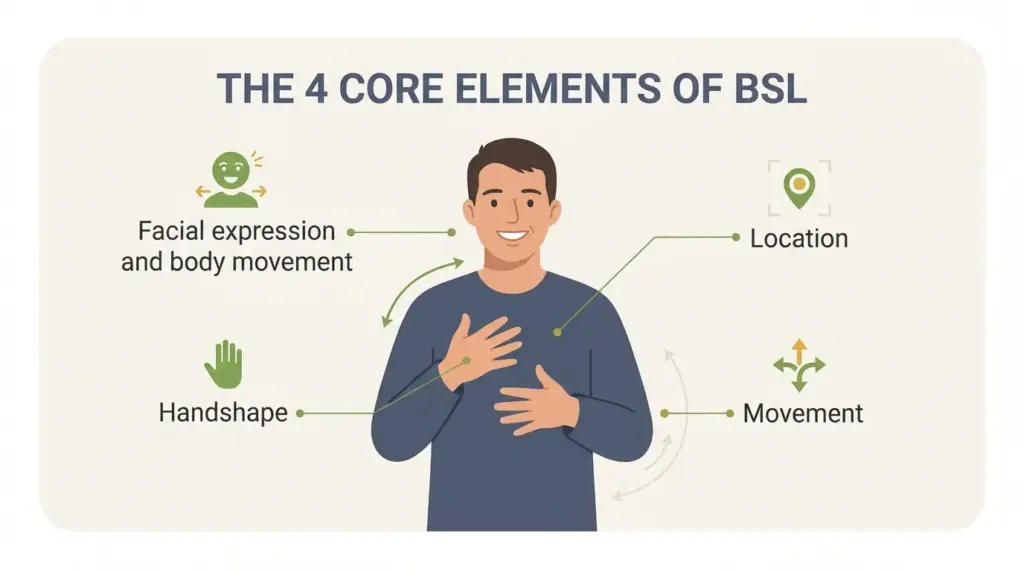
BSL is a visual language with its own grammar and word order. Meaning can involve handshape, movement, location, facial expression and body movement. It is not simply English translated word for word into signs.
Learn BSL as a visual language
When you watch a lesson, look at the whole sign: where it begins, how it moves and what the signer’s face and body are doing. Facial expressions and body movement can add meaning, so they are part of learning BSL rather than extra decoration.
Try not to rely only on written descriptions. A short video can show movement more clearly than a sentence can.

Learn signs in context
A long list of unrelated signs may be hard to remember. Instead, practise signs in simple situations: meeting someone, talking about family, asking for directions or describing an everyday routine.
Once you know a few signs, try putting them into a short exchange. This helps you practise how signs work together and gives you a reason to return to them later.
For a focused starting point, Janets’ article on everyday BSL phrases for beginners covers common phrases. Use it as a supplement to wider study rather than as a full BSL course.
Practise understanding and producing signs
Learning BSL involves both watching other people sign and practising how you sign. Try to watch short clips more than once: first for the general meaning, then again to notice hand movement and facial expression.
When practising, go slowly. It is more useful to make a sign clearly than to rush through many signs without checking them. If a lesson has a quiz or practice task, use it to see which signs you want to revisit.
Get feedback and practise respectfully with others
A teacher or experienced signer can notice habits you may not see yourself. A tutor-led class may offer regular feedback and a chance to practise conversations. NDCS recommends checking a tutor’s BSL training and experience when choosing a class.
BSL also has regional variations, much like spoken languages have accents and local expressions. Learning from people and resources connected to the region where you live can help you notice differences.
If you attend a Deaf community event or meet Deaf signers, approach people respectfully. Do not assume someone is there to teach you; follow the event’s guidance and ask before starting a conversation.
How can beginners build a regular practice routine?
A steady routine can help you remember signs and feel more comfortable using them. It does not need to be long. Choose a pattern that fits your week and adjust it when needed.
Use short, repeatable practice sessions
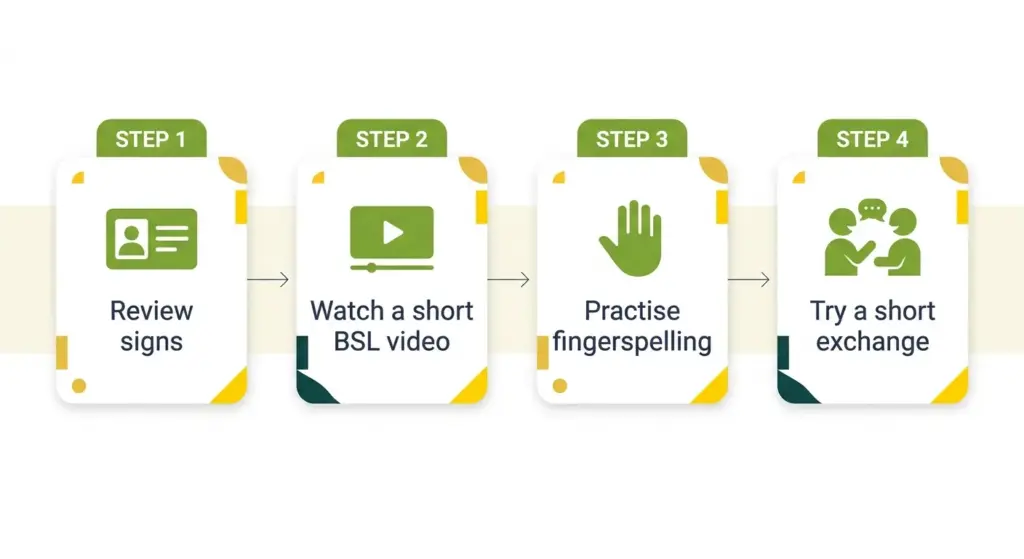
A simple session might include:
- Review a few signs from an earlier lesson.
- Watch a short BSL video and focus on the full movement.
- Practise fingerspelling a name or familiar word.
- Try a short exchange using signs you have already studied.
You could repeat this routine several times a week, or use it in shorter bursts when you have time. The aim is to return to BSL regularly, not to meet a strict timetable.
Revisit and apply what you have learned
At the end of the week, return to signs that felt difficult and try them in a new phrase or situation. Keep a short note of what you want to practise next. If you choose to record your signing for self-review, keep the recording private and delete it when you no longer need it.
The time it takes to develop BSL skills varies. It depends on your goals, how often you practise and how much opportunity you have to communicate with other signers. There is no single timetable that guarantees fluency. NDCS also notes that practice and everyday use affect how learners progress.
How should you use free BSL resources?
Free resources can help you begin, check a sign or revise between lessons. Use them with a clear goal: for example, practise fingerspelling, review a sign you have already learned or watch a short conversation.
Check that the resource teaches BSL
BSL and American Sign Language (ASL) are different languages. A resource labelled “sign language” may not teach BSL, so check its description before using it.
Makaton is different again: it is a communication programme that uses signs, symbols and speech. It has a different purpose from learning BSL as a language.
Use tools to support, not replace, structured practice
A dictionary can help you look up a sign, while videos can show how a sign moves. Apps and quizzes can help with revision, but they may not teach conversation, give personal feedback or provide a full course structure.
If you want a place to start with everyday phrases, Janets’ BSL phrases for beginners article offers a focused introduction.
How do you choose a BSL course or local class?
Before you enrol, consider what you want to learn and what kind of support will help you keep going. A course title alone may not answer those questions.
Find a class or course that fits your circumstances
To look for local classes, check nearby colleges, adult-learning services and Deaf organisations. You can also ask a local deaf children’s society or support service if you are looking for family learning. NDCS says local options may include family classes, resources and opportunities to practise, but availability varies by area.
Before booking, check:
- whether lessons are online, in person or a mix;
- when classes run and how long they last;
- what the full cost includes;
- whether assessment or certificate fees are separate;
- whether the course is designed for your goal and starting level.
Check the teaching, practice and support
Look for clear video demonstrations, regular practice and a way to ask questions. If feedback matters to you, check whether a teacher will see your signing and give individual guidance.
For an online course, review how lessons are organised and what support is available if you have a question. A course may be a good fit for self-paced study, while a live class may suit someone who wants regular interaction.
Check what the certificate means
Read the course page to see exactly what certificate is offered. A course-completion certificate or CPD-accredited certificate is not automatically the same as a regulated qualification. If you need a regulated qualification, check the qualification and the awarding organisation using GOV.UK’s qualification register and regulated awarding organisation search. The UK has different qualification services for England, Northern Ireland, Wales and Scotland.
Here is where our course comes in
Janets’ British Sign Language (BSL) Level 1 & 2 Training is an online option for beginners and other learners who want to study at their own pace. The course page says it covers everyday signs, vocabulary, greetings, conversations, fingerspelling, sentence structures and Deaf awareness. It states that no previous BSL knowledge is required. After passing the final assessment, learners can obtain a CPD-accredited Certificate of Achievement. The course page lists certificate charges separately, so check the current costs and terms before enrolling.
What should UK learners check about qualifications and support?
BSL learning routes and support can differ across the UK. Check the information that applies to where you live and what you want to achieve.
Check which rules and support apply where you live
The BSL Act 2022 recognises BSL as a language of England, Scotland and Wales. It does not extend to Northern Ireland, where equality law is devolved and both BSL and Irish Sign Language are used. The Act also sets out reporting duties for specified government departments; it should not be read as a blanket rule that every employer must provide BSL training. See the current GOV.UK report on BSL and the Act.
If you are a parent or carer, ask your local service what family support is available. Some councils offer help, but provision and funding vary. NDCS guidance can help you identify questions to ask.
Keep workplace communication and interpreting distinct
Basic BSL learning may help with simple interactions, but it does not make someone a professional interpreter. NRCPD sets professional requirements for interpreters, including approved training and high skill in the relevant languages. If a workplace situation requires an interpreter, follow the organisation’s procedures for arranging one.
Start with a route that fits your life
The best way to learn British Sign Language is one you can keep practising. Decide what you want to communicate, choose a route that suits your time and budget, and check what support and certificate it offers. If you want structured online study, Janets’ BSL course is one option to review. Start with a few clear lessons, practise regularly and build from there.
Frequently asked questions about learning BSL
Q Can I teach myself BSL?
You can begin with videos, dictionaries and free practice tools. They can help you learn signs and fingerspelling, but self-study may not give you feedback or practice with another signer. If you want to build conversation skills, consider adding a class, tutor or suitable group practice.
Q How long does it take to learn BSL?
It depends on what you mean by “learn”. You may pick up some everyday signs quickly, but using BSL in conversation takes ongoing practice. Your pace will depend on your learning route, how often you practise and how much opportunity you have to communicate with other signers.
Q Can I learn BSL online?
Yes. Online lessons can help you see demonstrations, review material and study around your schedule. Look for clear video, a planned sequence and chances to practise. If you want personal correction, check whether the course includes feedback or combine it with a tutor-led class.
Q Is there a free way to learn BSL?
Free videos, dictionaries and practice tools can help you start or revise. A free resource may not offer a complete course, feedback or a certificate. If you need a specific qualification, check its status and cost before you enrol.
Q Is BSL the same as ASL or Makaton?
No. BSL and ASL are separate sign languages with different vocabulary and grammar. Makaton is a communication programme that combines signs, symbols and speech. Choose the system that fits your communication goal, and check that any resource clearly names what it teaches.
Get a FREE Course