


Course Library View the full range of courses
-
Accounting (145 courses)
- Xero Accounting and Bookkeeping Online
- Sage 50 Accounting & Payroll
- Project Finance
- Financial Modelling Training
- Tax Accounting
- Introduction to VAT
- Accounting and Finance Course for Managers
- Internal Compliance Auditor
- Financial Statement Analysis
- Payroll Administrator Level 3 Diploma
- View all Accounting courses
-
Language (67 courses)
- British Sign Language (BSL) Level 1 & 2
- Speech and Language Therapy Diploma
- TEFL (TESOL) Course
- English Spelling, Punctuation, and Grammar
- Child & Adult Speech & Language Disorders Training
- Teaching English as Foreign Language (TEFL) Certificate
- Mastering Spanish Language
- French Course for Beginners
- German Course for Beginners
- Body Language and Gesture Training
- View all Language courses
-
Teaching & Education (37 courses)
- Teaching Assistant Complete Course (TA, SEN, Autism, ADHD & Dyslexia) – CPD Certified
- EYFS Teaching Assistant Training Course
- Advanced Diploma in Coaching and Mentoring
- Level 3 Diploma in Teaching and Classroom Management
- Remote Teaching
- SENCO – Special Educational Needs Coordination
- Teaching English as Foreign Language (TEFL)
- Life Coaching
- Phonics Teaching Diploma
- View all Teaching & Education courses
-
Health and Social Care (138 courses)
- Health and Social Care Management
- Paediatric Nursing Assistant
- Mental Health Awareness Training
- Emergency Medicine – Paramedicine
- Level 3 Diploma in Adult Care
- Paediatric First Aid Training
- Safeguarding Children Level 3
- Level 3 Diploma in Anatomy and Physiology of Human Body
- Play Therapy
- The Care Certificate Preparation – Standards (1 to 15)
- View all Health and Social Care courses
-
Management (539 courses)
- Office Admin, Secretarial and PA Diploma
- Estate Agent and Property Management Training
- Diploma in Data Analysis Fundamentals
- Advanced Diploma in Stress & Anxiety Management
- Good Manufacturing Practice (GMP)
- Property Development and Management Course
- Diploma in Hotel Management
- Supply Chain Management
- Quality Assurance (QA) Manager
- Compliance and Risk Management
- View all Management courses
-
IT & Software (123 courses)
- Coding with Python 3
- Search Engine Optimisation (SEO) Training
- Cyber Security
- Motion Graphics with After Effects
- CompTIA A+ Core 1 (220-1101) Course
- Machine Learning for Aspiring Data Scientists
- Next.js Web Dev: Master this Powerful React Framework
- Learn 2D Animation with Adobe Animate
- GDPR Challenges in Education
- View all IT & Software courses
-
Employability (1043 courses)
- Office Administrator Skills
- Presentation Skills
- Legal Secretary and Office Skills
- Hospitality Management
- Estate Agent Diploma
- Hairdressing and Barbering
- Diploma in UK Employment Law
- Diploma in Data Analysis Fundamentals
- Building Surveyor Training
- Emotional Intelligence Training
- View all Employability courses
-
Personal Development (1439 courses)
- Productivity Habits
- Minute Taking Course
- Presentation Skills
- Excel: Top 50 Microsoft Excel Formulas in 50 Minutes!
- Critical Thinking and Problem Solving Skills
- Time Management
- Self Esteem and Confidence Building Course
- Essential IT Skills
- Legal Secretary and Office Skills
- Personality Development
- View all Personal Development courses


Mastering Spanish Language
141 Students (9 Reviews)
Unlock the world of Spanish! Mastering Spanish Language equips you with all the tools you need to speak, listen, read, and write confidently, fostering fluency, cultural understanding, and a love for the language.

Course Curriculum
| Mastering Spanish Language | |||
| INTRODUCTION | 00:30:00 | ||
| Day-1 | |||
| Getting Started with Greetings and Basic Expressions in Spanish | 01:00:00 | ||
| Day-2 | |||
| Recognizing Letters and Sounds in the Spanish Alphabet | 01:00:00 | ||
| Day-3 | |||
| Forming Spanish Nominal Words and Phrases | 01:00:00 | ||
| Day-4 | |||
| Getting Familiar with Spanish Pronouns | 01:00:00 | ||
| Day-5 | |||
| Learn to Describe with Spanish Adjectives | 01:00:00 | ||
| Day-6 | |||
| Making Longer and Complete Phrases with Prepositions | 01:00:00 | ||
| Day-7 | |||
| Introduction to Spanish Verbs | 01:00:00 | ||
| Day-8 | |||
| Conjugating Verbs to Present Tense | 01:00:00 | ||
| Day-9 | |||
| Conjugating Verbs to Past Tense and Past Participle | 01:00:00 | ||
| Day-10 | |||
| Conjugating Verbs to Future Tense | 01:00:00 | ||
| Day-11 | |||
| Forming Basic Spanish Sentences | 01:00:00 | ||
| Day-12 | |||
| Familiarizing Situational Phrases | 01:00:00 | ||
| SUMMARY AND CONCLUSION | 00:15:00 | ||
| Recommended Reading | |||
| Recommended Reading : HR, Bookkeeping and Payroll Management | 00:00:00 | ||
| Mock Exam | |||
| Mock Exam-Mastering Spanish Language | 00:20:00 | ||
| Final Exam | |||
| Final Exam-Mastering Spanish Language | 00:20:00 | ||
| Order your Certificates & Transcripts | |||
| Order your Certificates & Transcripts | 00:00:00 | ||
| Order your Certificates & Transcripts | |||
| Order your Certificates & Transcripts | 00:00:00 | ||

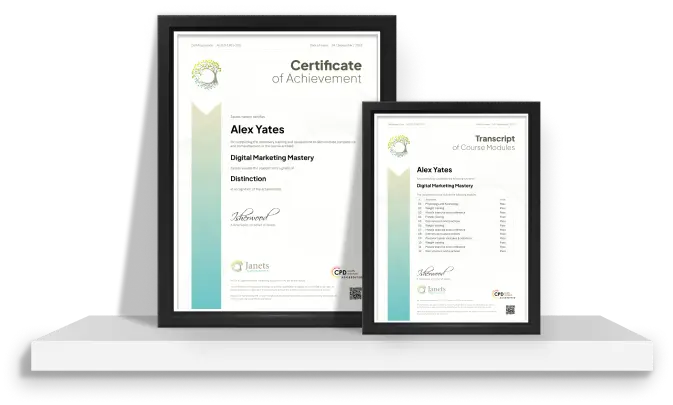
Original price was: £319.£25Current price is: £25. ex Vat
SAVE 92% - OFFER ENDS IN

 14-Day Money-Back Guarantee
- Personal
- Team
Quantity:
Total:
50% discount for orders of 10+ courses
60% discount for orders of 50+ courses
70% discount for orders of 100+ courses
For more personalised package, contact us


Frequently asked questions
Can’t find the anwser you’re looking for ? Reach out to customer support team.
To master Spanish, immerse yourself in the language as much as possible. This includes practicing speaking, listening, reading, and writing regularly. Enroll in a comprehensive language course, such as those offered by language schools or online platforms like Janet's. Practice with native speakers, use language learning apps, watch Spanish-language media, and read Spanish books and newspapers.
According to the Common European Framework of Reference for Languages (CEFR), it typically takes about 600-750 hours of study to reach C1 level in Spanish. This can vary depending on the intensity of study and individual learning pace.
Fully mastering Spanish, which involves reaching near-native fluency, can take several years. Consistent practice and immersion are key. Depending on your starting point and the amount of time you dedicate to practice, it could take anywhere from 3 to 5 years or more.
Reaching B2 level in Spanish generally requires about 450-500 hours of study. This level indicates an upper-intermediate proficiency where you can handle complex texts and communicate effectively in most situations.
B1 is considered an intermediate level. While it indicates a good understanding and ability to communicate in everyday situations, it is not considered fluent. B1 speakers can manage routine tasks and express themselves on familiar topics but may struggle with complex language and nuances.
B2 is considered upper-intermediate and is closer to fluency but not quite there. B2 speakers can understand the main ideas of complex texts, interact with a degree of fluency and spontaneity, and produce clear, detailed text on a wide range of subjects.
Mastering Spanish in 3 months is highly ambitious and unlikely for most learners, especially starting from a beginner level. However, with intense immersion and study, you can make significant progress and potentially reach a lower intermediate level (A2-B1).
Realistically, achieving fluency in Spanish typically takes 1 to 2 years of consistent study and practice, especially if you can immerse yourself in the language through travel, living in a Spanish-speaking country, or daily interaction with native speakers.
Yes, it is possible to become fluent in Spanish within 1 year with intensive study and immersion. This would require a significant daily commitment to learning and practicing the language, ideally involving living in a Spanish-speaking environment.
C1 is considered fluent. At this level, you can understand a wide range of demanding, longer texts, and express ideas fluently and spontaneously without much obvious searching for expressions. You can use the language flexibly and effectively for social, academic, and professional purposes.
C1 level is typically sufficient to start working as a translator, especially for general texts. However, specialized translation work may require a deeper understanding of specific terminology and context, which might necessitate higher proficiency or additional training.
Achieving C1 level in a year is possible but challenging. It would require intensive study, practice, and immersion. Full-time language learners who dedicate several hours daily to their studies and practice might reach this level within a year.
There is no single trick to learning Spanish, but some effective strategies include consistent daily practice, using language learning apps, engaging with native speakers, immersing yourself in Spanish media (TV shows, movies, music, and books), and maintaining a positive, persistent attitude.
Both Duolingo and Babbel have their strengths. Duolingo is great for beginners due to its gamified approach and free access, while Babbel offers more structured lessons with a focus on conversational skills and grammar. Your choice depends on your learning style and goals.
Duolingo can help build a strong foundation in Spanish and improve vocabulary and basic grammar. However, becoming fluent typically requires additional practice in speaking, listening, reading, and writing, which may not be fully covered by Duolingo alone.