


Course Library View the full range of courses
-
Accounting (145 courses)
- Xero Accounting and Bookkeeping Online
- Sage 50 Accounting & Payroll
- Project Finance
- Financial Modelling Training
- Tax Accounting
- Introduction to VAT
- Accounting and Finance Course for Managers
- Internal Compliance Auditor
- Financial Statement Analysis
- Payroll Administrator Level 3 Diploma
- View all Accounting courses
-
Language (67 courses)
- British Sign Language (BSL) Level 1 & 2
- Speech and Language Therapy Diploma
- TEFL (TESOL) Course
- English Spelling, Punctuation, and Grammar
- Child & Adult Speech & Language Disorders Training
- Teaching English as Foreign Language (TEFL) Certificate
- Mastering Spanish Language
- French Course for Beginners
- German Course for Beginners
- Body Language and Gesture Training
- View all Language courses
-
Teaching & Education (37 courses)
- Teaching Assistant Complete Course (TA, SEN, Autism, ADHD & Dyslexia) – CPD Certified
- EYFS Teaching Assistant Training Course
- Advanced Diploma in Coaching and Mentoring
- Level 3 Diploma in Teaching and Classroom Management
- Remote Teaching
- SENCO – Special Educational Needs Coordination
- Teaching English as Foreign Language (TEFL)
- Life Coaching
- Phonics Teaching Diploma
- View all Teaching & Education courses
-
Health and Social Care (138 courses)
- Health and Social Care Management
- Paediatric Nursing Assistant
- Mental Health Awareness Training
- Emergency Medicine – Paramedicine
- Level 3 Diploma in Adult Care
- Paediatric First Aid Training
- Safeguarding Children Level 3
- Level 3 Diploma in Anatomy and Physiology of Human Body
- Play Therapy
- The Care Certificate Preparation – Standards (1 to 15)
- View all Health and Social Care courses
-
Management (539 courses)
- Office Admin, Secretarial and PA Diploma
- Estate Agent and Property Management Training
- Diploma in Data Analysis Fundamentals
- Advanced Diploma in Stress & Anxiety Management
- Good Manufacturing Practice (GMP)
- Property Development and Management Course
- Diploma in Hotel Management
- Supply Chain Management
- Quality Assurance (QA) Manager
- Compliance and Risk Management
- View all Management courses
-
IT & Software (124 courses)
- Coding with Python 3
- Search Engine Optimisation (SEO) Training
- Cyber Security
- Motion Graphics with After Effects
- CompTIA A+ Core 1 (220-1101) Course
- Machine Learning for Aspiring Data Scientists
- Next.js Web Dev: Master this Powerful React Framework
- Learn 2D Animation with Adobe Animate
- GDPR Challenges in Education
- View all IT & Software courses
-
Employability (1043 courses)
- Office Administrator Skills
- Presentation Skills
- Legal Secretary and Office Skills
- Hospitality Management
- Estate Agent Diploma
- Hairdressing and Barbering
- Diploma in UK Employment Law
- Diploma in Data Analysis Fundamentals
- Building Surveyor Training
- Emotional Intelligence Training
- View all Employability courses
-
Personal Development (1439 courses)
- Productivity Habits
- Minute Taking Course
- Presentation Skills
- Excel: Top 50 Microsoft Excel Formulas in 50 Minutes!
- Critical Thinking and Problem Solving Skills
- Time Management
- Self Esteem and Confidence Building Course
- Essential IT Skills
- Legal Secretary and Office Skills
- Personality Development
- View all Personal Development courses


Diploma in Python Programming
2907 Students (150 Reviews)
Python is a highly multi-purposeful still easy-to-understand programming language, which is why it is more adaptable all over the world. Whether to make a web application in data science, software engineering, mobile app development, or artificial intelligence.
Course Curriculum
| Unit 01: Introduction to Python Programming | |||
| Module 01: Course Introduction | 00:02:00 | ||
| Unit 02: Getting Started with Python | |||
| Module 01: Software Installation | 00:02:00 | ||
| Module 02: Hello World Program | 00:06:00 | ||
| Module 03: Input and Output | 00:07:00 | ||
| Module 04: Calculating Average of 5 Numbers | 00:03:00 | ||
| Unit 03: Conditional Branching with Python | |||
| Module 01: If Loop In Python | 00:06:00 | ||
| Module 02: Program Using If Else part 1 | 00:03:00 | ||
| Module 03: Program Using If Else part 2 | 00:08:00 | ||
| Module 04: Program for Calculator | 00:02:00 | ||
| Module 05: Program Using For Loop | 00:08:00 | ||
| Module 06: For Table | 00:05:00 | ||
| Module 07: For loop and Mathematical Operator in Python | 00:04:00 | ||
| Module 08: Factorial of Number Using Python | 00:06:00 | ||
| Module 09: Program Using While | 00:05:00 | ||
| Module 10: While Loop Example | 00:07:00 | ||
| Module 11: Tasks for Practice | 00:02:00 | ||
| Unit 04: Importing external/internal library in python | |||
| Module 01: Importing Library in Python | 00:07:00 | ||
| Unit 05: Project Rock Paper and Scissors | |||
| Module 01: Rock Paper and Scissor Game | 00:06:00 | ||
| Unit 06: Strings Operation in Python | |||
| Module 01: Program Using String part 1 | 00:05:00 | ||
| Module 02: Program using String 2 | 00:06:00 | ||
| Module 03: Program Using String 3 | 00:06:00 | ||
| Module 04: Program Using String part 4 | 00:03:00 | ||
| Unit 07: Date and time in Python | |||
| Module 01: Use of Date and Time part 1 | 00:05:00 | ||
| Module 02: Use of Date and Time part 2 | 00:05:00 | ||
| Unit 08: File Handling, read and write using Python | |||
| Module 01: File Handling Part 1 | 00:08:00 | ||
| Module 02: File Handling Part 2 | 00:07:00 | ||
| Unit 09: Data Storage Structures, Tuple, List and Dictionary | |||
| Module 01: Tuple in Python Part 1 | 00:10:00 | ||
| Module 02: Tuple in Python Part 2 | 00:07:00 | ||
| Module 03: Using Lists part 1 | 00:07:00 | ||
| Module 04: Using List part 2 | 00:12:00 | ||
| Module 05: Using Lists part 3 mm | 00:06:00 | ||
| Module 06: Using Lists part 4 | 00:08:00 | ||
| Module 07: Using Lists part 5 | 00:02:00 | ||
| Module 08: Use of Dictionary Part 1 | 00:04:00 | ||
| Module 09: Use of Dictionary Part 2 | 00:05:00 | ||
| Module 10: Use of Dictionary Part 3 | 00:08:00 | ||
| Module 11: Use of Dictionary Part 4 | 00:07:00 | ||
| Unit 10: Writing user functions in Python | |||
| Module 01: Function in Python Part 1 | 00:06:00 | ||
| Module 02: Function in Python Part 2 | 00:05:00 | ||
| Module 03: Function in Python Part 3 | 00:04:00 | ||
| Module 04: Function in Python Part 4 | 00:07:00 | ||
| Module 05: Function in Python Part 5 | 00:08:00 | ||
| Unit 11: Sending mail | |||
| Module 01: Send Email | 00:09:00 | ||
| Unit 12: Import Tricks in Python | |||
| Module 01: Import Study part 1 | 00:07:00 | ||
| Module 02: Import Study part 2 | 00:03:00 | ||
| Unit 13: Import Operating System and Platform | |||
| Module 01: Importing OS | 00:06:00 | ||
| Module 02: Import Platform | 00:05:00 | ||
| Unit 14: Exceptions handling in python | |||
| Module 01: Exception in Python part 1 | 00:11:00 | ||
| Module 02: Exception in Python part 2 | 00:07:00 | ||
| Module 03: Exception in Python part 3 | 00:05:00 | ||
| Unit 15: Installing Packages and Scheduling In Python | |||
| Module 01: Installing Packages using built in package manager | 00:08:00 | ||
| Module 02: Scheduler in Python | 00:05:00 | ||
| Unit 16: Data Base In Python using sqlite | |||
| Module 01: Data Base 1 | 00:08:00 | ||
| Module 02: Data Base 2 | 00:09:00 | ||
| Module 03: Data Base 3 | 00:08:00 | ||
| Module 04: Data base 4 | 00:07:00 | ||
| Module 05: Data Base 5 | 00:06:00 | ||
| Unit 17: Running Program from Command Prompt and jupyter Notebook | |||
| Module 01: IDE_1 | 00:05:00 | ||
| Module 02: IDE_2 | 00:07:00 | ||
| Unit 18: Conclusion | |||
| Module 01: Conclusion | 00:02:00 | ||
| Resources | |||
| Resources – Diploma in Python Programming | 00:00:00 | ||
| Recommended Materials | |||
| Workbook – Diploma in Python Programming | 00:00:00 | ||
| Order your Certificates & Transcripts | |||
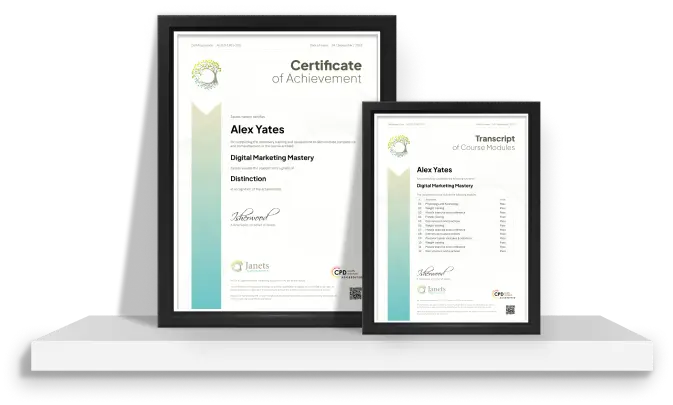
| Order your Certificates & Transcripts | 00:00:00 | ||

Original price was: £319.£25Current price is: £25. ex Vat
SAVE 92% - OFFER ENDS IN

 14-Day Money-Back Guarantee
- Personal
- Team
Quantity:
Total:
50% discount for orders of 10+ courses
60% discount for orders of 50+ courses
70% discount for orders of 100+ courses
For more personalised package, contact us


Frequently asked questions
Can’t find the anwser you’re looking for ? Reach out to customer support team.
The Diploma in Python Programming is an online course that introduces learners to Python and its core programming concepts. It helps learners understand how to write, organise, test, and manage basic Python programs.
Yes. The course is suitable for beginners and does not require previous programming experience. It introduces Python fundamentals in a structured way, allowing learners to develop their coding knowledge gradually.
You will learn Python fundamentals, including variables, data types, operators, conditions, loops, functions, lists, dictionaries, file handling, error handling, debugging, and basic object-oriented programming.
No. Previous programming experience is not required. Basic computer skills and a reasonable understanding of English are recommended to help you follow the course materials.
Python is a versatile programming language used in areas such as software development, web development, automation, data analysis, and artificial intelligence. Learning Python can provide a useful foundation for exploring different areas of technology.
Yes. The course is delivered online, allowing you to study at a convenient time and location. You can access the learning materials using an internet-enabled computer, tablet, or smartphone.
Yes. The course introduces the main concepts needed to create Python programs. You will explore how to use variables, conditions, loops, functions, and other programming structures to develop organised code.
Yes. Functions and loops are important parts of the course. You will learn how functions can organise reusable code and how loops can be used to repeat programming instructions efficiently.
Yes. The course introduces basic object-oriented programming concepts, helping learners understand how Python can be used to organise programs using objects, classes, and related programming structures.
The course can provide a strong foundation in Python programming. Learners can continue developing their skills through additional study, programming projects, portfolio development, and relevant technical qualifications.