


- Home
- Personal development
- Which CompTIA Certification Should You Get First?
Which CompTIA Certification Should You Get First?

Starting a career in IT can feel confusing when you discover how many certifications are available. CompTIA A+, Network+ and Security+ are frequently recommended, but choosing between them is not always straightforward.
You might be completely new to technology, considering a career change or already working with computers and hoping to move into cybersecurity.
So, which CompTIA certification should I get first?
For most beginners interested in IT support, CompTIA A+ is a sensible starting point. However, Tech+, Network+ or Security+ may be more suitable depending on your existing knowledge and career interests.
This guide explains how to choose your first CompTIA certification without spending unnecessary time studying topics you already understand.
Move into cybersecurity with Security+
Already have some IT grounding? Explore security concepts, threats and risk management at your own pace with Janets' CompTIA Security+ Certification course.
Which CompTIA Certification Should You Get First?
CompTIA A+ is generally a good first certification for beginners preparing for IT support roles. If you have very little technical knowledge, CompTIA Tech+ may be a better introduction. Learners who already understand IT fundamentals can consider Network+, while those with networking knowledge and an interest in cybersecurity may choose Security+.
Here is a quick guide to help you decide.
| Your Current Situation | Recommended Certification | Main Focus |
|---|---|---|
| Little or no technical knowledge | CompTIA Tech+ | Basic IT concepts and digital technology |
| New to professional IT | CompTIA A+ | Hardware, software and troubleshooting |
| Understand IT basics and enjoy networking | CompTIA Network+ | Networks, connectivity and infrastructure |
| Have IT foundations and want cybersecurity knowledge | CompTIA Security+ | Security threats, risk and protection |
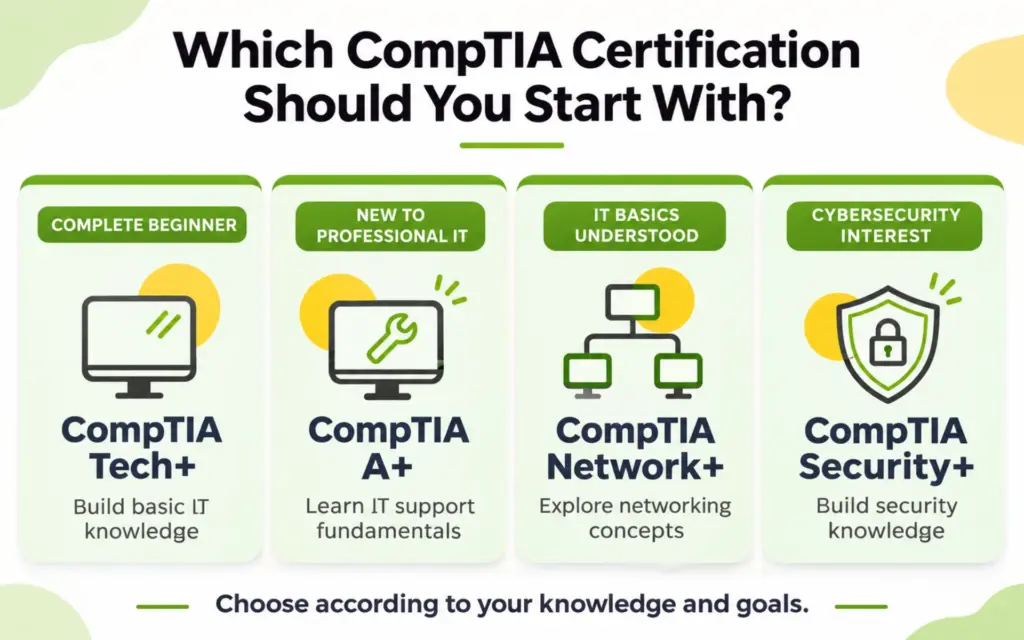
These are recommendations rather than compulsory steps. You do not have to earn every previous CompTIA certification before attempting a more specialised subject.
How to Choose Your First CompTIA Certification Based on Your Experience
Your previous experience is usually the most useful starting point when deciding which certification to pursue.
Someone who has never troubleshot a computer may need different preparation from someone who already manages networks at work.
If You Have No IT Experience: Consider Tech+ or A+
If technical terms such as operating systems, processors and IP addresses are unfamiliar, CompTIA Tech+ can provide a useful introduction.
Tech+, which replaced the earlier IT Fundamentals (ITF+) certification, introduces basic computer concepts, applications, networking, security and other fundamental IT topics.
It may suit people who want to build confidence before studying professional technical support.
However, you do not necessarily need Tech+ first.
If you can already use computers confidently, install software and understand common technical problems, CompTIA A+ may be the more practical choice.
A+ covers a broader range of professional IT support skills, including:
↪ Computer hardware and mobile devices.
↪ Operating systems and software.
↪ Basic networking and security.
↪ Troubleshooting common technical problems.
Beginner recommendation: Choose Tech+ if you need introductory IT knowledge. Choose A+ if you are ready to develop practical technical support skills.
If You Want to Start in IT Support: Consider CompTIA A+
CompTIA A+ is particularly relevant if you are interested in becoming an IT support technician, help desk technician or service desk analyst.
These roles involve helping people resolve computer problems, setting up equipment and maintaining everyday technology.
A+ introduces the technical knowledge behind these activities. For example, you might learn why a computer cannot connect to Wi-Fi, how operating systems work or how to identify common hardware faults.
This makes it a useful foundation for people who want to understand computers beyond everyday use.
You can also develop your skills through practical exercises, such as installing an operating system in a virtual machine or troubleshooting a spare computer.
A+ certification alone does not guarantee employment, but the knowledge it covers is relevant to many entry-level IT support responsibilities.
If You Already Understand IT Basics: Consider Network+
If you are comfortable with computers and understand basic troubleshooting, you may prefer to focus on networking.
CompTIA Network+ covers how devices communicate, how networks are configured and how common connectivity problems are investigated.
You will encounter subjects such as IP addressing, routers, network infrastructure, security and network troubleshooting.
Network+ may be suitable if you:
↪ Understand common hardware and software concepts.
↪ Have some experience solving computer problems.
↪ Want to learn how business networks operate.
↪ Are interested in networking or infrastructure-related work.
You do not need an A+ certificate to attempt Network+. However, understanding A+ topics can make networking concepts easier to follow.
If You Want to Work in Cybersecurity: Consider Security+
If your main interest is cybersecurity, CompTIA Security+ may be the certification that attracts your attention.
Security+ focuses on understanding and managing security risks in IT environments.
Its subject areas include security threats, vulnerabilities, access control, security operations and incident response.

However, cybersecurity relies heavily on understanding the systems and networks being protected.
For example, recognising suspicious network activity is easier when you understand normal network communication.
If you already have relevant IT knowledge, Security+ could be a suitable first CompTIA certification.
If you are starting without technical experience, building your IT and networking foundations first may make Security+ preparation more manageable.
The important question is not whether cybersecurity interests you. It is whether you currently understand enough IT to study its security concepts effectively.
Do You Need CompTIA A+ or Network+ Before Security+?
No. CompTIA A+ and Network+ are not mandatory prerequisites for taking the Security+ certification examination.
You can attempt Security+ without holding either certificate.
However, there is a difference between meeting formal entry requirements and being prepared for an examination.
CompTIA recommends prior networking knowledge and relevant IT experience for Security+ candidates. These recommendations reflect the technical understanding needed to work through security-related problems.
For example, Security+ may expect you to understand network protocols, operating systems and authentication before considering how they can be secured.
If you already possess this knowledge through work or independent study, taking earlier certification examinations may not be necessary.
If these concepts are unfamiliar, studying A+ or Network+ material first could be worthwhile, even if you do not sit those exams.
How Can You Tell Which CompTIA Certification You Are Ready For?
Before paying for an examination or choosing a training course, assess what you already know.
You do not need to answer every technical question perfectly. The aim is to identify whether you understand the foundations of your preferred certification.
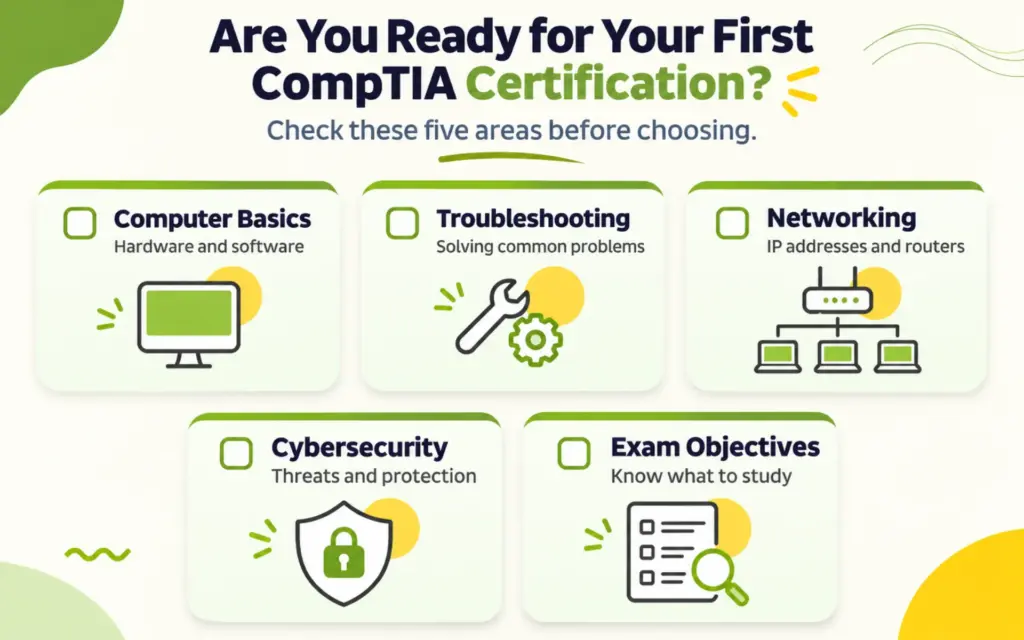
Consider these five questions:
↪ Computer knowledge: Can you explain the basic functions of hardware, software and operating systems?
↪ Troubleshooting: Could you investigate a computer that will not connect to the internet?
↪ Networking: Do you understand what IP addresses, routers and network protocols do?
↪ Cybersecurity: Can you explain common threats such as phishing, malware and unauthorised access?
↪ Exam readiness: Have you reviewed the official CompTIA exam objectives and identified which topics you need to learn?
If you struggle with the first two questions, Tech+ or A+ may be a useful starting point.
If you understand general IT but find networking difficult, Network+ could help you develop that knowledge.
If you are comfortable with networking and want to understand security controls, Security+ may be an appropriate next step.
↪ Practical tip: Try a few introductory lessons or practice questions before committing to an exam. This can reveal knowledge gaps that are not obvious from reading a certification description.
How Should Your UK IT Career Goals Influence Your First Choice?
Your intended career direction can also help determine which CompTIA certification to get first.
For example, if you want to work in IT support, A+ covers many of the technical foundations relevant to everyday support work.
If you are more interested in network infrastructure, Network+ may be a better match once you understand basic IT concepts.
For cybersecurity interests, Security+ introduces knowledge relevant to protecting systems and responding to threats.
The UK’s National Careers Service explains that IT support technicians deal with hardware, software and network problems. With further training and experience, professionals may progress towards networking or security-related responsibilities.
However, employers can have different expectations. Practical experience, communication skills, technical ability and other qualifications may also matter.
Therefore, review genuine UK job descriptions alongside certification objectives to understand what employers expect for the roles that interest you.
What Should You Do After Choosing Your First CompTIA Certification?
Once you have identified a suitable certification, the next step is to prepare in a structured way.
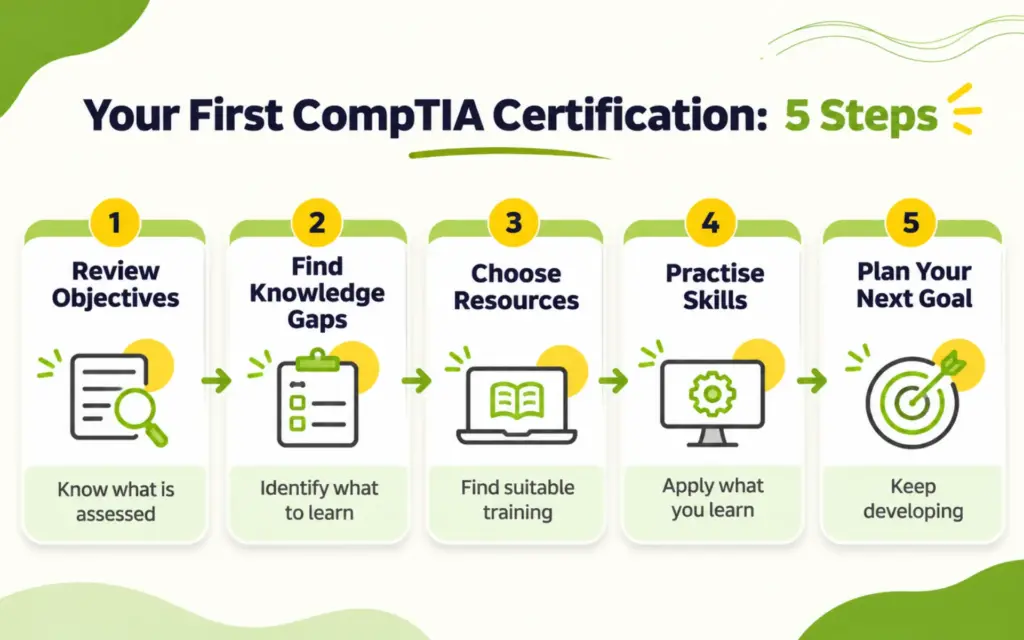
1. Review the Official Exam Objectives
Check CompTIA’s current exam objectives to understand the knowledge and skills being assessed.
Pay attention to the examination version, because objectives and exam codes can change over time.
2. Identify Your Knowledge Gaps
Compare the objectives with what you already understand.
If networking is your weakest area, for example, spend time improving those foundations before moving into more complex security topics.
3. Choose Suitable Learning Resources
Depending on your circumstances, you might use online courses, textbooks, instructional videos, virtual labs or guided practical exercises.
Choose resources that match your experience and preferred learning style. A structured course may help you study systematically, while practical exercises can strengthen your understanding of technical concepts.
When comparing training providers, also check the course content, assessment arrangements and type of certificate offered. Remember that a training course completion certificate is not necessarily the same as an official CompTIA certification.
4. Practise Before Booking Your Exam
Review practice questions, work through realistic technical scenarios and revisit topics you find difficult.
Do not rely entirely on memorising definitions. Understanding how concepts work in practical situations is particularly valuable.
5. Plan Your Next Learning Goal
Your first certification does not need to determine your entire career.
You may begin with A+, discover an interest in networking and later explore cybersecurity.
Build your cybersecurity knowledge
Study security topics at your own pace with Janets' CompTIA Security+ Certification course. CPD-accredited certificate
Frequently Asked Questions
In What Order Should I Get My CompTIA Certifications?
A common learning sequence is Tech+ (if needed), A+, Network+ and Security+. However, this order is not compulsory. Your existing knowledge and career interests should determine where you begin.
Should I Take CompTIA A+ Core 1 or Core 2 First?
You can take the two A+ examinations in either order. Core 1 concentrates on areas including hardware and networking, while Core 2 covers operating systems, software troubleshooting and related subjects. Both must be passed to earn the certification.
Can I Skip CompTIA A+ and Start With Network+?
Yes. A+ is not a formal prerequisite for Network+. If you already understand fundamental IT concepts and troubleshooting, you can choose to study Network+ directly.
Do I Need CompTIA Tech+ Before A+?
No. Tech+ is an optional introduction for people who need basic IT knowledge. If you are comfortable using computers and ready to learn technical support concepts, you can start with A+.
Get a FREE Course


