Network+ or Security+ First? The Right Order for Your Goals

Choosing between CompTIA Network+ and Security+ can be confusing, particularly when both appear in IT and cybersecurity job descriptions. Should you build networking knowledge first, or go straight towards a security-focused certification?
For most IT beginners, Network+ is a sensible starting point because it develops the networking fundamentals used in cybersecurity. However, if you already understand networking and have relevant practical experience, taking Security+ first may be more appropriate.
You do not need to pass Network+ before sitting Security+. The right choice depends on your current knowledge, career goals, and whether you need both certificates.
This guide compares the two certifications, explains when each makes sense, and helps you choose a practical route for your career in the UK.
Should You Take Network+ or Security+ First?
There is no single certification order that works for everyone. Network+ and Security+ develop different but complementary skills.
Consider your starting position:
- Completely new to networking? Start with Network+ knowledge to understand how computer networks operate.
- Already working in IT support? Consider Security+ if you understand networking fundamentals and want to develop cybersecurity skills.
- Interested in network administration? Network+ is more closely aligned with your immediate learning needs.
- Planning a cybersecurity career? Security+ may be more relevant, but you will still need sufficient networking knowledge.
- Studying Network+ material does not mean you must pay to sit the Network+ examination.
- If your goal is Security+ and your networking knowledge is already strong, an additional certification may not be necessary.
- If you are also considering CompTIA A+, understanding how A+, Network+ and Security+ compare can help you decide where to begin.
One important distinction is that studying Network+ material does not mean you must pay to sit the Network+ examination. If your goal is Security+ and your networking knowledge is already strong, an additional certification may not be necessary.
If you are also considering CompTIA A+, understanding how A+, Network+ and Security+ compare can help you decide where to begin.
Network+ vs Security+: What Is the Difference?
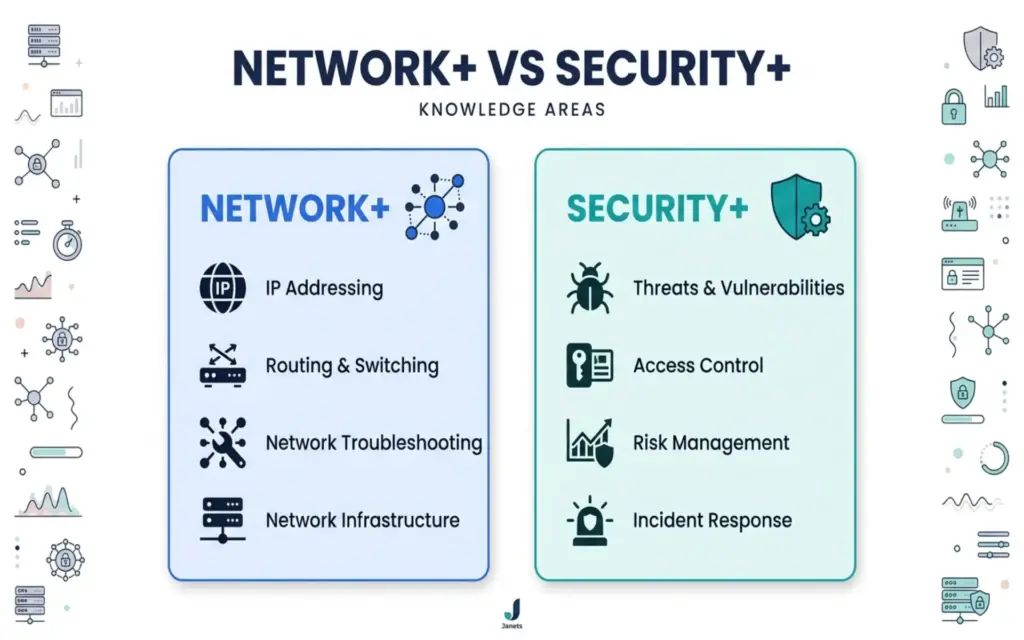
CompTIA Network+ focuses on building, maintaining and troubleshooting networks. CompTIA Security+ focuses on protecting systems, identifying threats and applying cybersecurity controls.
Both are professional IT certifications, but their examinations assess different areas of knowledge.
Swipe left to see the full table →
| Feature | CompTIA Network+ | CompTIA Security+ |
|---|---|---|
| Main focus | Computer networking | Cybersecurity |
| Core subjects | IP addressing, routing, switching, protocols and troubleshooting | Threats, vulnerabilities, security controls and incident response |
| Practical emphasis | Understanding and managing network infrastructure | Protecting systems, networks and information |
| Suitable for | Learners developing networking and infrastructure skills | Learners developing cybersecurity skills |
| Career relevance | IT support, network support and infrastructure | Security operations and security administration |
| Networking knowledge | Central examination focus | Important supporting knowledge |
What Does Network+ Cover?
Network+ develops knowledge of how devices communicate and how networks are configured, maintained, and repaired.
Its subject areas include:
- TCP/IP, IP addressing and subnetting.
- Network devices, switches and routers.
- Wireless networking and network services.
- Network troubleshooting and performance.
- Network security fundamentals.
These skills are valuable because many technical problems involve connectivity, configuration or network performance.
You can check the current syllabus through the official CompTIA Network+ exam objectives.
What Does Security+ Cover?
Security+ concentrates on recognising security risks and understanding how organisations protect their systems and information.
Important subjects include threats and vulnerabilities, security architecture, identity and access management, security operations and incident response.
Unlike Network+, the examination approaches networking primarily from a security perspective.
For example, Network+ may assess how network connectivity works, while Security+ may assess how security controls protect that connectivity.
The official CompTIA Security+ exam objectives provide the current examination scope.
Do You Need Network+ Before Security+?
No. Network+ certification is not a compulsory prerequisite for Security+.
CompTIA provides recommended experience to help candidates assess their readiness, but you do not have to earn Network+ before attempting Security+.
However, being eligible to sit an examination and being prepared to pass it are different things.
Security+ assumes that learners can understand technical scenarios involving devices, networks, protocols, and security controls. Without that background, some concepts may be difficult to apply.
Why Networking Knowledge Matters in Cybersecurity
Imagine a security analyst notices repeated suspicious connections between an internal computer and an unfamiliar external server.
To investigate, the analyst may need to understand:
- What the source and destination IP addresses represent.
- Which ports and protocols are involved.
- How network traffic moves between devices.
- Whether a firewall is permitting unexpected connections.
- How DNS records could help identify the destination.
These are networking concepts being applied to a security problem.
You do not necessarily need a Network+ certificate to understand them. However, you do need the underlying knowledge.
That is why studying networking before Security+ can be worthwhile even when you decide to sit only one certification examination.
When Should You Take Network+ First or Security+ First?
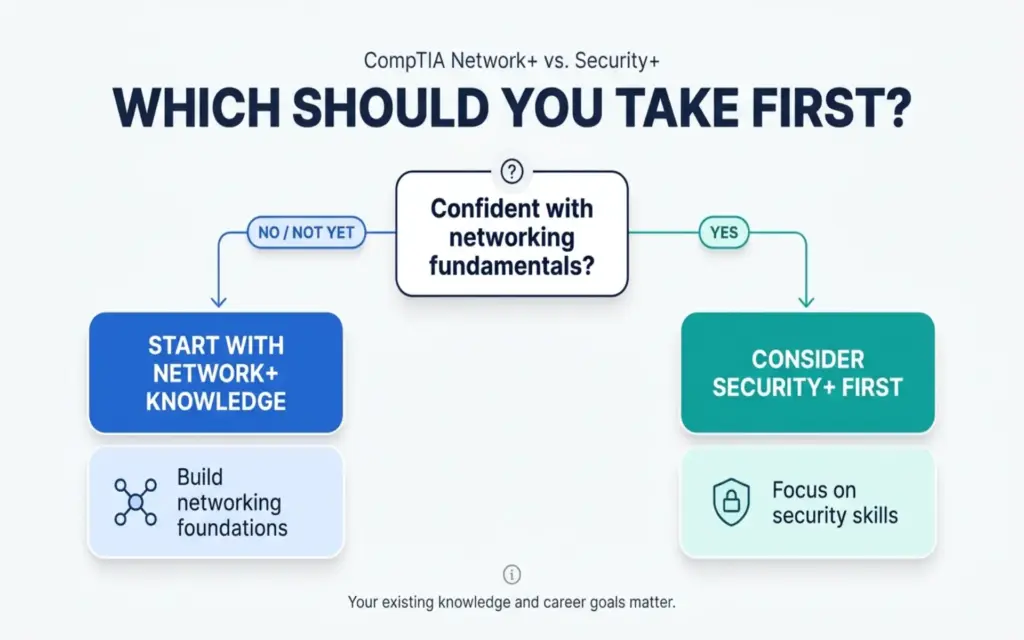
Your existing skills should carry more weight than any fixed certification order.
Take Network+ First If You Are New to Networking
Network+ is generally the better starting point when you have limited experience with computer networks.
For example, you may know how to use a computer but be unfamiliar with IP addresses, routers, DNS or network troubleshooting.
Starting with Security+ could mean learning networking fundamentals at the same time as unfamiliar security concepts.
Network+ provides a more structured way to develop that foundation.
It is particularly relevant if you want to:
- Work towards IT support or network support responsibilities.
- Understand how wired and wireless networks operate.
- Learn practical infrastructure troubleshooting.
- Develop networking knowledge before specialising in cybersecurity.
You can develop these skills through self-study, practical exercises or structured training.
Janets offers a CompTIA Network+ course covering networking concepts, IP addressing, routing, network security and troubleshooting. It may be a useful learning option if you prefer guided study.
Consider Security+ First If You Already Know Networking
Security+ may be a reasonable first certification if you already have relevant IT experience.
For example, an IT support technician who regularly troubleshoots network problems may understand the material covered by Network+ without holding the certificate.
Security+ could then provide a more relevant next step towards developing cybersecurity knowledge.
Consider starting with Security+ if:
- You understand IP addressing, DNS and common network protocols.
- You have experience troubleshooting networked devices.
- You understand how firewalls and network access controls operate.
- Cybersecurity is your immediate professional development goal.
However, experience alone does not guarantee examination readiness. Review the official objectives and test your understanding before booking.
What If You Are Completely New to IT?
If you have never worked with computer hardware, operating systems or basic troubleshooting, both certifications may feel demanding.
You may benefit from learning broader IT fundamentals before making your decision.
CompTIA A+ is another option, although it addresses a different range of technical skills.
For a more detailed introduction to choosing your first CompTIA certification, explore the beginner-focused comparison rather than assuming Network+ or Security+ must be your starting point.
Are You Ready for Security+ Without Network+?
Before deciding to skip Network+, check whether you can apply the networking knowledge that Security+ draws upon.
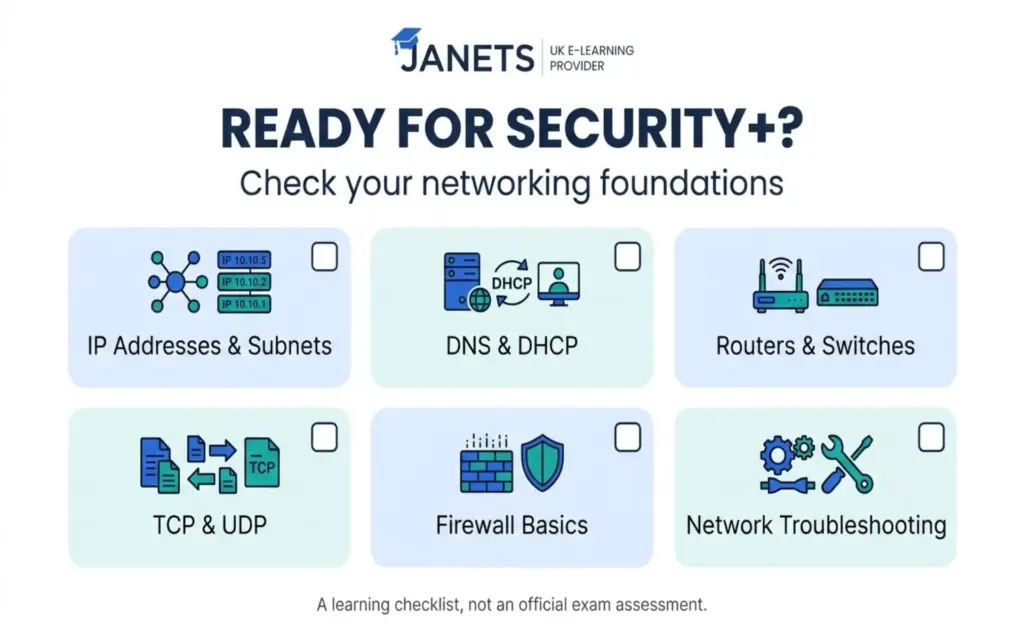
A Quick Networking Knowledge Check
Ask yourself these six questions:
- Can you explain what an IP address and subnet mask do?
- Do you understand the difference between DNS and DHCP?
- Can you describe how routers and switches work?
- Do you recognise common networking protocols, including TCP and UDP?
- Can you explain how a firewall controls network traffic?
- Could you investigate a basic connectivity problem using common troubleshooting tools?
You do not need to answer every question perfectly.
However, if most of these concepts are unfamiliar, strengthening your networking knowledge before Security+ would be sensible.
If you can already explain and apply them confidently, you may be ready to focus directly on security-related topics.
This is an informal self-assessment, not an official CompTIA readiness test. Practical exercises and examination practice questions are still important.
Is Network+ Harder Than Security+?
Neither examination is automatically harder for everyone. The difficulty depends largely on your background.
Network+ can be challenging because it requires an understanding of network configurations, protocols, infrastructure, and troubleshooting.
Learners unfamiliar with subnetting, routing, or network devices may find some questions demanding.
Security+ can be challenging because it covers a wider range of security situations, including risk assessment, authentication, vulnerabilities, and incident response.
Many questions require you to interpret a scenario and identify an appropriate security response.
For someone with networking experience but limited cybersecurity knowledge, Security+ may require more preparation.
For someone who has studied security concepts but has little practical networking experience, Network+ may feel more technical.
Both certifications use multiple-choice and performance-based questions, so understanding concepts is more useful than memorising definitions alone.
Rather than asking which examination is universally easier, consider which subject contains more unfamiliar material for you.
Which Certification Is Better for Your Career in the UK?
The value of Network+ or Security+ depends on the responsibilities you want to develop towards.
Neither certificate guarantees employment, and UK employers may assess practical experience, qualifications and wider technical skills alongside certifications.
Network+ for IT Support and Networking Roles
Network+ is closely related to technical work involving network configuration, connectivity and troubleshooting.
Its knowledge may support progression towards responsibilities associated with:
- IT support technician.
- Network support technician.
- Network administrator.
- Network engineer.
These roles are not interchangeable, and some require substantial experience.
For example, the UK’s National Careers Service network engineer profile describes responsibilities involving network design, installation and maintenance. It also identifies several entry routes, including apprenticeships, further education and employment-based development.
Network+ can contribute useful knowledge, but it does not replace all the practical skills associated with these roles.
Security+ for Cybersecurity and Security Operations
Security+ is more directly aligned with work involving cybersecurity controls, threats and incident management.
It may be relevant to people exploring security administration, cybersecurity analysis or security operations.
However, entry-level opportunities should be considered realistically.
The UK Government’s Cyber security skills in the UK labour market 2026 report found that only 16% of core cybersecurity job advertisements specifying experience sought candidates with less than one year’s experience in 2025. Among adverts specifying experience, 64% requested between two and six years.

This does not mean beginners cannot enter cybersecurity. It shows why relevant experience and demonstrable skills can matter alongside certification.
If you are already developing technical experience, Security+ may help you build more specialised knowledge.
If you are starting without experience, IT support or network support can provide opportunities to develop practical foundations.
For a broader view of a pathway from IT support into cybersecurity, the related career progression guide explores how different learning stages fit together.
Network+ vs Security+: Costs and Exam Changes in 2026
Certification decisions also involve time and financial considerations.
Add Your Heading Text Here
Not necessarily.
There are three separate costs worth considering:
- Learning materials: Courses, books, practice resources or other preparation materials.
- Certification examination: The official examination voucher.
- Additional attempts: Potential costs if you need to retake an examination.
These expenses should not be confused.
If you want to develop networking knowledge before taking Security+, you can study relevant Network+ material without purchasing the Network+ examination.
On the other hand, earning both certifications may be useful if networking and cybersecurity knowledge are both relevant to your career plans.
If your budget is limited, prioritise the examination that best supports your immediate goal and make sure your preparation is sufficient.
Check CompTIA’s current UK examination pricing before booking, as fees and available purchasing options can change.
Which Exam Versions Should You Study?
As of 4 November 2026, the established examination versions are Network+ N10-009 and Security+ SY0-701.
A new Security+ examination, SY0-801, is expected around 17 November 2026, with the outgoing English SY0-701 examination expected to retire in June 2027.
Because examination dates can change, confirm the latest information with CompTIA before purchasing preparation materials or booking an examination.
The important point is to choose learning resources that match the objectives of the examination you intend to sit.
How to Prepare for the Certification You Choose
Once you have decided which certification suits your goals, start with the official examination objectives.
Identify unfamiliar topics, create a realistic study schedule and practise applying the concepts rather than relying entirely on memorisation.
For Network+, this may involve configuring simple networks or troubleshooting connectivity in a practice environment.
For Security+, it may involve reviewing security scenarios, analysing access controls and understanding responses to common threats.
If you have already developed the necessary networking foundations, Janets’ CompTIA Security+ training covers topics including network security, risk management, security threats and incident response.
Janets’ relevant courses offer self-paced online learning and a CPD-accredited certificate of achievement following successful completion of the final assessment. This course certificate is separate from the official CompTIA certification, which requires passing the relevant CompTIA examination.
Before enrolling, check that the course content matches your learning needs and the examination version you intend to take.
Frequently Asked Questions About Network+ and Security+
Q Can You Take Security+ Without Network+?
Yes. Network+ certification is not a compulsory prerequisite for Security+. However, you should understand networking fundamentals before attempting security-focused examination questions.
Q Do You Need Network+ If You Already Have Security+?
Not automatically. If you already have strong networking knowledge, another certification may not be necessary. Network+ could still be useful if your responsibilities involve network support or infrastructure.
Q Is Network+ Useful Before Becoming a SOC Analyst?
Yes. Networking knowledge can help SOC analysts understand network traffic, suspicious connections and security alerts. However, Network+ alone does not qualify someone for a SOC analyst position.
Q Can You Study Network+ Without Taking the Exam?
Yes. You can learn networking concepts through courses, books, practical exercises or independent study without taking the official examination. This may be appropriate if your immediate goal is to prepare for Security+ rather than earn both certificates.
Get a FREE Course