- Home
- Career Development
- Hotel Management in the UK: Study and Career Prospects
Hotel Management in the UK: Study and Career Prospects

Hotel Management in the UK can be a worthwhile study and career choice, particularly for people interested in customer service, business operations and team leadership. British hotels range from independent accommodation businesses to large properties with separate reception, housekeeping, catering and events departments. That variety creates different ways to enter the profession, although management posts usually require experience and sound judgement.
There is no single best qualification or guaranteed route into a hotel career. University degrees, apprenticeships, workplace progression and online professional development offer different benefits. The right choice depends on your background, budget, preferred responsibilities and willingness to work irregular hours. This guide examines what managers do, how UK training routes compare, what published salaries indicate and which challenges deserve consideration. It also explains how to assess whether a hotel management role genuinely suits your interests.
Is the UK a Good Place to Study and Work in Hotel Management?
Opportunities Within the UK Hospitality Industry
The UK offers a varied hospitality environment, including city hotels, coastal accommodation, countryside properties, business hotels and venues hosting conferences or celebrations. Their customers have different expectations, so operational experience can develop in more than one setting. A small establishment may need a manager who handles several functions, while a larger hotel might employ separate heads of housekeeping, finance and food services.
Tourism figures help illustrate the sector’s wider context. The Office for National Statistics Travel Trends: 2025 estimates 40.8 million visits to the UK by overseas residents during 2025, with spending of approximately £29.8 billion. These figures concern completed visits, not distinct visitors or hotel stays. The ONS also describes the estimates as official statistics in development, so comparisons and conclusions need care.
This activity can support accommodation and guest-service businesses, but visitor spending does not establish how many hotel jobs are available. Prospective applicants should examine vacancies in the towns or regions where they intend to work. A busy tourist destination may have seasonal patterns, whereas a business-focused property might experience different peaks.
Factors That Could Make Hotel Management Less Suitable
Hotel management is not simply welcoming guests in an attractive lobby. Employers may expect previous supervisory experience, budget awareness and the ability to resolve complaints. Competition for management-trainee places can also vary. If you need predictable working hours or dislike resolving problems under pressure, investigate actual shift patterns before committing to a qualification or career change.
What Does a Hotel Manager Actually Do?
The National Careers Service hotel manager profile describes a role spanning guest services, housekeeping, restaurants and events. Duties differ by property size and management structure, but the central responsibility is coordinating people and resources so guests receive an appropriate service.
Guest Services and Daily Hotel Operations
Front-office teams handle reservations, arrivals, departures and enquiries. Managers may establish service procedures, review complaints, support employees and communicate changing priorities to other departments. They also need to consider accessibility, privacy, customer expectations and the consequences of delays.
Imagine a guest arrives early to find their allocated room unavailable. Reception must explain the situation accurately, housekeeping needs an achievable room-readiness estimate, and a supervisor must decide what alternatives can be offered. A strong response combines practical coordination with respectful communication rather than making promises staff cannot deliver.
Financial and Commercial Responsibilities
A manager must know whether decisions make commercial sense. Typical considerations include occupancy levels, room prices, departmental expenditure and the relationship between income and costs. Revenue specialists may forecast demand and examine distribution channels, while finance staff prepare budgets and assess cash requirements. Managers use that information to plan staffing or identify an operational problem without treating revenue growth as the only measure of success.
Events, Catering and Operational Compliance
Hotels serving food or hosting functions have additional coordination needs. Restaurant teams manage service periods and food-related responsibilities; events teams liaise with organisers, suppliers and hotel departments. Operational managers must understand which tasks require trained colleagues, established procedures or specialist advice. They are accountable for supporting standards, not necessarily performing every technical task themselves.
How Can You Study Hotel Management in the UK?
There is no universal requirement to hold a hotel management degree. According to the National Careers Service, people can enter through university, apprenticeships or progression from relevant work. Each route offers a different balance of academic learning, employer experience and commitment.

University Degrees and Higher Education Qualifications
Relevant subjects include hotel management, hospitality management, hospitality business management and international hotel management. Degree programmes may examine business strategy, operations, finance, marketing and organisational behaviour. Some providers offer placements, which can help students experience service environments and build professional contacts.
A foundation degree or Higher National Diploma can also provide a higher-education route. The National Careers Service gives typical entry expectations of one or two A levels, or equivalent, for these qualifications, and two or three for a degree. However, individual courses set their own requirements, and alternative qualifications may be accepted.
The UCAS hospitality, leisure and tourism subject guide explains relevant study choices and reminds applicants to check each provider’s criteria. Compare actual modules, placement availability, costs and assessment methods before deciding. A degree can provide structured business education, but it does not automatically lead to a management post. Applicants from unrelated degree subjects may also enter the profession.
Hotel Management Apprenticeships
Apprenticeships combine employment with training and assessment. They may appeal to people who want structured learning while gaining practical experience and earning a wage. The National Careers Service identifies the Hospitality Supervisor Level 3 and Hospitality Manager Level 4 routes as relevant options in England, subject to eligibility and employer recruitment.
The Skills England Hospitality Manager standard covers managerial responsibilities across hospitality settings. It states that employers establish entry requirements and typically expect applicants to have held supervisory responsibilities. The standard is marked as undergoing revision: a revised assessment plan is available for information, while the current end-point assessment arrangements remain in place pending the applicable approval process. Check the latest status before applying.
Apprenticeship systems differ across England, Wales, Scotland and Northern Ireland. Applicants should use the relevant nation’s official apprenticeship service rather than assuming an English standard operates identically throughout the UK.
Entering Hotel Management Through Work Experience
Working towards a management role is another possibility. Experience in reception, housekeeping or catering helps people understand how a hotel operates. Someone might take on shift coordination, train new colleagues or assist a departmental supervisor before applying for greater responsibility. Progression depends on performance, employer structure, additional training and vacancies; time served alone does not secure promotion.
Online Hotel Management Training and Professional Development
Online study may suit people exploring the field, refreshing their knowledge or supplementing existing experience. Topics such as operational organisation, budgeting, revenue planning and guest services offer useful context for workplace decisions. For example, Diploma in Hotel Management is one subject covered within the wider Janets hotel management bundle, rather than a separate link recommendation here.
Check whether a programme is introductory or advanced, how it assesses learning and whether its recognition matches your goal. Short online training should not be confused with a university award, a regulated qualification or employer-supervised practice.
A Note for International Students
Studying online from another country is different from moving to attend an eligible UK institution. The GOV.UK Student visa guide sets out requirements including a place with a licensed student sponsor, financial eligibility and English-language criteria. Buying an online training bundle does not, by itself, provide UK study sponsorship, a visa or permission to work.
Explore Hotel Management and Operations Training
If you want to examine several hotel departments before choosing a specialism, the Hotel Management & Operations Career Bundle brings related knowledge areas together. Its subjects include administration, revenue, housekeeping, food operations and event coordination. Consider it as an optional way to explore professional concepts alongside researching qualifications, workplace opportunities and employer expectations.
What Skills Matter Most in UK Hotel Management?
Managers need both interpersonal judgement and the ability to interpret operational information. Strong communication alone is insufficient when staffing, costs and service standards are competing for attention. Equally, a commercially sound decision may fail if employees and guests are not informed appropriately.
Customer Service and Team Leadership
Hotel leaders must listen carefully, explain decisions and respond constructively when something goes wrong. They may allocate duties, coach colleagues and agree priorities between departments. A guest complaint involving noise, for instance, requires tact and a practical remedy, plus clear communication with the teams responsible. Effective supervision also means knowing when to escalate a problem rather than improvising beyond one’s authority.
Financial and Analytical Skills
Occupancy rate indicates how much available accommodation is sold during a period. Revenue measures help managers interpret pricing and sales performance, but should be considered alongside operating costs and guest experience. Budget awareness includes recognising overspending, checking forecasts and understanding why planned income differs from actual results. A beginner need not master every financial system immediately, but should be willing to work with figures.
Housekeeping, Food Safety and Operational Standards
Room readiness depends on cleaning routines, inventory, safe equipment use and communication with reception. Housekeeping Management Training is another topic represented within the complete Janets bundle and may interest readers examining accommodation operations. It is not a substitute for workplace instruction.
Where a hotel handles food, staff responsibilities also include appropriate hygiene training. GOV.UK food business guidance says employers must ensure workers have suitable, current skills and training, although food handlers do not universally need a food hygiene certificate. Managers must follow the legal requirements relevant to their operations and location.
Hotel Management Career Prospects in the UK
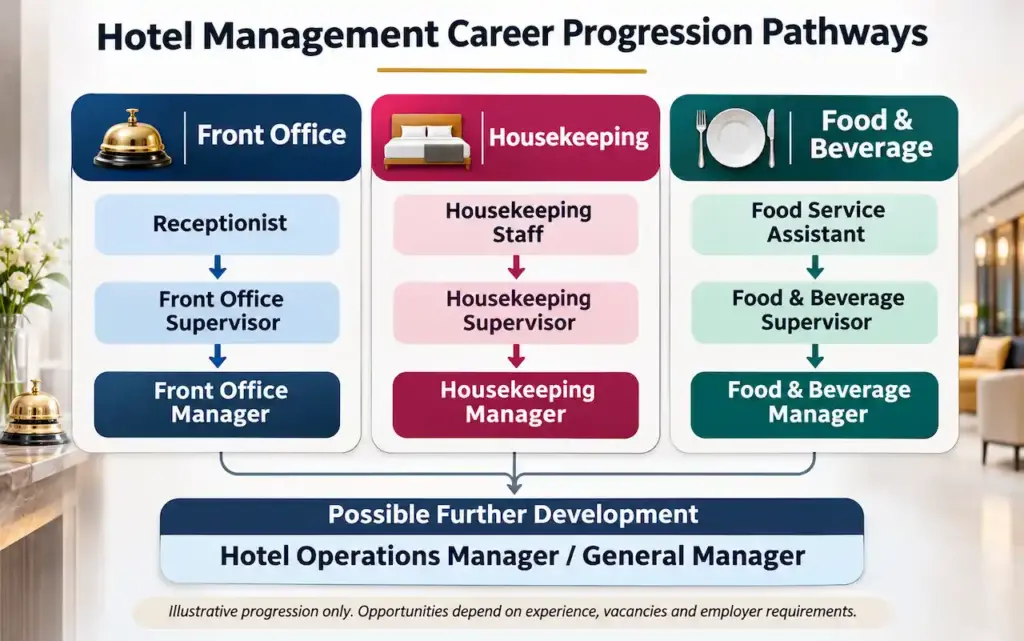
Hotel careers do not follow one fixed ladder. The National Careers Service hospitality and tourism guide shows that the sector includes varied occupations and entry routes. A suitable first role depends on your experience, preferences and the jobs available locally.
Entry-Level and Operational Opportunities
Hotel receptionists support reservations, check-ins and customer enquiries. Guest services assistants focus on helping visitors with requests and problems. Housekeeping employees prepare rooms, check supplies and report maintenance issues. Food service assistants contribute to restaurant, breakfast or event operations. These positions expose staff to service procedures and may help them identify preferred departments, but they are occupations in their own right rather than compulsory steps towards management.
Supervisory and Departmental Management
With relevant experience, some employees pursue front-office supervision, housekeeping management or food and beverage leadership. Others develop specialist interests in reservations, revenue or events. Supervisors normally coordinate teams and standards within defined responsibilities; departmental managers also consider budgets, staffing and longer-term improvement. The precise titles and authority differ among employers.
Senior Hotel Management Opportunities
Operations managers and general managers may oversee several departments, working with department heads to balance performance, safety, resources and guest satisfaction. The scope of these posts can be substantially wider than that of a single-team supervisor. Leadership experience, commercial understanding and the ability to resolve complex problems become increasingly important.
Large hotel groups may offer opportunities across properties, while smaller establishments can provide broad exposure to daily operations. Neither environment guarantees rapid progression. Review real vacancy requirements, including systems knowledge, leadership experience and willingness to work across sites, before choosing a career direction.
Hotel Management Salaries in the UK
Published salary guides help with early research, but they do not predict an individual offer. The National Careers Service provides these indicative annual ranges for relevant occupations:
Start With the Basics and Build Your Confidence
| Role | Indicative Annual Salary |
|---|---|
| Hotel housekeeper | £21,000–£28,000 |
| [Second job role] | [Salary range] |
| [Third job role] | [Salary range] |
| [Fourth job role] | [Salary range] |
Restaurant and events management roles are not necessarily based within hotels. The figures are career-guide estimates spanning starting and experienced positions, not guaranteed graduate salaries. Actual pay depends on employer size, location, responsibilities, skills and experience. Some packages include additional benefits, but these vary and should be confirmed directly.
When comparing vacancies, look beyond the headline salary. Consider contracted hours, overtime arrangements, shift patterns, travel, training opportunities and the management responsibilities attached to the position. A higher advertised salary may reflect more demanding duties. Completing a training bundle does not guarantee employment, promotion or a particular income.
What Are the Challenges of Working in UK Hotels?
Working Hours and Hospitality Pressures
Hotels serve guests outside conventional office hours. The National Careers Service lists typical hotel manager hours of 40 to 45 per week and notes that evening, weekend and bank holiday work may be required. Actual schedules vary across employers. When a booking problem or guest complaint occurs, managers may need to act quickly while maintaining a calm and professional manner.
Operational and Commercial Challenges
A hotel must deliver consistent service while managing limited resources. Staff absence can affect room preparation or restaurant operations. Unexpected costs may disrupt budgets, and a sudden booking change can alter workloads. Managers often make decisions with incomplete information, then communicate them clearly and review the results. Good processes matter, but they cannot prevent every problem.
Is the Work Environment Right for Everyone?
Some people enjoy the variety, teamwork and visible results of guest-service work. Others find unpredictable shifts or continuous customer contact tiring. Consider your preferences honestly, particularly if you have caring responsibilities or need fixed hours. Speaking with people currently working in hotels, or trying a suitable entry role, can reveal more than a job title alone.
How to Decide Whether Hotel Management Is Right for You
Evaluate Your Interests and Existing Experience
Start by identifying the work you actually want to do. Do you enjoy solving guest problems, organising colleagues, interpreting business figures or overseeing standards? Hotel management combines these responsibilities, but different positions emphasise different strengths. Someone returning to hospitality may need updated operational knowledge. A career changer might first investigate guest-facing employment and the relevance of transferable skills.
Compare Education Routes Against Your Circumstances
Use a practical sequence rather than choosing a programme solely because its title sounds impressive:
- Identify a preferred direction. Compare reception, accommodation services, food operations, revenue and wider management.
- Read current job adverts. Note required experience, qualifications, software knowledge and shift expectations.
- Compare learning routes. Check degrees, HNDs, apprenticeships, workplace training and suitable online study.
- Assess the commitment. Consider eligibility, costs, travel, placements and available study time.
- Identify your gaps. Separate knowledge you can study from practical experience you must gain.
- Choose a realistic next step. That could mean applying for an entry role, speaking with an employer or exploring an eligible qualification.
Common Mistakes to Avoid
Do not assume a university degree automatically secures a hotel management job. Equally, do not dismiss formal study if your preferred employer values it. Check course content and recognition before paying, especially when regulated qualifications or apprenticeship eligibility matter. Avoid treating published salary ranges as personal forecasts or overlooking unsocial working hours.
So, is the UK a good choice? It can be, for someone who values hospitality work and selects an appropriate route. The strongest decision combines realistic career research, relevant learning and an understanding of how hotels operate.
Get a FREE Course