- Home
- Personal development
- Can a Beginner Pass Security+? What to Learn First
Can a Beginner Pass Security+? What to Learn First

Yes, a complete beginner can pass CompTIA Security+, even without previous IT employment or another CompTIA certification. However, the exam is not designed around absolute beginner knowledge. You will need to understand how computers, networks and security systems work before tackling more advanced questions.
If you are considering CompTIA Security+ for beginners, the best starting point is not memorising exam answers. It is building enough technical knowledge to understand why security measures work.
This guide explains what you should learn first, how to approach studying and how to judge whether you are ready for the exam.
CompTIA Security+ Certification Course
Flexible, self-paced learning to prepare for your exam. Exam voucher purchased separately.
View CourseCan a Complete Beginner Pass CompTIA Security+?
CompTIA Security+ is a professional certification covering essential cybersecurity knowledge and practical security skills. It assesses your understanding of threats, vulnerabilities, security controls, risk management and security operations.
You do not need to complete another CompTIA certification before taking the exam. However, being eligible to sit Security+ and being prepared to pass it are two different things.
Do You Need Previous IT Experience?
There is no mandatory professional experience requirement for the Security+ exam. CompTIA traditionally recommends Network+ knowledge and approximately two years of IT administration experience with a security focus.
These are recommendations rather than compulsory entry conditions. UK training organisations such as the British Standards Institution (BSI) also emphasise the value of networking knowledge before studying Security+.
A beginner can therefore work towards the certification through self-study, structured training and practical exercises.
Who Should Consider Security+ as Their First Certification?
Security+ may be a suitable starting certification if you:
- Understand basic computer and networking concepts.
- Have some experience using or supporting IT systems.
- Are interested in cybersecurity and prepared to develop technical skills.
- Prefer a security-focused certification rather than a general IT support qualification.
If you have never studied networking or operating systems, starting with those subjects will make Security+ preparation much more manageable.
Is CompTIA Security+ Hard for Beginners?

Security+ can be challenging for beginners because it tests how security principles apply to real situations, not simply whether you remember definitions.
For example, recognising the term multi-factor authentication is straightforward. Choosing an appropriate authentication method for a particular security scenario requires deeper understanding.
What Makes Security+ Challenging?
Three areas commonly require additional attention:
Technical vocabulary: Terms such as network segmentation, encryption, authentication protocols and vulnerability management may initially seem unfamiliar.
Scenario-based questions: You may need to identify a security problem, evaluate possible responses and select the most appropriate action.
Performance-based questions (PBQs): These assess how you apply knowledge to practical tasks or simulated technical situations.
You do not need to be an experienced cybersecurity professional to learn these subjects. However, understanding the foundations before practising complex questions is important.
Is Security+ Easier With Basic IT Knowledge?
Usually, yes. Knowing how devices communicate, how operating systems manage permissions and how networks are protected gives you a useful starting point.
Without that knowledge, you may spend additional time learning basic IT concepts alongside the security syllabus.
The objective is not to memorise more information. It is to understand how different security concepts connect.
What Should You Learn Before CompTIA Security+?
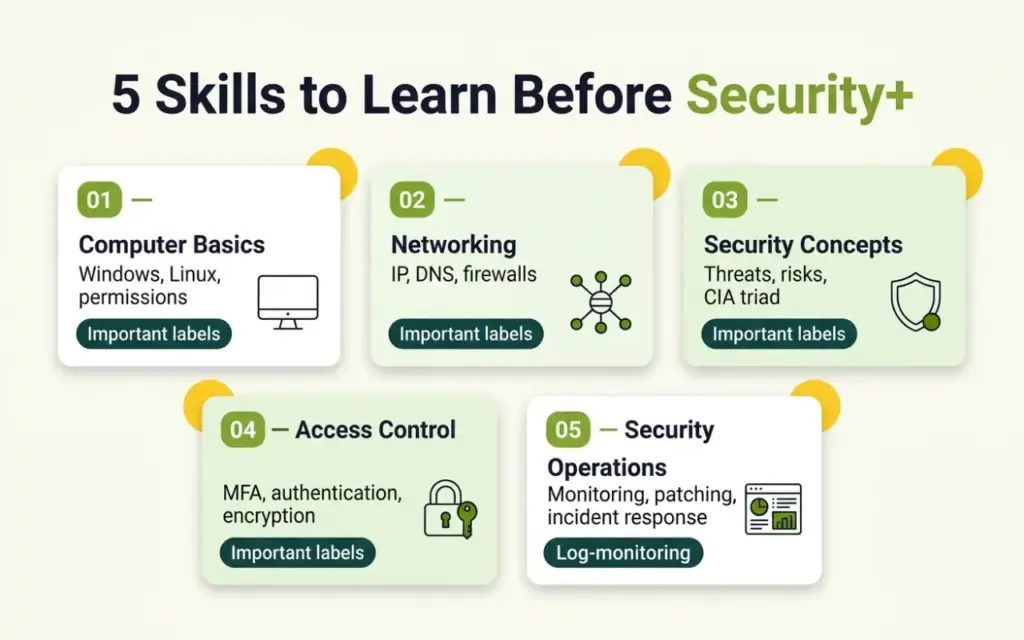
Before focusing on exam questions, build a foundation in five areas: computer systems, networking, cybersecurity principles, access control and basic security operations.
These subjects will help you understand the terminology and scenarios encountered throughout Security+.
1. Basic Computer and Operating System Skills
Start by understanding how computers and operating systems function.
You should be comfortable with:
- Hardware, software and operating-system functions.
- Basic Windows and Linux concepts.
- User accounts and file permissions.
- Software installation and security updates.
- Common system settings and administrative tools.
For example, understand why a standard user account should not automatically have permission to install software or change important security settings.
This introduces the principle of least privilege, which becomes important when studying access control.
2. Networking Fundamentals
Networking is one of the most valuable foundations for Security+ because many cybersecurity threats involve communication between devices and systems.
Focus on these concepts:
| Networking Concept | What Beginners Should Understand |
|---|---|
| IP address | How devices are identified on a network |
| DNS | How domain names are translated into IP addresses |
| DHCP | How devices can receive network configuration automatically |
| TCP/IP | How data is communicated across networks |
| Routers and switches | How network traffic is directed |
| Firewalls | How network traffic can be permitted or blocked |
| Ports and protocols | How different network services communicate |
Consider what happens when you open a website.
Your computer uses DNS to find the website’s address, establishes a connection and exchanges information using network protocols. Security controls help protect those communications.
Understanding this process makes subjects such as firewalls, malicious traffic and network attacks easier to grasp.
If networking is completely new to you, introductory networking training may help before moving into Security+ preparation.
3. Core Cybersecurity Concepts
Next, learn the principles that explain why organisations use cybersecurity controls.
An important starting point is the CIA triad:
- Confidentiality: Ensuring information is accessible only to authorised people.
- Integrity: Protecting information from unauthorised or unintended changes.
- Availability: Keeping information and systems accessible when needed.
You should also understand the difference between threats, vulnerabilities and risks.
For example, a weak password is a vulnerability. An attacker attempting to guess that password represents a threat. The possibility of unauthorised account access creates risk.
Other useful introductory subjects include malware, phishing, social engineering, security awareness and common protective controls.
4. Identity, Access Control and Encryption
Many security incidents involve inappropriate access to systems or information.
Beginners should understand:
- Authentication: verifying someone’s identity.
- Authorisation: deciding what an authenticated user may access.
- Multi-factor authentication (MFA): using more than one authentication factor.
- Least privilege: limiting access to what is necessary.
- Encryption: protecting information by making it unreadable without the appropriate key.
- Hashing: transforming data into a fixed-length value, often used for integrity checking and password protection.
You do not need advanced mathematics to begin learning cryptography.
Start by understanding what these technologies achieve and where they are commonly used.
5. Basic Security Operations
Security+ also introduces how organisations maintain security and respond to incidents.
Learn the purpose of:
- Security monitoring and event logs.
- Software patching and vulnerability management.
- Incident detection and response.
- Backup and recovery procedures.
- Risk assessments and security policies.
A practical starting exercise is reviewing a fictional security log showing several failed sign-in attempts followed by a successful login.
Ask yourself what might have happened, what additional evidence would help and what action might be appropriate.
Exercises like this develop the reasoning required for applied security questions.
The official CompTIA Security+ examination objectives provide the detailed V7 topic list. If preparing for a newer exam version, use its corresponding objectives instead.
CompTIA Security+ Certification Course
Flexible, self-paced learning to prepare for your exam. Exam voucher purchased separately.
View CourseDo You Need CompTIA A+ or Network+ Before Security+?
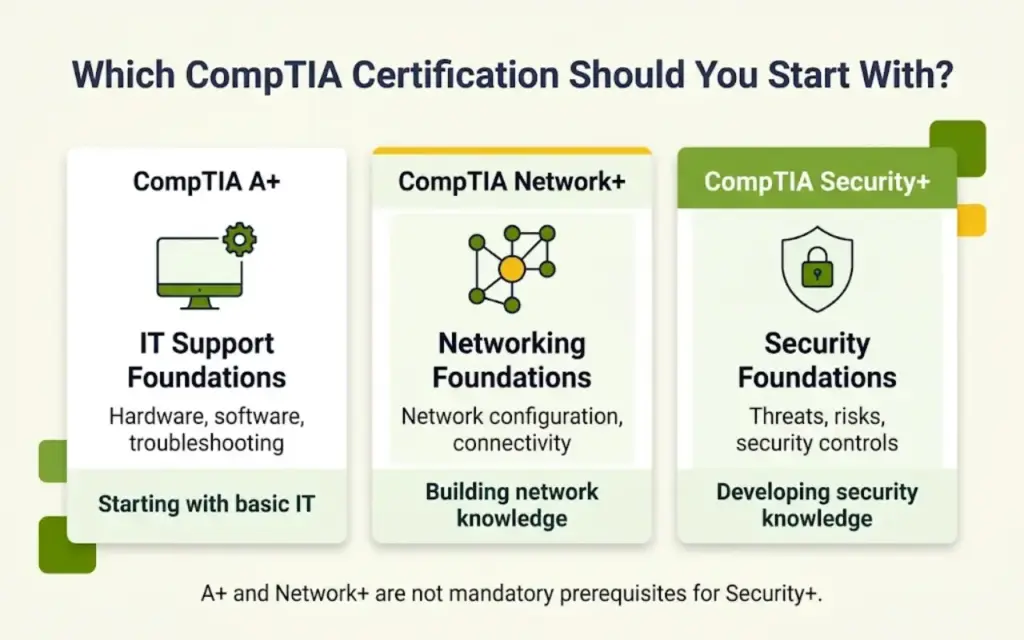
No. CompTIA A+ and Network+ are not mandatory prerequisites for Security+.
However, the knowledge they cover can help you prepare.
A+ focuses on foundational IT support skills, hardware, software and troubleshooting. Network+ covers networking concepts, infrastructure and network troubleshooting. Security+ concentrates on protecting systems, managing risks and responding to security threats.
Your preferred starting point depends on your existing knowledge.
| Your Starting Point | Suggested Approach |
|---|---|
| No IT experience | Learn basic computing and operating systems first |
| Some computer knowledge | Build networking and cybersecurity fundamentals |
| Comfortable with networking | Begin studying the Security+ exam objectives |
| Existing IT support experience | Focus on security concepts and practical scenarios |
There is no need to collect certifications simply to follow a particular order.
How to Study for CompTIA Security+ as a Beginner
Once you understand the foundations, you can begin structured exam preparation.
The most effective approach is usually to combine theory, practical exercises and regular knowledge checks.
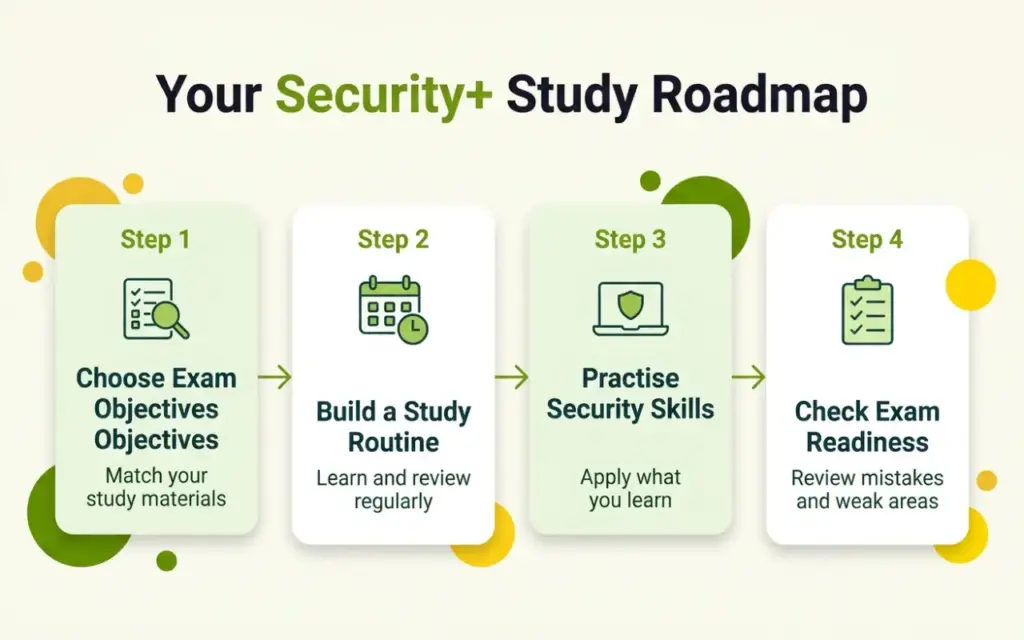
Step 1: Choose the Right Exam Objectives
Start with the official objectives for the examination you intend to take.
Divide them into manageable subjects and identify which areas are familiar and which need more attention.
Avoid studying exclusively from resources designed for an outdated examination version.
A simple progress tracker can help you monitor completed topics, revision requirements and practice results.
Step 2: Follow a Consistent Study Routine
A realistic weekly routine is more useful than occasional lengthy study sessions.
For example, you might spend one session learning a concept, another applying it and a third reviewing questions.
Try to explain what you have learned without consulting your notes.
If you cannot explain why a firewall rule or authentication control is appropriate, revisit the underlying concept before moving forward.
Step 3: Build Practical Skills
Security knowledge becomes easier to remember when you see how it works.
Beginner-friendly exercises include:
- Using ipconfig on Windows to inspect network settings.
- Using nslookup to explore DNS resolution.
- Reviewing the firewall settings on your own computer.
- Exploring account permissions in a safe environment.
- Identifying suspicious signs in sample phishing messages.
Only practise on devices, accounts and systems you own or are authorised to use.
You do not need an expensive home laboratory to begin developing practical familiarity.
Step 4: Use Practice Questions and Structured Learning
Start with questions covering individual topics before attempting full-length practice examinations.
When you answer incorrectly, investigate why your choice was wrong and why the correct option fits the scenario.
If you prefer guided learning, Janets offers a CompTIA Security+ Certification course covering security fundamentals, network security, authentication, risk management and incident response.
The course provides self-paced online study, mock assessment and a CPD-accredited certificate of achievement following successful completion of its final assessment.
Completing the Janets course does not itself award official CompTIA Security+ certification. You must pass the separate CompTIA examination to earn that credential. Before enrolling for exam preparation, check that the course content matches your intended exam version.
How Long Does It Take a Beginner to Prepare for Security+?
Preparation time varies considerably depending on your technical background, study habits and practical experience.
The following are illustrative planning ranges rather than official CompTIA requirements.
| Starting Experience | Possible Preparation Period |
|---|---|
| Complete beginner | 3–6 months |
| Some IT knowledge | 2–4 months |
| IT support or networking experience | 1–3 months |
Someone unfamiliar with networking may need additional time to understand IP addressing, protocols and system administration.
An experienced IT worker might already recognise many of these concepts and spend more time on security-specific subjects.
Rather than concentrating on a particular number of weeks, measure whether you can explain and apply the exam objectives.
Which CompTIA Security+ Exam Should You Study for in 2026?
Security+ examination versions matter because each version has its own published objectives.
As of 7 November 2026, Security+ V7 (SY0-701) is the existing examination. Its successor, Security+ V8 (SY0-801), is expected to launch on or around 17 November 2026, with the English SY0-701 examination scheduled to retire on 11 June 2027.
These dates have been reported in an October 2026 Security+ exam-version information session listed by NIST. Always verify the final arrangements through CompTIA before booking.
Security+ V7 includes up to 90 questions, a 90-minute examination and a passing score of 750 on a scale of 100–900.
For beginners, the important decision is which exam version you intend to take.
Choose matching study materials, practice assessments and official objectives. Do not assume resources prepared for an older version cover everything in the newer syllabus.
How Do You Know You're Ready for the Security+ Exam?
Finishing a course or completing a set number of practice questions does not automatically mean you are exam-ready.
Use this checklist to assess your progress:
- I can explain the main exam topics without relying entirely on notes.
- I understand basic networking, authentication and security controls.
- I can distinguish threats, vulnerabilities and risks.
- I can work through unfamiliar security scenarios and explain my decisions.
- I have identified weaker subjects and revised them using the official objectives.
You should also be comfortable with timed questions and practical problem-solving.
Certification can support professional development, but employers may also look for technical experience and demonstrated skills.
The UK Cyber Security Skills in the Labour Market 2026 report found that only 16% of core cybersecurity job adverts specifying minimum experience sought candidates with less than one year’s experience.
Frequently Asked Questions
Can I Pass Security+ Without Working in IT?
Yes. Previous IT employment is not mandatory. However, you should understand basic networking, operating systems and cybersecurity principles before attempting the examination. Practical exercises can help you develop that understanding.
Is Security+ a Good First IT Certification?
It can be, particularly if you already understand fundamental IT concepts. Complete beginners may find it easier to learn general computing and networking skills before beginning intensive Security+ preparation.
Can You Self-Study for CompTIA Security+?
Yes. Self-study can work well when you follow the current exam objectives, use reliable learning materials and combine revision with practical exercises. Structured training is another option if you prefer guided lessons.
What Is the Hardest Part of Security+ for Beginners?
It depends on your background. Networking, cryptography and applied security scenarios may be challenging when they are unfamiliar. Performance-based questions can also require more practical understanding than straightforward knowledge-recall questions.
Get a FREE Course