Course Library View the full range of courses
-
Accounting (144 courses)
- Xero Accounting and Bookkeeping Online
- Sage 50 Accounting & Payroll
- Project Finance
- Financial Modelling Training
- Tax Accounting
- Introduction to VAT
- Accounting and Finance Course for Managers
- Internal Compliance Auditor
- Financial Statement Analysis
- Payroll Administrator Level 3 Diploma
- View all Accounting courses
-
Language (67 courses)
- British Sign Language (BSL) Level 1 & 2
- Speech and Language Therapy Diploma
- TEFL (TESOL) Course
- English Spelling, Punctuation, and Grammar
- Child & Adult Speech & Language Disorders Training
- Teaching English as Foreign Language (TEFL) Certificate
- Mastering Spanish Language
- French Course for Beginners
- German Course for Beginners
- Body Language and Gesture Training
- View all Language courses
-
Teaching & Education (37 courses)
- Teaching Assistant Complete Course (TA, SEN, Autism, ADHD & Dyslexia) – CPD Certified
- EYFS Teaching Assistant Training Course
- Advanced Diploma in Coaching and Mentoring
- Level 3 Diploma in Teaching and Classroom Management
- Remote Teaching
- SENCO – Special Educational Needs Coordination
- Teaching English as Foreign Language (TEFL)
- Life Coaching
- Phonics Teaching Diploma
- View all Teaching & Education courses
-
Health and Social Care (140 courses)
- Health and Social Care Management
- Paediatric Nursing Assistant
- Mental Health Awareness Training
- Emergency Medicine – Paramedicine
- Level 3 Diploma in Adult Care
- Paediatric First Aid Training
- Safeguarding Children Level 3
- Level 3 Diploma in Anatomy and Physiology of Human Body
- Play Therapy
- The Care Certificate Preparation – Standards (1 to 15)
- View all Health and Social Care courses
-
Management (538 courses)
- Office Admin, Secretarial and PA Diploma
- Estate Agent and Property Management Training
- Diploma in Data Analysis Fundamentals
- Advanced Diploma in Stress & Anxiety Management
- Good Manufacturing Practice (GMP)
- Property Development and Management Course
- Diploma in Hotel Management
- Supply Chain Management
- Quality Assurance (QA) Manager
- Compliance and Risk Management
- View all Management courses
-
IT & Software (131 courses)
- Coding with Python 3
- Search Engine Optimisation (SEO) Training
- Cyber Security
- Motion Graphics with After Effects
- CompTIA A+ Core 1 (220-1101) Course
- Machine Learning for Aspiring Data Scientists
- Next.js Web Dev: Master this Powerful React Framework
- Learn 2D Animation with Adobe Animate
- GDPR Challenges in Education
- View all IT & Software courses
-
Employability (1043 courses)
- Office Administrator Skills
- Presentation Skills
- Legal Secretary and Office Skills
- Hospitality Management
- Estate Agent Diploma
- Hairdressing and Barbering
- Diploma in UK Employment Law
- Diploma in Data Analysis Fundamentals
- Building Surveyor Training
- Emotional Intelligence Training
- View all Employability courses
-
Personal Development (1439 courses)
- Productivity Habits
- Minute Taking Course
- Presentation Skills
- Excel: Top 50 Microsoft Excel Formulas in 50 Minutes!
- Critical Thinking and Problem Solving Skills
- Time Management
- Self Esteem and Confidence Building Course
- Essential IT Skills
- Legal Secretary and Office Skills
- Personality Development
- View all Personal Development courses


U&P AI - Natural Language Processing (NLP) with Python
33 Students (16 Reviews)
Explore Natural Language Processing (NLP) with Python through comprehensive online training. Learn NLP fundamentals, feature engineering, text corpus analysis, WordNet, vocabulary creation and Word2Vec. Develop an understanding of word representations, text meaning and topic modelling to build a strong foundation in AI, machine learning and language processing.
Overview
U&P AI – Natural Language Processing (NLP) with Python is a comprehensive training course designed to introduce learners to the fascinating world of Natural Language Processing (NLP) and its practical applications using Python. As artificial intelligence continues to transform how people interact with technology, NLP plays an essential role in enabling computers to understand, interpret, and process human language. This course provides a structured introduction to NLP concepts, helping learners develop an understanding of how machines work with text and extract meaningful information from language.
Throughout the course, learners will explore the fundamental concepts of NLP, its real-world applications, and the importance of feature engineering in language processing. The training covers working with text corpora and WordNet, building custom vocabularies for NLP models, and understanding Word2Vec in detail, including how word representations work behind the scenes. Learners will also explore techniques for identifying and representing meaning, context, and topics within natural language text. These concepts provide a foundation for understanding how intelligent systems can process words, recognise relationships, and uncover patterns in large volumes of textual data.
This course is suitable for beginners, students, Python enthusiasts, aspiring data scientists, developers, and individuals interested in artificial intelligence and machine learning. Whether you want to explore language-based AI applications, develop your technical knowledge, or build a foundation for further study in machine learning, this course offers an accessible introduction to NLP with Python.
Learning Outcomes
- Understand Natural Language Processing and its real-world applications
- Explore the fundamental concepts of NLP using Python
- Understand the importance of feature engineering in text processing
- Work with text corpora and WordNet
- Create custom vocabularies for NLP models
- Understand Word2Vec and how it works internally
- Explore word representations and relationships in NLP
- Identify meaning and topics within natural language text
- Understand techniques for processing and analysing textual information
- Develop foundational knowledge of NLP applications in artificial intelligence
Why choose this course
- Affordable, accessible, informative and well-structured study materials
- Earn a globally recognised accredited qualification
- Study in your own time, at your own pace, through any device
- Benefit from feedback through mock exams and multiple-choice assessments
- Excellent career advancement/career switch opportunities
- Get 24/7 help or advice from our email and live chat teams
Certification
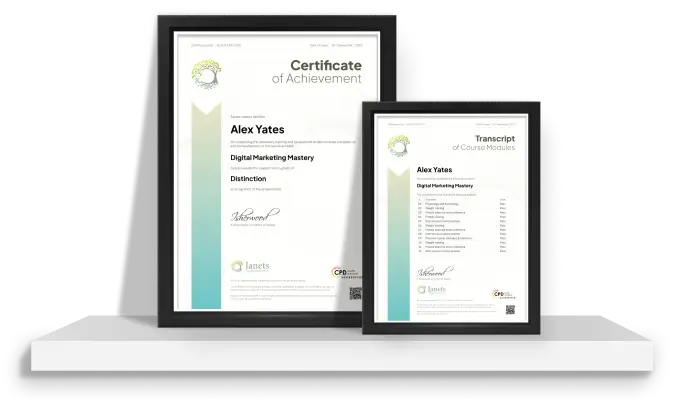
Certificate of Achievement
After the successful completion of the final assessment, you will receive a CPD-accredited certificate of achievement. The PDF certificate is for 9.99, and it will be sent to you immediately after through e-mail. You can get the hard copy for 15.99, which will reach your doorsteps by post.
Entry Requirements
No formal qualifications or previous professional experience in artificial intelligence are required. A basic understanding of Python programming will be helpful, as the course explores Natural Language Processing concepts and their applications using Python. An interest in programming, data science, machine learning, or artificial intelligence will be beneficial but is not essential.
Who is this course for?
This course is ideal for:
- Beginners interested in Natural Language Processing and artificial intelligence
- Python learners looking to explore practical AI applications
- Students interested in machine learning and data science
- Aspiring NLP Engineers and AI Developers
- Software developers expanding their programming knowledge
- Data analysts interested in text processing and analysis
- Researchers exploring language-based technologies
- Technology enthusiasts interested in how computers understand human language
Career Paths
Completing the U&P AI – Natural Language Processing (NLP) with Python course can help learners develop foundational knowledge and technical skills relevant to artificial intelligence, programming, data science, and language technology. Combined with suitable qualifications, practical experience, and further technical training, this knowledge may support progression into roles such as:
- Natural Language Processing (NLP) Engineer
- AI Developer
- Python Developer
- Machine Learning Engineer
- Data Analyst
- Junior Data Scientist
- AI Research Assistant
- Computational Linguistics Assistant
- Text Analytics Specialist
- Artificial Intelligence Specialist
Course Curriculum
| Unit 01: Getting An Idea Of NLP And Its Applications | |||
| Module 01: Introduction to NLP | 00:03:00 | ||
| Module 02: By the End of This Section | 00:01:00 | ||
| Module 03: Installation | 00:04:00 | ||
| Module 04: Tips | 00:01:00 | ||
| Module 05: U – Tokenization | 00:01:00 | ||
| Module 06: P – Tokenization | 00:02:00 | ||
| Module 07: U – Stemming | 00:02:00 | ||
| Module 08: P – Stemming | 00:05:00 | ||
| Module 09: U – Lemmatization | 00:02:00 | ||
| Module 10: P – Lemmatization | 00:03:00 | ||
| Module 11: U – Chunks | 00:02:00 | ||
| Module 12: P – Chunks | 00:05:00 | ||
| Module 13: U – Bag of Words | 00:04:00 | ||
| Module 14: P – Bag of Words | 00:04:00 | ||
| Module 15: U – Category Predictor | 00:05:00 | ||
| Module 16: P – Category Predictor | 00:06:00 | ||
| Module 17: U – Gender Identifier | 00:01:00 | ||
| Module 18: P – Gender Identifier | 00:08:00 | ||
| Module 19: U – Sentiment Analyzer | 00:02:00 | ||
| Module 20: P – Sentiment Analyzer | 00:07:00 | ||
| Module 21: U – Topic Modeling | 00:03:00 | ||
| Module 22: P – Topic Modeling | 00:06:00 | ||
| Module 23: Summary | 00:01:00 | ||
| Unit 02: Feature Engineering | |||
| Module 01: Introduction | 00:02:00 | ||
| Module 02: One Hot Encoding | 00:02:00 | ||
| Module 03: Count Vectorizer | 00:04:00 | ||
| Module 04: N-grams | 00:04:00 | ||
| Module 05: Hash Vectorizing | 00:02:00 | ||
| Module 06: Word Embedding | 00:11:00 | ||
| Module 07: FastText | 00:04:00 | ||
| Unit 03: Dealing With Corpus And WordNet | |||
| Module 01: Introduction | 00:01:00 | ||
| Module 02: In-built corpora | 00:06:00 | ||
| Module 03: External Corpora | 00:08:00 | ||
| Module 04: Corpuses & Frequency Distribution | 00:07:00 | ||
| Module 05: Frequency Distribution | 00:06:00 | ||
| Module 06: WordNet | 00:06:00 | ||
| Module 07: Wordnet with Hyponyms and Hypernyms | 00:07:00 | ||
| Module 08: The Average according to WordNet | 00:07:00 | ||
| Unit 04: Create Your Vocabulary For Any NLP Model | |||
| Module 01: Introduction and Challenges | 00:08:00 | ||
| Module 02: Building your Vocabulary Part-01 | 00:02:00 | ||
| Module 03: Building your Vocabulary Part-02 | 00:03:00 | ||
| Module 04: Building your Vocabulary Part-03 | 00:07:00 | ||
| Module 05: Building your Vocabulary Part-04 | 00:12:00 | ||
| Module 06: Building your Vocabulary Part-05 | 00:06:00 | ||
| Module 07: Tokenization Dot Product | 00:03:00 | ||
| Module 08: Similarity using Dot Product | 00:03:00 | ||
| Module 09: Reducing Dimensions of your Vocabulary using token improvement | 00:02:00 | ||
| Module 10: Reducing Dimensions of your Vocabulary using n-grams | 00:10:00 | ||
| Module 11: Reducing Dimensions of your Vocabulary using normalizing | 00:10:00 | ||
| Module 12: Reducing Dimensions of your Vocabulary using case normalization | 00:05:00 | ||
| Module 13: When to use stemming and lemmatization? | 00:04:00 | ||
| Module 14: Sentiment Analysis Overview | 00:05:00 | ||
| Module 15: Two approaches for sentiment analysis | 00:03:00 | ||
| Module 16: Sentiment Analysis using rule-based | 00:05:00 | ||
| Module 17: Sentiment Analysis using machine learning – 1 | 00:10:00 | ||
| Module 18: Sentiment Analysis using machine learning – 2 | 00:04:00 | ||
| Module 19: Summary | 00:01:00 | ||
| Unit 05: Word2Vec In Detail And What Is Going On Under The Hood | |||
| Module 01: Introduction | 00:04:00 | ||
| Module 02: Bag of words in detail | 00:14:00 | ||
| Module 03: Vectorizing | 00:08:00 | ||
| Module 04: Vectorizing and Cosine Similarity | 00:11:00 | ||
| Module 05: Topic modeling in Detail | 00:16:00 | ||
| Module 06: Make your Vectors will more reflect the Meaning, or Topic, of the Document | 00:10:00 | ||
| Module 07: Sklearn in a short way | 00:03:00 | ||
| Module 08: Summary | 00:02:00 | ||
| Unit 06: Find And Represent The Meaning Or Topic Of Natural Language Text | |||
| Module 01: Keyword Search VS Semantic Search | 00:04:00 | ||
| Module 02: Problems in TI-IDF leads to Semantic Search | 00:10:00 | ||
| Module 03: Transform TF-IDF Vectors to Topic Vectors under the hood | 00:11:00 | ||
Frequently asked questions
Can’t find the anwser you’re looking for ? Reach out to customer support team.
There are no specific prerequisites for this course, nor are there any formal entry requirements. All you need is an internet connection, a good understanding of English and a passion for learning for this course.
You have the flexibility to access the course at any time that suits your schedule. Our courses are self-paced, allowing you to study at your own pace and convenience.
For this course, you will have access to the course materials for 1 year only. This means you can review the content as often as you like within the year, even after you've completed the course. However, if you buy Lifetime Access for the course, you will be able to access the course for a lifetime.
Yes, upon successfully completing the course, you will receive a certificate of completion. This certificate can be a valuable addition to your professional portfolio and can be shared on your various social networks.
We want you to have a positive learning experience. If you're not satisfied with the course, you can request a course transfer or refund within 14 days of the initial purchase.
Our platform provides tracking tools and progress indicators for each course. You can monitor your progress, completed lessons, and assessments through your learner dashboard for the course.
If you encounter technical issues or content-related difficulties with the course, our support team is available to assist you. You can reach out to them for prompt resolution.