


Course Library View the full range of courses
-
Accounting (145 courses)
- Xero Accounting and Bookkeeping Online
- Sage 50 Accounting & Payroll
- Project Finance
- Financial Modelling Training
- Tax Accounting
- Introduction to VAT
- Accounting and Finance Course for Managers
- Internal Compliance Auditor
- Financial Statement Analysis
- Payroll Administrator Level 3 Diploma
- View all Accounting courses
-
Language (67 courses)
- British Sign Language (BSL) Level 1 & 2
- Speech and Language Therapy Diploma
- TEFL (TESOL) Course
- English Spelling, Punctuation, and Grammar
- Child & Adult Speech & Language Disorders Training
- Teaching English as Foreign Language (TEFL) Certificate
- Mastering Spanish Language
- French Course for Beginners
- German Course for Beginners
- Body Language and Gesture Training
- View all Language courses
-
Teaching & Education (37 courses)
- Teaching Assistant Complete Course (TA, SEN, Autism, ADHD & Dyslexia) – CPD Certified
- EYFS Teaching Assistant Training Course
- Advanced Diploma in Coaching and Mentoring
- Level 3 Diploma in Teaching and Classroom Management
- Remote Teaching
- SENCO – Special Educational Needs Coordination
- Teaching English as Foreign Language (TEFL)
- Life Coaching
- Phonics Teaching Diploma
- View all Teaching & Education courses
-
Health and Social Care (138 courses)
- Health and Social Care Management
- Paediatric Nursing Assistant
- Mental Health Awareness Training
- Emergency Medicine – Paramedicine
- Level 3 Diploma in Adult Care
- Paediatric First Aid Training
- Safeguarding Children Level 3
- Level 3 Diploma in Anatomy and Physiology of Human Body
- Play Therapy
- The Care Certificate Preparation – Standards (1 to 15)
- View all Health and Social Care courses
-
Management (539 courses)
- Office Admin, Secretarial and PA Diploma
- Estate Agent and Property Management Training
- Diploma in Data Analysis Fundamentals
- Advanced Diploma in Stress & Anxiety Management
- Good Manufacturing Practice (GMP)
- Property Development and Management Course
- Diploma in Hotel Management
- Supply Chain Management
- Quality Assurance (QA) Manager
- Compliance and Risk Management
- View all Management courses
-
IT & Software (123 courses)
- Coding with Python 3
- Search Engine Optimisation (SEO) Training
- Cyber Security
- Motion Graphics with After Effects
- CompTIA A+ Core 1 (220-1101) Course
- Machine Learning for Aspiring Data Scientists
- Next.js Web Dev: Master this Powerful React Framework
- Learn 2D Animation with Adobe Animate
- GDPR Challenges in Education
- View all IT & Software courses
-
Employability (1043 courses)
- Office Administrator Skills
- Presentation Skills
- Legal Secretary and Office Skills
- Hospitality Management
- Estate Agent Diploma
- Hairdressing and Barbering
- Diploma in UK Employment Law
- Diploma in Data Analysis Fundamentals
- Building Surveyor Training
- Emotional Intelligence Training
- View all Employability courses
-
Personal Development (1438 courses)
- Productivity Habits
- Minute Taking Course
- Presentation Skills
- Excel: Top 50 Microsoft Excel Formulas in 50 Minutes!
- Critical Thinking and Problem Solving Skills
- Time Management
- Self Esteem and Confidence Building Course
- Essential IT Skills
- Legal Secretary and Office Skills
- Personality Development
- View all Personal Development courses


Business Management & Bookkeeping Training
112 Students (6 Reviews)
Learn business management, bookkeeping, budgeting, and financial control skills with the Business Management & Bookkeeping Training course.

Course Curriculum
| **Business Management** | |||
| Module 01: Basics of Business Process Management | |||
| The Fundamentals of Business Process Management | 00:30:00 | ||
| Defining Business Process Management | 00:30:00 | ||
| The Business Process Life Cycle | 00:15:00 | ||
| Module 02: The Vision, Design & Execution Phase of Business Management | |||
| The Vision Phase | 00:15:00 | ||
| The Design Phase | 01:00:00 | ||
| The Execution Phase | 01:00:00 | ||
| Module 03: The Monitoring & Optimising Phase of Business Management | |||
| The Monitoring Phase | 00:30:00 | ||
| The Optimising Phase | 00:10:00 | ||
| Module 04: Project Management | |||
| Project Management | 00:40:00 | ||
| Module 05: Marketing, Positioning and Pricing | |||
| Marketing and Its Components | 00:05:00 | ||
| Positioning and Pricing | 00:05:00 | ||
| Module 06: Selling and Negotiating | |||
| Selling and Negotiating | 00:10:00 | ||
| Module 07: Leadership and Management | |||
| Leadership and Management | 00:25:00 | ||
| Module 08: Five Practices and Change Management | |||
| Five Practices | 00:15:00 | ||
| Managing Change | 00:30:00 | ||
| Module 09: Critical Thinking | |||
| Critical Thinking | 00:40:00 | ||
| Module 10: Business Relationship Management | |||
| Managing Relationships | 01:00:00 | ||
| Module 11: Meeting Management | |||
| Meeting Management | 01:00:00 | ||
| Module 12: Infrastructure of the Information Technology for Business Management | |||
| IT Infrastructure and Emerging Technologies | 00:15:00 | ||
| Foundations of Business Intelligence : Databases and Information Management | 00:15:00 | ||
| Telecommunications, Internet, and Wireless Technology | 00:15:00 | ||
| Securing Information Systems | 01:00:00 | ||
| Module 13: Key System Applications for the Digital Business | |||
| Achieving Operational Excellence and Customer Intimacy: Enterprise Applications | 00:30:00 | ||
| E-Commerce : Digital Markets, Digital Goods | 00:30:00 | ||
| Knowledge Management Systems | 00:30:00 | ||
| **Bookkeeping Training** | |||
| Bookkeeping | |||
| Introduction | 00:02:00 | ||
| Introduction to the course | |||
| Introduction to Bookkeeping | 00:15:00 | ||
| Bookkeeping systems | |||
| Manual System | 00:10:00 | ||
| Computerised Systems | 00:10:00 | ||
| How it Fits Together | 00:08:00 | ||
| Basics of Bookkeeping | |||
| Bookkeeping Basics | 00:30:00 | ||
| The functionality of bookkeeping | |||
| Ledgers | 00:10:00 | ||
| Trial Balance and Coding | 00:10:00 | ||
| PNL Account and Balance Sheet | 00:04:00 | ||
| On a personal note | |||
| AILE Personal | 00:05:00 | ||
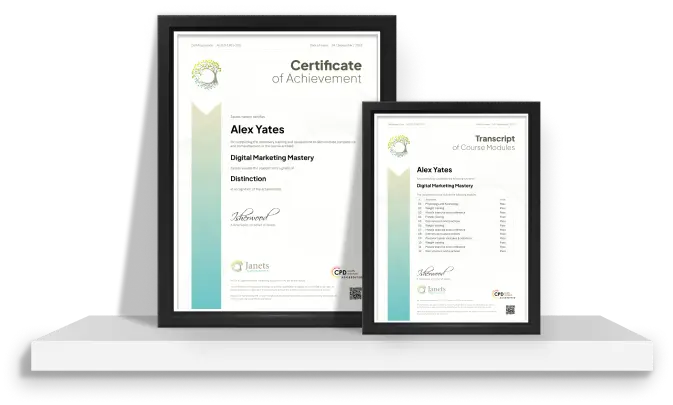
| Order your Certificates & Transcripts | |||
| Order your Certificates & Transcripts | 00:00:00 | ||

Original price was: £319.£25Current price is: £25. ex Vat
SAVE 92% - OFFER ENDS IN

 ALL
COURSES FOR £49
ALL
COURSES FOR £49  14-Day Money-Back Guarantee
- Personal
- Team
Quantity:
Total:
50% discount for orders of 10+ courses
60% discount for orders of 50+ courses
70% discount for orders of 100+ courses
For more personalised package, contact us


Frequently asked questions
Can’t find the anwser you’re looking for ? Reach out to customer support team.
Business management involves planning, organising, and supervising business activities to achieve organisational goals efficiently.
Bookkeeping is the process of recording and organising financial transactions such as sales, purchases, income, and expenses.
It ensures accurate financial records, helps track business performance, supports tax preparation, and improves financial decision-making.
You will learn business operations, budgeting, financial control, bookkeeping systems, invoicing, payroll basics, and reporting.
No. This course is designed for beginners as well as those looking to improve their business and bookkeeping skills.
Bookkeeping records financial data, while accounting interprets, analyses, and summarises that data for decision-making.
Basic records include sales invoices, purchase receipts, bank statements, ledgers, and financial journals.
Yes. The course provides essential skills to help you plan, manage, and operate a small business.
Common tools include spreadsheets and accounting software such as Excel and other digital bookkeeping systems.
Yes. It offers opportunities across many industries including retail, finance, administration, and entrepreneurship.
Key skills include leadership, communication, organisation, financial awareness, and problem-solving.
Cash flow refers to the movement of money in and out of a business, including income and expenses.