


Course Library View the full range of courses
-
Accounting (145 courses)
- Xero Accounting and Bookkeeping Online
- Sage 50 Accounting & Payroll
- Project Finance
- Financial Modelling Training
- Tax Accounting
- Introduction to VAT
- Accounting and Finance Course for Managers
- Internal Compliance Auditor
- Financial Statement Analysis
- Payroll Administrator Level 3 Diploma
- View all Accounting courses
-
Language (67 courses)
- British Sign Language (BSL) Level 1 & 2
- Speech and Language Therapy Diploma
- TEFL (TESOL) Course
- English Spelling, Punctuation, and Grammar
- Child & Adult Speech & Language Disorders Training
- Teaching English as Foreign Language (TEFL) Certificate
- Mastering Spanish Language
- French Course for Beginners
- German Course for Beginners
- Body Language and Gesture Training
- View all Language courses
-
Teaching & Education (37 courses)
- Teaching Assistant Complete Course (TA, SEN, Autism, ADHD & Dyslexia) – CPD Certified
- EYFS Teaching Assistant Training Course
- Advanced Diploma in Coaching and Mentoring
- Level 3 Diploma in Teaching and Classroom Management
- Remote Teaching
- SENCO – Special Educational Needs Coordination
- Teaching English as Foreign Language (TEFL)
- Life Coaching
- Phonics Teaching Diploma
- View all Teaching & Education courses
-
Health and Social Care (138 courses)
- Health and Social Care Management
- Paediatric Nursing Assistant
- Mental Health Awareness Training
- Emergency Medicine – Paramedicine
- Level 3 Diploma in Adult Care
- Paediatric First Aid Training
- Safeguarding Children Level 3
- Level 3 Diploma in Anatomy and Physiology of Human Body
- Play Therapy
- The Care Certificate Preparation – Standards (1 to 15)
- View all Health and Social Care courses
-
Management (539 courses)
- Office Admin, Secretarial and PA Diploma
- Estate Agent and Property Management Training
- Diploma in Data Analysis Fundamentals
- Advanced Diploma in Stress & Anxiety Management
- Good Manufacturing Practice (GMP)
- Property Development and Management Course
- Diploma in Hotel Management
- Supply Chain Management
- Quality Assurance (QA) Manager
- Compliance and Risk Management
- View all Management courses
-
IT & Software (127 courses)
- Coding with Python 3
- Search Engine Optimisation (SEO) Training
- Cyber Security
- Motion Graphics with After Effects
- CompTIA A+ Core 1 (220-1101) Course
- Machine Learning for Aspiring Data Scientists
- Next.js Web Dev: Master this Powerful React Framework
- Learn 2D Animation with Adobe Animate
- GDPR Challenges in Education
- View all IT & Software courses
-
Employability (1043 courses)
- Office Administrator Skills
- Presentation Skills
- Legal Secretary and Office Skills
- Hospitality Management
- Estate Agent Diploma
- Hairdressing and Barbering
- Diploma in UK Employment Law
- Diploma in Data Analysis Fundamentals
- Building Surveyor Training
- Emotional Intelligence Training
- View all Employability courses
-
Personal Development (1439 courses)
- Productivity Habits
- Minute Taking Course
- Presentation Skills
- Excel: Top 50 Microsoft Excel Formulas in 50 Minutes!
- Critical Thinking and Problem Solving Skills
- Time Management
- Self Esteem and Confidence Building Course
- Essential IT Skills
- Legal Secretary and Office Skills
- Personality Development
- View all Personal Development courses


Cognitive Behavioural Therapy (CBT)
166 Students (7 Reviews)
Take control of your thoughts and emotions! This CBT course equips you with powerful tools to challenge negative thinking, manage stress, and build resilience. Improve your mental well-being and create lasting change in your life.

Course Curriculum
| Introduction | |||
| CBT Eating Disorders Promo | FREE | 00:02:00 | |
| About the Tutor | 00:01:00 | ||
| About the Course | 00:02:00 | ||
| CBT & Therapeutic principles | |||
| What is CBT (the CBT model) | 00:07:00 | ||
| NICE guidelines | 00:04:00 | ||
| The therapeutic alliance, Trust and Empathy | 00:07:00 | ||
| Ethics of the therapy | 00:05:00 | ||
| The Psychology & Causations of Eating Disorders | |||
| Eating disorders: Categorisations | 00:07:00 | ||
| Core Psychopathology of Eating Disorders | 00:07:00 | ||
| Co-morbid psychiatric illness | 00:07:00 | ||
| Social and Family factors | 00:08:00 | ||
| Cognitive factors | 00:07:00 | ||
| Emotional factors | 00:09:00 | ||
| The Assessment & Planning | |||
| First session – Assessment | 00:08:00 | ||
| Dietary and Nutritional issues | 00:06:00 | ||
| Setting Goals with the client | 00:07:00 | ||
| Motivational factors | 00:07:00 | ||
| CBT in Practice | |||
| Working with Anxiety | 00:05:00 | ||
| The Socratic approach (Socratic questioning) | 00:06:00 | ||
| Psychoeducation | 00:04:00 | ||
| The ‘Exposure’ technique | 00:07:00 | ||
| Working with Beliefs (shape, weight, food) | 00:07:00 | ||
| Behavioural Experiments | 00:07:00 | ||
| Reviewing & Wrapping up | |||
| Designing and Reviewing Action plans | 00:06:00 | ||
| Concluding therapy successfully | 00:04:00 | ||
| Follow up and Relapse Prevention | 00:05:00 | ||
| Thank you and Good Bye! | 00:03:00 | ||
| Resources | |||
| Resources – Cognitive Behavioural Therapy (CBT) | 00:00:00 | ||
| Mock Exam | |||
| Mock Exam – Cognitive Behavioural Therapy (CBT) | 00:20:00 | ||
| Final Exam | |||
| Final Exam – Cognitive Behavioural Therapy (CBT) | 00:20:00 | ||
| Order your Certificates & Transcripts | |||
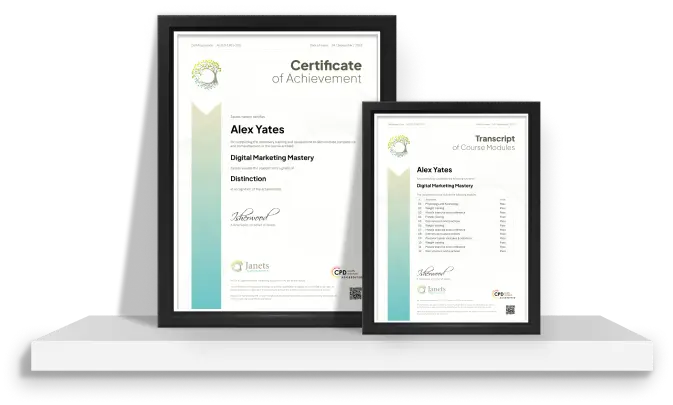
| Order your Certificates & Transcripts | 00:00:00 | ||

Original price was: £319.£25Current price is: £25. ex Vat
SAVE 92% - OFFER ENDS IN

 14-Day Money-Back Guarantee
- Personal
- Team
Quantity:
Total:
50% discount for orders of 10+ courses
60% discount for orders of 50+ courses
70% discount for orders of 100+ courses
For more personalised package, contact us


Frequently asked questions
Can’t find the anwser you’re looking for ? Reach out to customer support team.
Cognitive Behavioral Therapy (CBT) is a form of psychotherapy that aims to identify and change negative thought patterns and behaviors. It works by helping individuals recognize distorted thoughts, evaluate their accuracy, and replace them with more balanced thoughts. Additionally, it involves modifying behaviors that contribute to the individual's problems through techniques like gradual exposure and the development of coping skills.
The five steps of CBT include assessment to understand the client’s issues, problem identification to pinpoint specific issues and contributing thought patterns, goal setting to establish clear and achievable objectives, intervention to implement techniques for changing thoughts and behaviors, and evaluation to monitor progress and make necessary adjustments.
An example of CBT is a person with social anxiety learning to challenge their fear of social situations. They identify the fear of being judged negatively, question the validity of this fear, develop balanced thoughts like “Most people are not focused on judging me,” and gradually expose themselves to social situations to build confidence and reduce anxiety.
The three principles of CBT are the cognitive principle that suggests thoughts influence emotions and behaviors rather than external events, the behavioral principle that emphasizes the role of changing maladaptive behaviors to improve emotional well-being, and the principle of learning which highlights that new, healthier behaviors and thoughts can be learned.
CBT may not be appropriate for individuals with severe mental health conditions that impair cognitive functions, such as advanced dementia or severe psychosis. It might also be less effective for those who are not willing to engage actively in the process or are resistant to exploring their thoughts and behaviors.
The 3 C's of cognitive therapy are catching the negative thought, checking it by evaluating its validity and evidence, and changing it to a more balanced and realistic thought.
To use CBT in daily life, individuals can practice identifying and challenging negative thoughts, using relaxation techniques to manage stress, setting realistic goals, and gradually exposing themselves to feared situations to build confidence.
CBT therapy is beneficial for individuals experiencing anxiety, depression, PTSD, phobias, eating disorders, and other mental health issues. It is suitable for anyone looking to change negative thought patterns and behaviors impacting their mental health.
CBT typically takes about 12 to 20 sessions to produce significant improvement, but this can vary based on the individual’s specific issues and their engagement in the process.
The worst that could happen in CBT is that it might not be effective for the individual, leading to frustration or a sense of failure. In some cases, confronting distressing thoughts and situations can initially increase anxiety or discomfort, but this usually decreases over time with continued practice.
Yes, CBT can change your life by helping you develop healthier thought patterns, reduce symptoms of mental health issues, and improve overall well-being and functioning.
CBT is effective because it is structured, goal-oriented, and based on the principle that changing negative thought patterns and behaviors can lead to improvements in emotional regulation and mental health. It is supported by extensive research and has been shown to be effective for a wide range of mental health conditions.
The five stages of CBT are assessment, problem identification, goal setting, intervention, and evaluation.
To do CBT therapy at home, individuals can use self-help books, online resources, and worksheets to identify and challenge negative thoughts, set realistic goals, practice relaxation techniques, and gradually expose themselves to feared situations.
CBT can significantly reduce anxiety by helping individuals understand and change the thought patterns and behaviors that contribute to their anxiety, though it may not completely eliminate it. Regular practice and continued application of CBT techniques can help manage and reduce anxiety symptoms effectively.