


Course Library View the full range of courses
-
Accounting (145 courses)
- Xero Accounting and Bookkeeping Online
- Sage 50 Accounting & Payroll
- Project Finance
- Financial Modelling Training
- Tax Accounting
- Introduction to VAT
- Accounting and Finance Course for Managers
- Internal Compliance Auditor
- Financial Statement Analysis
- Payroll Administrator Level 3 Diploma
- View all Accounting courses
-
Language (67 courses)
- British Sign Language (BSL) Level 1 & 2
- Speech and Language Therapy Diploma
- TEFL (TESOL) Course
- English Spelling, Punctuation, and Grammar
- Child & Adult Speech & Language Disorders Training
- Teaching English as Foreign Language (TEFL) Certificate
- Mastering Spanish Language
- French Course for Beginners
- German Course for Beginners
- Body Language and Gesture Training
- View all Language courses
-
Teaching & Education (37 courses)
- Teaching Assistant Complete Course (TA, SEN, Autism, ADHD & Dyslexia) – CPD Certified
- EYFS Teaching Assistant Training Course
- Advanced Diploma in Coaching and Mentoring
- Level 3 Diploma in Teaching and Classroom Management
- Remote Teaching
- SENCO – Special Educational Needs Coordination
- Teaching English as Foreign Language (TEFL)
- Life Coaching
- Phonics Teaching Diploma
- View all Teaching & Education courses
-
Health and Social Care (138 courses)
- Health and Social Care Management
- Paediatric Nursing Assistant
- Mental Health Awareness Training
- Emergency Medicine – Paramedicine
- Level 3 Diploma in Adult Care
- Paediatric First Aid Training
- Safeguarding Children Level 3
- Level 3 Diploma in Anatomy and Physiology of Human Body
- Play Therapy
- The Care Certificate Preparation – Standards (1 to 15)
- View all Health and Social Care courses
-
Management (539 courses)
- Office Admin, Secretarial and PA Diploma
- Estate Agent and Property Management Training
- Diploma in Data Analysis Fundamentals
- Advanced Diploma in Stress & Anxiety Management
- Good Manufacturing Practice (GMP)
- Property Development and Management Course
- Diploma in Hotel Management
- Supply Chain Management
- Quality Assurance (QA) Manager
- Compliance and Risk Management
- View all Management courses
-
IT & Software (124 courses)
- Coding with Python 3
- Search Engine Optimisation (SEO) Training
- Cyber Security
- Motion Graphics with After Effects
- CompTIA A+ Core 1 (220-1101) Course
- Machine Learning for Aspiring Data Scientists
- Next.js Web Dev: Master this Powerful React Framework
- Learn 2D Animation with Adobe Animate
- GDPR Challenges in Education
- View all IT & Software courses
-
Employability (1043 courses)
- Office Administrator Skills
- Presentation Skills
- Legal Secretary and Office Skills
- Hospitality Management
- Estate Agent Diploma
- Hairdressing and Barbering
- Diploma in UK Employment Law
- Diploma in Data Analysis Fundamentals
- Building Surveyor Training
- Emotional Intelligence Training
- View all Employability courses
-
Personal Development (1439 courses)
- Productivity Habits
- Minute Taking Course
- Presentation Skills
- Excel: Top 50 Microsoft Excel Formulas in 50 Minutes!
- Critical Thinking and Problem Solving Skills
- Time Management
- Self Esteem and Confidence Building Course
- Essential IT Skills
- Legal Secretary and Office Skills
- Personality Development
- View all Personal Development courses


Diploma in Cyber Security
188 Students (1 Reviews)
Be an informed and secure digital citizen! The Diploma in Cyber Security equips you with the knowledge to navigate online threats. Learn about online safety, password protection, scams, and more. Protect yourself, your family, and your information in the digital world!
Original price was: £319.£25Current price is: £25.
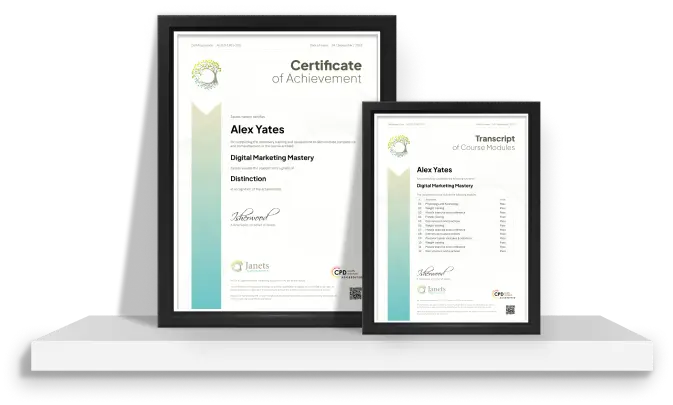
Course Curriculum
| Introduction | |||
| Introduction | 00:30:00 | ||
| Child Safety Online | |||
| Child Safety Online | 01:00:00 | ||
| Secure Payment Sites | |||
| Secure Payment Sites | 01:00:00 | ||
| Online Banking | |||
| Online Banking | 00:30:00 | ||
| How To Keep Your Password Safe | |||
| How To Keep Your Password Safe | 00:30:00 | ||
| Common Scams | |||
| Common Scams | 01:00:00 | ||
| How I Got Pharmed | |||
| How I Got Pharmed | 01:00:00 | ||
| Virus Protection | |||
| Virus Protection | 01:00:00 | ||
| Self Maintenance | |||
| Self Maintenance | 00:30:00 | ||
| Personal Information Online | |||
| Personal Information Online | 01:00:00 | ||
| Is The Internet Safe? | |||
| Is The Internet Safe? | 00:30:00 | ||
| Recommended Reading | |||
| Recommended Reading: Diploma in Cyber Security | 00:00:00 | ||
| Mock Exam | |||
| Mock Exam – Diploma in Cyber Security | 00:20:00 | ||
| Final Exam | |||
| Final Exam – Diploma in Cyber Security | 00:20:00 | ||
| Order your Certificates & Transcripts | |||
| Order your Certificates & Transcripts | 00:00:00 | ||

Original price was: £319.£25Current price is: £25. ex Vat
SAVE 92% - OFFER ENDS IN

 14-Day Money-Back Guarantee
- Personal
- Team
Quantity:
Total:
50% discount for orders of 10+ courses
60% discount for orders of 50+ courses
70% discount for orders of 100+ courses
For more personalised package, contact us


Frequently asked questions
Can’t find the anwser you’re looking for ? Reach out to customer support team.
Some of the best diplomas for cyber security include: CompTIA Security+: A globally recognized entry-level certification. Certified Information Systems Security Professional (CISSP): An advanced certification for experienced professionals. Certified Ethical Hacker (CEH): Focuses on offensive security and penetration testing. GIAC Security Essentials (GSEC): Covers fundamental cybersecurity concepts. Certified Information Security Manager (CISM): Focuses on management and strategy in information security.
Cyber security can be pursued as a diploma, certificate, or degree program. Diplomas and certificates often focus on practical skills and specific areas of cybersecurity, while degree programs provide a more comprehensive education, including theoretical foundations and advanced topics.
One notable free cyber security course offered in Finland is the "Elements of AI" course by the University of Helsinki and Reaktor. Although it primarily focuses on artificial intelligence, it includes cybersecurity elements. Additionally, Finland offers free education to EU/EEA students, and there are various online platforms offering free cybersecurity courses, such as Coursera and edX.
A Level 7 Diploma in Cyber Security is an advanced qualification typically equivalent to a postgraduate level of study. It covers in-depth cybersecurity concepts, risk management, strategic planning, and advanced technical skills. This diploma is suitable for those seeking leadership roles in cybersecurity.
Yes, a Level 7 Diploma is worth it for individuals seeking advanced knowledge and skills in cybersecurity. It can enhance career prospects, qualify you for higher-level positions, and demonstrate a commitment to professional development.
A Level 7 Diploma is equivalent to a postgraduate degree, such as a master’s degree. While it is not the same as a traditional academic degree, it represents a high level of expertise and is recognized in professional and academic contexts.
Yes, Finland is considered good for cybersecurity due to its strong focus on digitalization, robust cybersecurity infrastructure, and high-quality education system. Finnish universities offer excellent programs in cybersecurity, and the country is known for its innovation and technology sectors.
Cyber security can be challenging due to the fast-paced nature of the field and the need for a deep understanding of both technical and theoretical concepts. It requires continuous learning and adaptation to new threats and technologies. However, with dedication and the right resources, it is manageable and rewarding.
EU/EEA students can study for free in Finland at the bachelor’s and master’s level. Non-EU/EEA students may have to pay tuition fees, but scholarships and grants are available to help cover costs.
Yes, you can enter the field of cyber security without a degree by obtaining relevant certifications, gaining practical experience, and building a portfolio of your work. Certifications like CompTIA Security+, CISSP, and CEH are highly valued and can help you get started in the industry.
Cybersecurity requires some level of math, particularly in areas such as cryptography, algorithms, and statistical analysis. However, the extent of math required varies by role and specialization. Many cybersecurity positions focus more on problem-solving, critical thinking, and technical skills.
Yes, cybersecurity is a real and recognized degree offered by many universities and colleges worldwide. These programs cover various aspects of cybersecurity, including network security, ethical hacking, information assurance, and cyber forensics.
A typical bachelor's degree in cybersecurity takes about 3-4 years to complete. Master's programs usually take 1-2 years. Diplomas and certifications can vary in duration, from a few months to a year, depending on the depth and intensity of the program.
Yes, cybersecurity is a good career choice. It offers strong job prospects, competitive salaries, and opportunities for advancement. The demand for cybersecurity professionals is high due to the increasing prevalence of cyber threats and the need for robust security measures.
While not all cybersecurity roles require coding, having coding skills is highly beneficial. Understanding programming languages such as Python, Java, C++, and scripting languages can help in tasks like writing security tools, automating processes, and analyzing malware. Some specific roles, like penetration testers and security analysts, may require more extensive coding knowledge.