- Home
- Career Guide
- Level 2 vs Level 3 Teaching Assistant: Which Should You Choose
Level 2 vs Level 3 Teaching Assistant: Which Should You Choose

Choosing between Level 2 and Level 3 teaching assistant training can be confusing, especially when course titles, entry requirements and school vacancies all seem to say something different.
The main difference is that Level 2 generally focuses on foundational classroom-support knowledge, while Level 3 involves more advanced learning and understanding of teaching and learning. However, Level 3 is not automatically the right choice for everyone.
Your experience, career plans, budget and the qualifications a school expects all matter. This comparison explains the differences so you can choose a suitable route.
If you also want to develop classroom-support knowledge, Janets offers a Teaching Assistant Complete Course covering teaching assistant duties and additional learning needs.
Make a Difference as a Teaching Assistant
Build classroom support skills and explore SEN, Autism, ADHD and Dyslexia through flexible online learning.
Level 2 vs Level 3 Teaching Assistant: Quick Comparison
Level 2 and Level 3 describe different levels of qualification difficulty. They do not automatically determine your job title, pay grade or responsibilities in a school.
According to GOV.UK’s qualification levels, Level 2 is comparable in difficulty to GCSE grades 4–9, while Level 3 is comparable to A levels.
| Feature | Level 2 Teaching Assistant | Level 3 Teaching Assistant |
|---|---|---|
| Qualification level | Comparable to GCSE level | Comparable to A-level standard |
| Learning focus | Foundational classroom-support knowledge | More advanced teaching and learning knowledge |
| Suitable learners | Beginners and those developing their skills | Learners ready for more advanced study |
| Typical subjects | Classroom routines, communication, learning support | Child development, assessment, interventions and additional needs |
| Entry requirements | Vary by course and provider | Vary; Level 2 is not always required first |
| Practical assessment | Depends on the qualification | Depends on the qualification |
| Job opportunities | May support applications for TA and classroom support roles | May support applications for roles seeking more advanced knowledge |
| Course costs | Vary by provider and qualification | Vary by provider and qualification |
The important distinction: A Level 3 Award, Certificate and Diploma may have very different assessment requirements and study volumes. Always compare the exact qualifications rather than assuming that every course at the same level is equivalent.
Fees are another consideration, so it helps to compare what teaching assistant courses can cost before enrolling.
What Do Level 2 and Level 3 Teaching Assistant Courses Cover?
Both levels can introduce essential classroom-support skills. The difference lies mainly in the depth and complexity of the knowledge and skills being assessed.
What You Typically Study at Level 2
Level 2 teaching assistant courses commonly cover the foundations of supporting pupils and teachers.
You may study:
● Helping pupils with reading, writing and numeracy activities.
● Preparing learning materials and organising classrooms.
● Communicating effectively with pupils and school staff.
● Supporting positive behaviour and following school policies.
● Understanding basic child development and safeguarding responsibilities.
For example, a teaching assistant might help a small group practise reading while the teacher works with the rest of the class.
Level 2 may be a sensible starting point if you have limited classroom experience and want to build your confidence.
What Changes at Level 3?
Level 3 training generally examines classroom practice in greater depth.
Depending on the qualification, learners may develop knowledge of assessment, child development, individual learning needs and supporting planned interventions.
Some programmes also involve workplace observation and practical evidence of competence.
For example, a teaching assistant might help deliver a teacher-planned literacy intervention, record pupil progress and share observations with the teacher.
The precise responsibilities still depend on the school role, rather than the qualification alone.
For a broader explanation of progression, see the wider teaching assistant qualification pathway.
Learners can also develop additional knowledge through Janet’s classroom support and SEN training, alongside their chosen qualification.
Can You Do Level 3 Teaching Assistant Without Level 2?
Yes, you may be able to start Level 3 without completing Level 2 first. However, admission depends on the qualification, training provider and assessment requirements.
Some courses accept beginners, while others expect relevant experience or access to a suitable workplace.
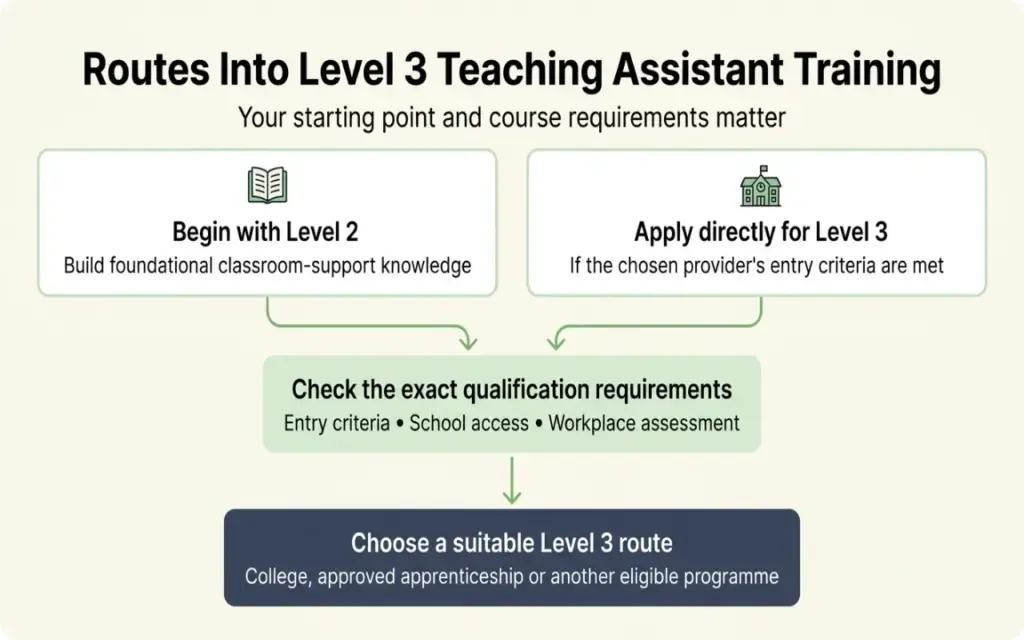
Entry Requirements and School Experience
Before applying, check whether your chosen course requires:
● Particular English and maths qualifications.
● Previous experience working with children.
● A school placement or employed teaching assistant role.
● Workplace observations or a practical assessment portfolio.
A knowledge-based online course may not require a placement, but a competence-based qualification can require evidence gathered in a real school environment.
There are also alternative routes. The National Careers Service identifies college courses, apprenticeships, volunteering and direct applications as ways to enter teaching assistant work.
Another option is the Level 3 teaching assistant apprenticeship, which combines employment with structured training and assessment.
If you already volunteer in a primary school, for instance, you may be able to consider Level 3 directly, provided you meet the specific provider’s requirements.
Level 2 vs Level 3 Teaching Assistant Jobs and Salaries
The qualification you hold may influence which vacancies you can apply for, but schools also consider relevant experience, communication skills and the responsibilities of the role.
What Jobs Can You Apply for at Each Level?
Level 2 learners may consider vacancies for classroom assistants, teaching assistants or learning support assistants where they meet the employer’s requirements.
Level 3 training may be relevant to posts involving more advanced support, such as structured learning interventions or additional responsibilities for pupil development.
However, a school advertising a Level 3 teaching assistant position may be referring to its employment grade rather than requiring one particular Level 3 qualification.
Always read the person specification carefully.

Some experienced teaching assistants also consider moving towards a higher level teaching assistant role as part of their longer-term development.
Does a Level 3 Teaching Assistant Earn More?
Not necessarily. A Level 3 qualification does not automatically increase your salary.
The National Careers Service gives an indicative teaching assistant salary range of £19,000 for starters to £26,000 for experienced workers. These are general career figures, not separate Level 2 and Level 3 salary bands.
Actual pay depends on the employer, job grade, location, contracted hours and experience.
Many school support roles are term-time only. An advertised full-time equivalent salary may therefore be higher than the amount actually received for a part-time, term-time contract.
For employment context, the Department for Education reported 295,183 full-time-equivalent teaching assistants in England for 2025/26, an increase of approximately 6,200 on the previous year, in its school workforce statistics.
This demonstrates the scale of the workforce, although it does not guarantee vacancies in any particular area.
How Much Do Level 2 and Level 3 Teaching Assistant Courses Cost?
There is no fixed national price for Level 2 or Level 3 teaching assistant training.
Costs depend on the awarding organisation, course provider, qualification size, assessment arrangements and delivery format.
A shorter knowledge-based course may cost less than a regulated qualification requiring workplace assessment. However, that does not make the two options equivalent.
Before enrolling, compare a breakdown of teaching assistant course costs, including assessment and certificate fees.
Course Fees, Study Time and Funding
Course duration varies considerably. Some online learning programmes offer flexible study, while practical qualifications may take longer because learners must demonstrate workplace competence.
Funding may also be available.
Under England’s 2026–27 Adult Skills Fund rules, eligible adults can receive support for certain approved qualifications.
Eligibility depends on factors including age, previous qualifications, earnings, residency and the course being funded. Arrangements also differ across devolved areas.
Check the exact qualification’s funding status before assuming that a course is free.
Make a Difference as a Teaching Assistant
Build classroom support skills and explore SEN, Autism, ADHD and Dyslexia through flexible online learning.
Should You Choose Level 2 or Level 3 Teaching Assistant Training?
The best qualification is the one that matches your experience, learning needs and intended school role.
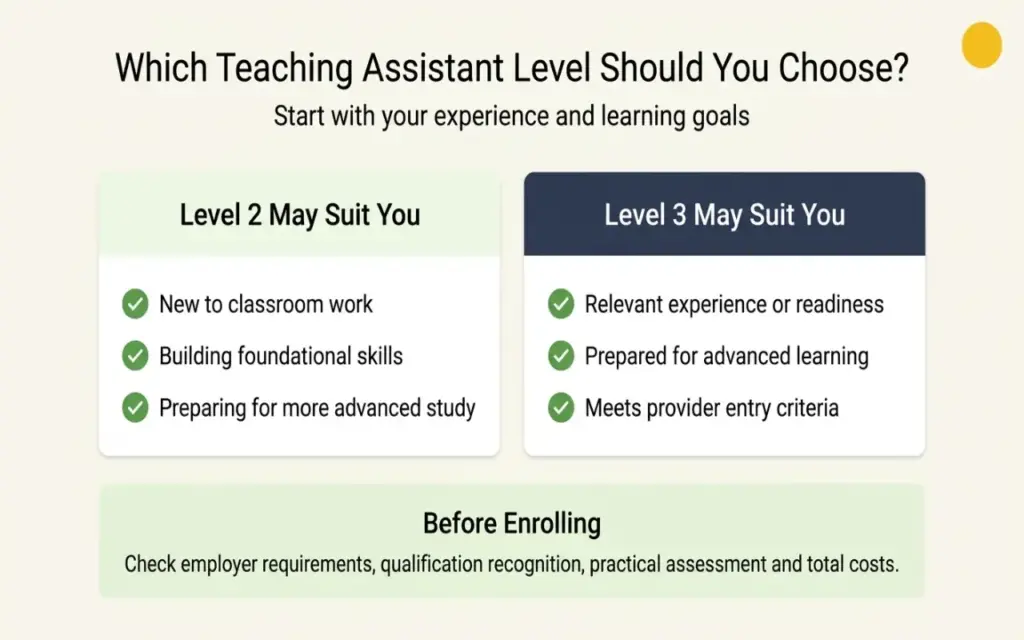
Level 2 May Suit You If…
Level 2 could be appropriate if you:
● Have little or no classroom experience.
● Want to develop foundational teaching assistant knowledge.
● Prefer to build confidence before undertaking more advanced study.
● Have identified suitable school roles that accept Level 2 qualifications.
For example, someone returning to work after caring for children may prefer to begin with foundational study while gaining experience through school volunteering.
Level 3 May Suit You If…
Level 3 may be suitable if you:
Already have relevant childcare or classroom experience.
Feel prepared for more advanced study and assessment.
Meet the entry requirements of your preferred qualification.
Want to apply for vacancies requesting relevant Level 3 training.
Someone already working as a classroom assistant may choose Level 3 to develop their knowledge and demonstrate further competence.
It is also worth considering different teaching assistant training routes before committing to a particular qualification.
Five Things to Check Before Enrolling
School requirements: Look at local teaching assistant vacancies to see what qualifications and experience employers request.
Qualification recognition: Confirm the full qualification title and awarding organisation using the register of regulated qualifications.
Certificate type: Distinguish a regulated qualification from CPD training or a QLS-endorsed course.
Practical assessment: Check whether school access, workplace observation or a portfolio is necessary.
Total commitment: Compare course fees, additional costs and study time.
You can compare course fees and additional costs in greater detail before choosing a provider.
Build Additional Teaching Assistant Skills Alongside Your Training
Formal qualifications are only one part of professional development. Classroom communication, understanding additional needs and adapting support to individual pupils are also valuable skills.
Janets’ Teaching Assistant Complete Course (TA, SEN, Autism, ADHD & Dyslexia) offers flexible online study covering teaching assistant responsibilities, SEN support, autism, ADHD and dyslexia.
The course includes online assessment and CPD-accredited certification, with an optional Quality Licence Scheme endorsed certificate of achievement available under the provider’s stated terms.
It can support further knowledge development, but it is not a substitute for an Ofqual-regulated Level 2 or Level 3 teaching assistant qualification where an employer requires one.
Final Thoughts
Level 2 can provide a suitable foundation, while Level 3 may be a better fit for learners prepared for advanced study and assessment.
Your choice should reflect your experience, the qualifications employers request and the practical requirements of the course.
To complement your chosen route, consider additional teaching assistant skills training that develops your knowledge of classroom support and pupils’ learning needs.
Frequently Asked Questions
Is Level 3 Teaching Assistant Better Than Level 2?
Level 3 involves more advanced learning, but it is not necessarily the best starting point for everyone. Level 2 may suit beginners, while Level 3 may be appropriate for learners ready for more advanced study.
Does a Level 3 Teaching Assistant Need a School Placement?
Some qualifications require access to a school for observation and workplace evidence. Others focus on knowledge-based learning. Check the exact assessment requirements before enrolling.
Can You Complete a Level 3 Teaching Assistant Course Online?
Some Level 3 courses offer online study. However, qualifications assessing workplace competence may still require practical observation or evidence from a school setting.
What Comes After Level 3 Teaching Assistant Training?
Experienced teaching assistants may develop specialist SEND skills, take on additional responsibilities or consider HLTA development.
Get a FREE Course