- Home
- Career Guide
- Jobs You Can Get With CompTIA Security+ in the UK
Jobs You Can Get With CompTIA Security+ in the UK

A cybersecurity qualification might help you get noticed, but which jobs can you realistically apply for once you have it?
CompTIA Security+ can support applications for UK roles such as junior SOC analyst, cybersecurity analyst, security administrator, and IT support technician. It also provides a useful foundation for progressing towards security engineering, incident response, and consultancy.
However, holding Security+ does not automatically qualify you for every cybersecurity position. Employers often look for practical IT skills, relevant experience and the ability to apply security knowledge in real situations.
If you are exploring CompTIA Security+ jobs in the UK, this guide explains nine potential career paths, realistic salary expectations, and what you can do to strengthen your applications.
CompTIA Security+ Certification Course
Build essential cybersecurity knowledge and prepare for your exam with flexible, self-paced learning that fits around your life.
- Self-paced learning
- Essential cybersecurity concepts
- Exam preparation support
Official CompTIA exam voucher purchased separately.
What Jobs Can You Get With CompTIA Security+ in the UK?
Security+ covers foundational cybersecurity concepts, including threats, vulnerabilities, network protection, access controls, risk management and incident response.
These subjects are relevant to several IT and cybersecurity occupations. The best role for you will depend on your previous experience and technical abilities.
1. Entry-Level IT Support Technician
Best suited to: Beginners and people moving into IT.
IT support technicians troubleshoot computer, software and network problems. They may also help organisations maintain secure user accounts, install updates and resolve access issues.
Although IT support is not exclusively a cybersecurity job, it can provide valuable experience with the systems that security professionals protect.
Common responsibilities include:
- Resolving hardware, software and network issues.
- Managing user accounts and access permissions.
- Supporting password security and multi-factor authentication.
- Installing updates and troubleshooting endpoint devices.
According to the National Careers Service’s IT support technician profile, this occupation can provide routes into more specialised technical work.
Career potential: IT Support Technician → Security Administrator → Cybersecurity Analyst.
2. Junior SOC Analyst
Best suited to: Beginners with practical networking and security knowledge.
A Security Operations Centre (SOC) monitors an organisation’s systems for suspicious activity.
Junior SOC analysts typically review alerts, investigate potential threats and escalate incidents when necessary.
Their responsibilities may include:
- Monitoring security dashboards and alerts.
- Reviewing system and network logs.
- Identifying suspicious login attempts.
- Recording incidents and escalating serious findings.
Knowledge of Security Information and Event Management (SIEM) tools, such as Microsoft Sentinel, can strengthen an application.
Security+ provides relevant theoretical knowledge, but employers may also expect evidence of practical monitoring and troubleshooting skills.
3. Junior Cybersecurity Analyst
Best suited to: Early-career IT professionals and candidates with demonstrated technical skills.
Cybersecurity analysts help organisations identify vulnerabilities, monitor threats and maintain protective measures.
Depending on the employer, they may investigate security alerts, support vulnerability assessments or review existing security controls.
Security+ is relevant because it introduces several concepts used in analyst work, particularly risk assessment and incident response.
However, candidates should also understand operating systems, networking fundamentals and common security tools.
A junior cybersecurity analyst position may be a realistic target when you can demonstrate both foundational knowledge and practical ability.
4. Security Administrator
Best suited to: Candidates with IT support or systems administration experience.
Security administrators help maintain the settings and controls used to protect organisational systems.
Their work may include managing user permissions, reviewing authentication settings, configuring endpoint protection and supporting security policies.
Understanding identity and access management (IAM) is particularly useful.
Security+ can complement existing IT experience by introducing the principles behind those controls.
For someone already working in technical support, security administration may offer a practical transition towards dedicated cybersecurity responsibilities.
5. Network or Systems Administrator
Best suited to: IT professionals with networking or infrastructure knowledge.
Network and systems administrators maintain the technology that organisations rely on every day.
Their responsibilities can include server management, network configuration, system updates and access control.
Security+ knowledge can help administrators understand why secure configurations, network segmentation and vulnerability management matter.
However, the certification does not replace practical experience with networking equipment, operating systems or server environments.
This route may be particularly relevant to people who already work in IT and want to introduce more security-focused responsibilities.
6. Information Security or GRC Analyst
Best suited to: Candidates with relevant IT, business, auditing or risk-management skills.
Governance, Risk and Compliance (GRC) focuses on how organisations identify security risks, establish policies and assess whether controls are working.
An information security or GRC analyst might:
- Review risk assessments.
- Maintain security documentation.
- Support internal audits.
- Help assess compliance with organisational policies.
- Gather evidence relating to security controls.
Familiarity with ISO 27001, Cyber Essentials and risk management can be beneficial.
This career path may appeal to people who enjoy analysis, documentation and problem-solving rather than continuous technical monitoring.
7. Incident Response Analyst
Best suited to: Candidates with previous SOC or cybersecurity experience.
Incident response analysts investigate security incidents and help organisations contain threats, recover systems and understand what happened.
They may review logs, analyse suspicious activity and document findings.
Security+ introduces incident response principles, but professional investigations usually require deeper technical knowledge.
Employers may prefer candidates who have already worked in security operations, system administration or related technical roles.
For beginners, incident response is often better viewed as a progression opportunity rather than an immediate first position.
8. Security Engineer
Best suited to: Experienced IT infrastructure or cybersecurity professionals.
Security engineers design, implement and maintain technical security controls.
Their work may involve firewalls, cloud security, endpoint protection, network architecture and automated security processes.
A Security+ certification can support an understanding of security principles, but employers generally expect substantial practical expertise.
Experience with infrastructure, cloud platforms, scripting and security technologies can be particularly valuable.
Security engineering is therefore a potential longer-term destination for people developing their careers from administration or analyst positions.
9. Cybersecurity Consultant
Best suited to: Professionals with relevant technical or advisory experience.
Cybersecurity consultants help organisations assess risks, improve protective measures and address security challenges.
Their responsibilities vary considerably. Some specialise in technical assessments, while others focus on governance, compliance or security strategy.
Consultants need to explain complex issues clearly, prepare recommendations and understand clients’ business requirements.
If you’re planning to take Security+, it’s worth checking how much the exam costs before you start preparing.
Although graduate and junior consultancy opportunities exist, experienced consulting positions usually require more than foundational certification knowledge.
Security+ may contribute to a consultant’s technical foundation, but specialist experience remains important.
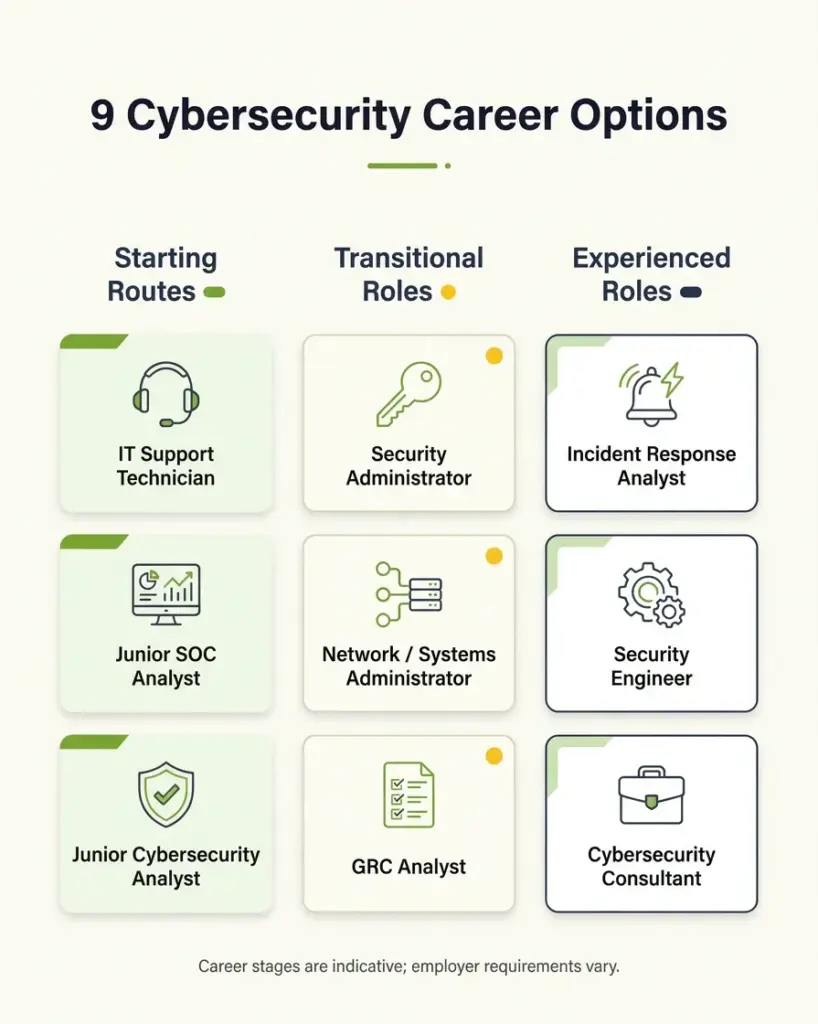
Which Security+ Jobs Are Most Realistic for Beginners?
| Job Role | Typical Career Stage | Additional Skills or Experience |
|---|---|---|
| IT support technician | Beginner | IT troubleshooting and networking |
| Junior SOC analyst | Beginner to early career | SIEM, logs and security monitoring |
| Junior cybersecurity analyst | Early career | Security tools and technical analysis |
| Security administrator | Early to mid-career | Systems administration and IAM |
| Network/systems administrator | Usually requires IT experience | Server and network management |
| GRC analyst | Varies by background | Risk assessment and documentation |
| Incident response analyst | Usually experienced | Security investigations |
| Security engineer | Usually experienced | Infrastructure and security engineering |
| Cybersecurity consultant | Usually experienced | Technical or advisory expertise |
These classifications are general guidance. Individual employers may use different job titles and experience requirements.
The UK government’s Cyber Security Skills in the UK Labour Market 2026 report shows that employers seek a mixture of technical, analytical and governance skills across cybersecurity roles.
How Much Can You Earn With CompTIA Security+ in the UK?
Cybersecurity salaries vary significantly depending on job responsibilities, location and experience.
There is no single official salary for Security+ holders. Earning the certification does not automatically place someone within a particular pay band.
UK Cybersecurity Salary Expectations in 2026
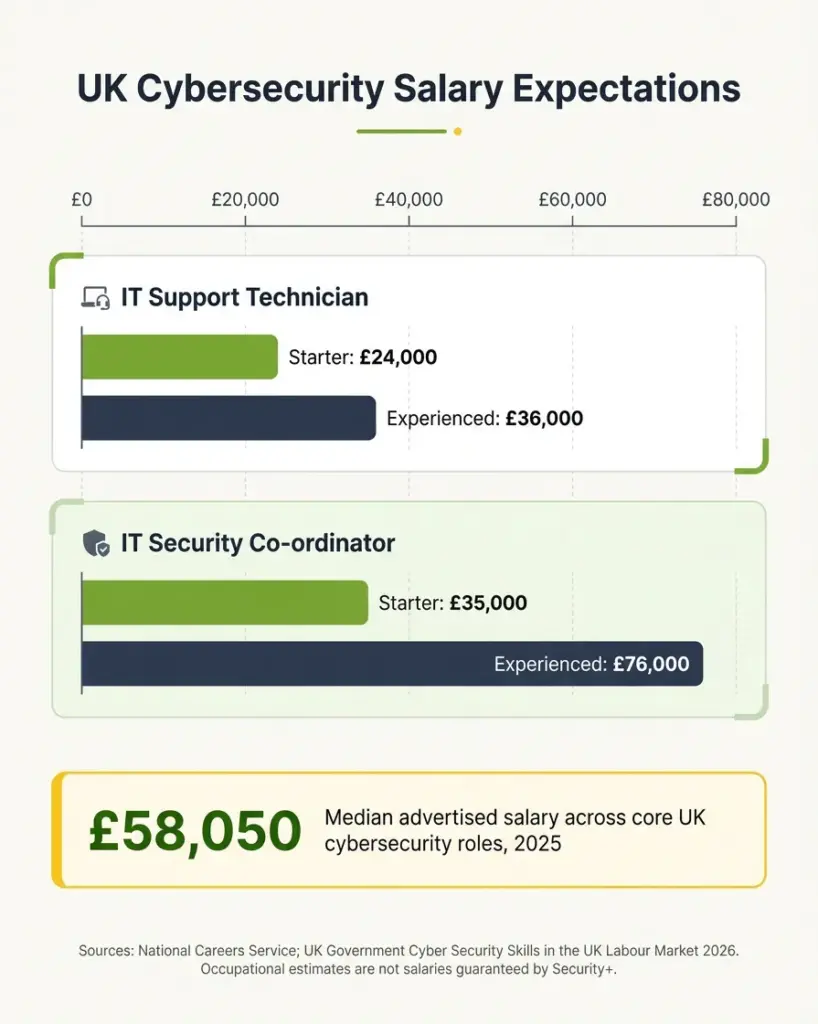
The UK government’s 2026 cybersecurity labour-market report recorded a median advertised salary of £58,050 for core cybersecurity roles in 2025.
However, this figure covers positions at different seniority levels. It should not be interpreted as a starting salary for someone who has recently passed Security+.
For a more practical comparison, the National Careers Service provides the following occupational salary estimates:
| UK Job Profile | Starter Salary | Experienced Salary |
|---|---|---|
| IT support technician | £24,000 | £36,000 |
| IT security co-ordinator | £35,000 | £76,000 |
What Is the Total Cost of CompTIA Security+ Certification?
The figures are from the National Careers Service’s IT support technician and IT security co-ordinator profiles.
These are estimates for occupations, not salaries guaranteed by Security+ certification.
UK Cybersecurity Salary Expectations in 2026
Several factors influence earnings:
- Experience: Candidates with proven professional skills may qualify for more complex responsibilities.
- Specialisation: Cloud security, engineering and incident response can require additional expertise.
- Location: Salaries may differ between London and other UK regions.
- Employer: Financial services, consultancies, public sector organisations and technology companies have different pay structures.
- Responsibilities: Seniority, shift patterns and specialist requirements can affect compensation.
When comparing jobs, look at the duties and essential requirements rather than relying on the advertised salary alone.
Can You Get a Job With Security+ Without Experience?
Yes, it is possible to obtain an entry-level IT or cybersecurity role without previous cybersecurity employment, but Security+ alone may not be enough.
Employers usually want evidence that applicants can apply technical knowledge.
The UK’s 2026 cybersecurity labour-market research found that, among core cyber job postings which specified experience requirements, 64% requested between two and six years of experience.
This indicates why candidates should consider junior roles, transferable skills and practical experience rather than applying indiscriminately to every security vacancy.
Practical Routes Into UK Cybersecurity
There are several ways to begin building a cybersecurity career.
- 1. Start with IT support
Working in technical support can develop knowledge of operating systems, networking, account administration and troubleshooting.
These skills are transferable to several security occupations.
- 2. Explore apprenticeships
UK apprenticeships combine employment with structured training.
For example, the Level 4 Cyber Security Technologist apprenticeship includes pathways relating to security engineering, cyber risk and incident response.
Entry requirements and opportunities depend on the employer and apprenticeship programme.
- 3. Develop relevant experience
Candidates who already work in networking, infrastructure, auditing or administration may be able to move towards security responsibilities within their organisation.
What Skills Do UK Employers Expect Alongside Security+?
Security+ introduces important concepts, but employers also value the ability to use technical tools, investigate problems and communicate findings.
According to the UK government’s 2026 labour-market research, frequently requested skills in core cybersecurity vacancies included auditing, governance, risk management, incident response and Microsoft Azure.
Technical Skills That Strengthen Your Application
Useful areas to develop include:
- Networking: Understanding TCP/IP, DNS, firewalls and network communication.
- Operating systems: Working knowledge of Windows and Linux.
- Security monitoring: Interpreting logs and understanding SIEM platforms.
- Identity management: Managing permissions, authentication and access controls.
- Vulnerability management: Understanding how weaknesses are identified and prioritised.
- Cloud fundamentals: Recognising security responsibilities in cloud environments.
You do not need to master every area before applying for junior positions. Focus on the skills most relevant to the roles you want.
How to Demonstrate Practical Experience

A small portfolio can help demonstrate what you have learnt.
For example, you might document a home-network security review, analyse sample logs or configure a test environment to practise access controls.
Only assess systems you own or have explicit permission to test.
Explain what you did, why it mattered and what you learnt. Employers may find specific examples more useful than a list of tools you have only read about.
For structured preparation, Janets offers a CompTIA Security+ Certification course covering security fundamentals, network protection, access control, risk management and incident response.
The course offers self-paced training and a CPD-accredited Certificate of Achievement following successful completion of its assessment. This is separate from the official CompTIA Security+ certification, which requires passing CompTIA’s own examination.
Training can help develop knowledge, but professional certification and practical experience are separate considerations when applying for jobs.
How to Find CompTIA Security+ Jobs in the UK
Searching only for “CompTIA Security+ jobs” may mean overlooking suitable vacancies.
Employers often advertise positions by job title and mention certifications within the requirements.
Search for the Right Job Titles
Try searching for:
- Junior SOC Analyst
- Junior Cybersecurity Analyst
- IT Security Administrator
- Security Operations Analyst
- Information Security Analyst
- IT Support Technician
Use additional filters such as “graduate”, “junior”, “entry-level” and your preferred location.
The UK government’s 2026 research identified Greater London, Manchester, Birmingham, Bristol and Edinburgh as leading locations for core cybersecurity job postings.
However, opportunities also exist outside these areas.
Check recruitment platforms, employer career pages and apprenticeship vacancies. Consider organisations in financial services, healthcare, technology, government and other sectors where information security is important.
Read Job Requirements Before Applying
Pay attention to the difference between essential and desirable requirements.
An employer might list Security+ as desirable while placing greater importance on troubleshooting experience, knowledge of networking or familiarity with security tools.
Tailor your CV to the responsibilities mentioned in the vacancy. Include relevant projects, technical skills and examples of problem-solving.
Some government and defence positions may require additional checks. The UK Government’s security vetting guidance explains screening and clearance arrangements.
The Baseline Personnel Security Standard (BPSS) is a pre-employment screening standard, not a formal security clearance. More sensitive positions may require national security vetting.
Always check the requirements of the individual vacancy before applying.
Is CompTIA Security+ Worth It for UK Jobs in 2026?
Security+ can be a worthwhile certification for people seeking to demonstrate foundational cybersecurity knowledge.
Its value depends on your career goals, existing skills and the types of jobs you want.
For experienced IT professionals, it may complement knowledge gained through networking, technical support or system administration. Beginners may need additional practical experience before becoming competitive candidates.
CompTIA Security+ Certification Course
Build essential cybersecurity knowledge and prepare for your exam with flexible, self-paced learning that fits around your life.
- Self-paced learning
- Essential cybersecurity concepts
- Exam preparation support
Official CompTIA exam voucher purchased separately.
Frequently Asked Questions
Do UK Employers Recognise CompTIA Security+?
Yes. Some UK employers recognise Security+ as evidence of foundational cybersecurity knowledge and may list it as a required or desirable certification. Its importance depends on the vacancy.
Can You Get a Cybersecurity Job Without a Degree in the UK?
Yes. Some employers accept candidates who demonstrate relevant experience, practical skills or industry certifications. Apprenticeships and progression from IT support can also provide alternative routes.
Can CompTIA Security+ Help You Get a Remote Job?
Security+ may be relevant to remote-capable cybersecurity positions, particularly those involving monitoring or analysis. However, remote working arrangements depend on the employer, role and security requirements.
Get a FREE Course