- Home
- Accounting
- Xero Courses With a Certificate: Which Ones Do Employers Value?
Xero Courses With a Certificate: Which Ones Do Employers Value?

A Xero course with a certificate can be a useful addition to your CV, especially if you want to work in bookkeeping, accounting or finance administration. But here’s something worth knowing before you enrol: not every Xero certificate represents the same training or carries the same recognition.
Some certificates confirm that you have completed a training provider’s course. Others are issued directly by Xero through its official certification programme. Understanding that difference can help you choose training that suits your experience, career plans and budget.
This guide compares Xero courses available through Janets, explains what UK employers may value and shows you what to check before investing in training.
A Xero course with a certificate can demonstrate completed accounting software training, but its value depends on the certificate issuer, course content and assessment. UK employers may also consider practical bookkeeping skills, qualifications and experience. The right course should match your current knowledge, career goals and intended job responsibilities.
What Does a Xero Course Certificate Actually Mean?
A Xero certificate is evidence of a particular learning achievement. However, the type of achievement depends on the programme.
You might receive a certificate for completing an online training course, passing an assessment or meeting the requirements of Xero’s official certification programme.
These credentials are not interchangeable.
Official Xero Certification vs a Course Completion Certificate
The main distinction is between certification issued directly by Xero and certificates provided by independent training organisations.
According to Xero’s official certification programme, learners can complete its certification training free of charge. Xero offers different certification levels and learning methods.
Third-party training providers, including Janets, offer separate courses designed to develop accounting software knowledge. These may lead to provider-issued certificates after successful completion.
| Certificate type | What it demonstrates | Important distinction |
|---|---|---|
| Official Xero certification | Completion of Xero’s own certification requirements | Issued through Xero’s certification programme |
| Third-party Xero course certificate | Completion of training provided by an independent organisation | Not automatically equivalent to official Xero certification |
| CPD-related course certificate | Completion of learning intended to support professional development | Does not automatically represent a regulated qualification |
| Regulated accounting qualification | Achievement of a recognised qualification’s specified requirements | Separate from software-specific course certification |
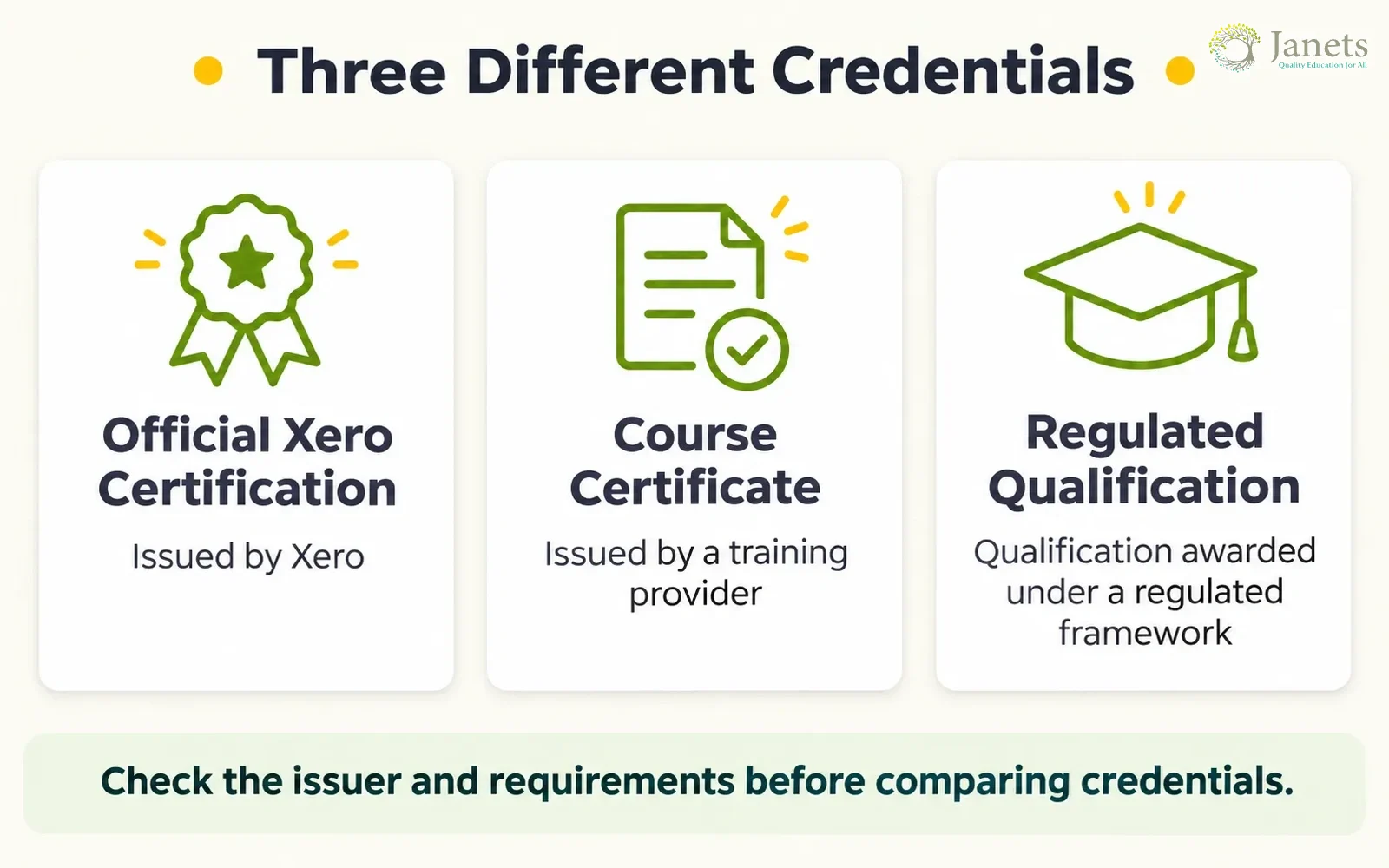
For example, the disclaimer for Janets’ Xero Accounting and Bookkeeping Course calls its standard certificate a CPD QS certificate, while its certification section describes a CPD-accredited certificate of achievement. It also offers an optional Quality Licence Scheme (QLS)-endorsed certificate of achievement. Certificate orders may involve separate charges after completing the assessment.
Its course page explicitly states that the programme is not associated with Xero Limited and does not provide official Xero certification. The QLS-endorsed provision is also non-regulated.
If an accounting qualification is advertised as regulated, you can check its status using the GOV.UK Register of Regulated Qualifications, which covers England and Northern Ireland. Wales and Scotland have separate qualification-regulation arrangements.
The essential point is to check the issuing organisation and the assessment requirements before comparing certificates.
What Do UK Employers Value in a Xero Certificate?
The most important question is not simply whether you have a certificate. It is whether you can demonstrate knowledge relevant to the position you are applying for.
A Xero certificate may support an application, but there is no verified evidence that all UK employers recognise or prefer one particular third-party Xero certificate.
Individual employers decide what training, qualifications and experience they require.
Practical Skills Matter Alongside the Certificate
Imagine two candidates applying for an accounts assistant position.
One has completed a Xero course and lists the certificate on their CV. The other has also completed training but can explain how to record invoices, reconcile bank transactions and investigate discrepancies.
Both may have relevant learning experience. However, the second candidate can provide more detail about how their knowledge relates to everyday accounting responsibilities.
A useful Xero accounting course with certificate should help learners understand tasks such as:
- Creating and managing customer invoices.
- Recording purchases, bills and payments.
- Using the chart of accounts.
- Understanding bank feeds and reconciliation.
- Maintaining accurate customer and supplier records.
- Generating and interpreting basic financial reports.

The ability to explain these processes is valuable when discussing your training during an interview.
However, completing lessons about these activities does not necessarily establish that you can perform them independently in a workplace. Practical competence develops through appropriate exercises, feedback and experience.
Certificate, Experience and Accounting Knowledge: What's the Difference?
These three elements contribute differently to your professional development.
A certificate records a learning achievement and identifies the course or programme completed.
Practical experience demonstrates how you have applied knowledge to real tasks, whether through appropriate workplace responsibilities or supervised activities.
Accounting knowledge provides the broader understanding needed to interpret transactions, maintain records and recognise errors.
For instance, a person may know which buttons to select in Xero without fully understanding why a transaction should be recorded in a particular account.
That is why software familiarity and bookkeeping fundamentals work well together.
The Association of Accounting Technicians (AAT) provides information on accounting and bookkeeping qualifications, which offer broader learning pathways beyond individual software programmes.
When reviewing vacancies, compare the employer’s essential criteria with your actual knowledge rather than assuming a certificate satisfies every requirement.
Compare Janets Xero Courses With Certificates
Janets offers several online courses covering Xero accounting and bookkeeping tasks. Although the course names differ, some learning outcomes and curriculum topics overlap.
The most useful comparison is therefore based on what each course teaches, its certificate arrangements and how closely it matches your needs.
Xero Accounting and Bookkeeping Course
The Xero Accounting and Bookkeeping Course covers a range of common accounting software tasks.
Its curriculum includes initial setup, the chart of accounts, bank accounts, contacts, invoicing, sales and bookkeeping processes. Learners also encounter bank reconciliation and reporting topics.
This makes it worth considering if you want structured exposure to several everyday Xero functions rather than studying one narrow feature.
The course is self-paced, and Janets states that learners must achieve at least 60% in its automated online multiple-choice assessment to pass.
Following successful completion of the assessment, the page refers to a CPD QS certificate in its disclaimer and a CPD-accredited certificate of achievement in its certification section. An optional QLS-endorsed certificate of achievement is also offered. Ordering certificates may involve separate charges.
Neither represents official Xero certification or an Ofqual-regulated qualification.
Who might consider it? Beginners, aspiring bookkeepers, small-business owners and people wanting to develop general Xero accounting software knowledge.
Xero Accounting and Bookkeeping Online
The Xero Accounting and Bookkeeping Online course also covers Xero-related accounting tasks, with learning outcomes that include opening balances, customer invoices, credit notes, customer receipts and wages journal entries.
Month-end reporting is another stated learning outcome.
These topics are particularly relevant if you want to understand how accounting records move through a business’s bookkeeping processes.
The course page describes self-paced online study. Its disclaimer refers to a CPD QS certificate, while the certification section describes a CPD-accredited certificate of achievement following successful assessment. It states that the programme is not associated with Xero Limited and does not provide official Xero certification.
There is substantial curriculum overlap with the previous course, so it would be misleading to describe this option as automatically more advanced or more suitable for beginners.
Instead, compare their individual modules and assessment requirements.
Who might consider it? Learners interested in accounting records, sales-ledger activities and Xero bookkeeping workflows.
Xero Training for Accountants and Bookkeepers
The Xero Training for Accountants and Bookkeepers course covers software setup, entering financial information, working with contacts, recording receipts and supplier transactions.
It also introduces bank connections, petty cash, reconciliation and reporting.
The course page identifies existing accounting professionals, career changers and people seeking to expand their knowledge among its intended learners.
This makes it an option to investigate if you already have some finance experience but want to become more familiar with Xero.
However, the professional-sounding title does not mean the course awards a regulated accounting qualification.
You can order a CPD-accredited certificate after passing the assessment, with an optional QLS-endorsed certificate. These refer to provider-issued training credentials, not official Xero certification; check any certificate-ordering charges separately.
Who might consider it? Existing accounting staff, aspiring bookkeepers and career changers interested in Xero software training.
Comparing the Courses Before You Enrol
The following comparison highlights the documented differences without assuming that one course is universally better.
| Janets course | Main learning emphasis | Certificate information | Potential learner fit |
|---|---|---|---|
| Xero Accounting and Bookkeeping Course | Setup, invoicing, bank accounts, reconciliation and reporting | CPD QS / CPD-accredited certificate wording; optional non-regulated QLS-endorsed certificate | Learners seeking broad introductory and practical coverage |
| Xero Accounting and Bookkeeping Online | Opening balances, invoices, credit notes, receipts and month-end reports | CPD QS / CPD-accredited certificate wording | Learners interested in accounting entries and records |
| Xero Training for Accountants and Bookkeepers | Financial data, contacts, receipts, banking and reports | CPD QS / CPD-accredited certificate wording | Finance learners and professionals developing Xero knowledge |
Course descriptions reflect the published Janets information. Certificate charges, assessment terms and course availability should be checked before purchase.
The three active course pages also contain similar lesson topics. This is a reason to examine the full curricula carefully, not to assume that purchasing several courses will necessarily provide substantially different learning.
Ready to learn Xero step by step?
Study Xero setup, invoicing, bank reconciliation and reporting online, at your own pace.
- Setup, invoicing, bank reconciliation and reporting in one course
- Self-paced online study with lifetime access
- Online assessment and a CPD-accredited certificate option
👥 5,500+ students · 🎓 CPD-accredited certificate · 💻 100% online, lifetime access
Which Xero Course Should You Choose for Your Career Goal?
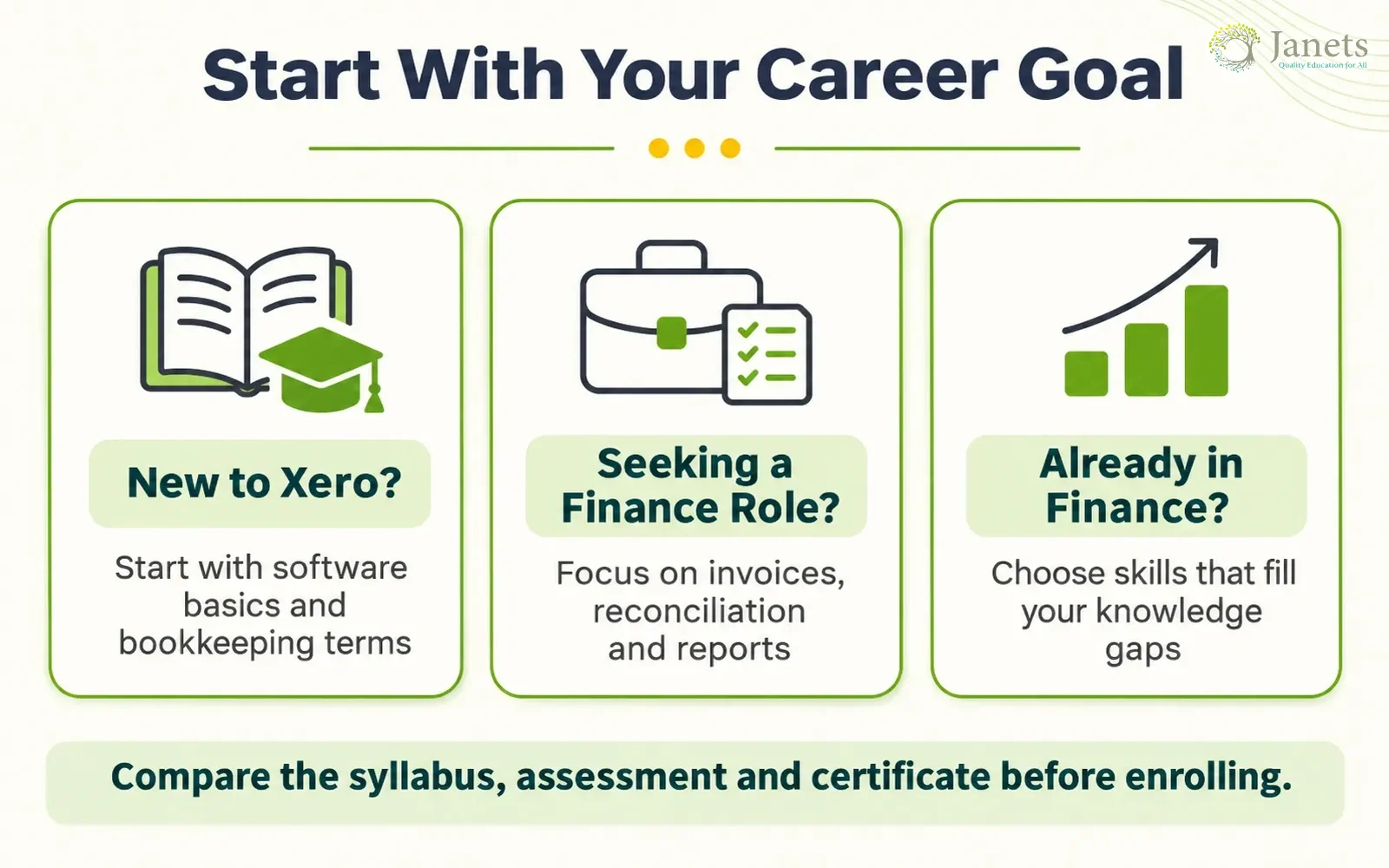
The best course depends on the role you want, your accounting knowledge and the specific skills you need to develop.
A beginner preparing for an entry-level finance role may have different priorities from someone already working in accounts administration.
For Beginners and Career Changers
If you are new to bookkeeping, begin with a course that explains how Xero works before moving into more complicated transactions.
Look for introductory lessons on navigation, company setup, customer records, invoices and bank reconciliation.
You should also be comfortable with basic accounting concepts. For example, understanding the difference between money owed by customers and money owed to suppliers makes the software easier to interpret.
A beginner-friendly Xero course should not simply show where features are located. It should help explain the purpose of the activities being demonstrated.
Before enrolling, check whether the course assumes prior bookkeeping experience.
You may benefit from practising basic terminology alongside your Xero lessons.
For Aspiring Bookkeepers and Accounts Assistants
If you want to work in bookkeeping or accounts administration, compare courses against the responsibilities described in relevant vacancies.
Common areas worth developing include sales and purchase records, bank reconciliation, invoice processing and reporting.
You may also encounter employers using other accounting software, so understanding the principles behind transactions matters alongside familiarity with Xero.
For example, being able to explain why an unreconciled transaction requires investigation demonstrates more understanding than memorising the steps needed to open the reconciliation screen.
A Xero bookkeeping course with certificate may support your preparation, but it cannot replace any additional qualifications or experience specified by an employer.
For Existing Finance Professionals and Small-Business Owners
If you already understand accounting processes, identify the Xero features you are least familiar with.
You might want to strengthen your knowledge of reporting, account setup, transaction handling or reconciliations.
For small-business owners, the priority may be managing invoices and understanding financial records. For finance employees, it could be using Xero within an established workplace process.
These are related but different learning goals.
Avoid selecting a course purely because its name includes advanced or professional. Review the modules to see whether they add skills you genuinely need.
If you are weighing several training options, compare their learning outcomes against your current skills and intended responsibilities.
Seven Things to Check Before Paying for a Xero Course
A course can look attractive until you discover that its certificate, assessment or learning format does not meet your expectations.
Use this checklist before enrolling.
Check the Certificate and Assessment Requirements
1. Who issues the certificate?
Check whether the certificate comes from Xero itself, the training provider or another organisation. The issuer determines what achievement you can accurately claim.
2. Is the certificate included in the course fee?
A course may have separate charges for PDF certificates, printed copies or optional endorsements. Check the total cost before paying.
3. What must you complete to receive it?
Some courses require a final assessment, while others may use different completion conditions. Find out whether there is a pass mark, assessment fee or opportunity to repeat an assessment.
4. Does the course provide opportunities to practise?
Look for exercises, demonstrations, case studies or access to suitable practice environments. Watching a software demonstration and independently completing a task are different learning experiences.
Check the Course Content, Access and Support
5. Does the syllabus cover the skills you need?
Choose learning outcomes that match your intended responsibilities. If bank reconciliation is important to your role, make sure it is actually included.
6. How long can you access the learning materials?
Confirm the access period, whether lessons are self-paced and what happens if you need longer to finish.
7. What support is available?
Check whether you can ask questions, receive feedback or get assistance with technical problems.
These considerations are especially important when comparing Xero courses online with certificates. Similar-sounding courses can offer different learning experiences.
How Much Does a Xero Course With a Certificate Cost?
The advertised course price is only one part of the cost.
You should also consider certificate charges, assessment requirements, access conditions and any optional extras.
Course Fees vs Certificate Fees
Janets’ published certificate information illustrates why checking the full price matters.
For its Xero Accounting and Bookkeeping Course, the page currently lists:
| Certificate option | Published charge |
|---|---|
| PDF CPD-accredited certificate | £9.99 |
| Printed CPD-accredited certificate | £15.99 |
| Optional QLS-endorsed certificate | £119 |
These are optional certificate-ordering charges, not the complete tuition price or a fee for passing the course. The QLS-endorsed option is subject to its stated requirements, and additional overseas postage charges may apply.
Prices can change, so confirm the amount displayed when you enrol and again when ordering a certificate.
Also check what is included in the course purchase. Access to a learning platform, software demonstrations and downloadable materials should not be assumed to be identical across providers.
Is Free Xero Certification Better Than a Paid Course?
Official Xero certification is free, as explained on Xero’s certification page.
That does not automatically make every paid third-party training course unnecessary.
The two options can serve different purposes.
Official certification focuses on completing Xero’s own programme. A separate training course may offer additional lessons, a particular curriculum structure or another form of completion evidence.
The decision comes down to what you need.
If your goal is specifically to obtain an official Xero credential, investigate Xero’s free programme first.
If you want structured bookkeeping lessons or additional introductory explanations, compare the curriculum of a third-party course before paying.
You should not purchase a course under the assumption that its certificate is official Xero certification unless the provider explicitly confirms that outcome.
How to Show Your Xero Training on a UK CV
Completing training is useful, but presenting it accurately matters just as much.
A certificate should help an employer understand what you studied, not create confusion about qualifications you hold.

Describe the Certificate Accurately
Include the course name, provider and completion date in a relevant training or professional-development section.
For example:
Xero Accounting and Bookkeeping Course — Janets
Completed training covering Xero invoicing, bank reconciliation and financial reporting. Provider-issued course certificate.
This is an illustrative entry. Only use it if you completed the course, obtained the certificate and studied the stated topics.
Only call yourself Xero certified if you have passed Xero’s own free certification (Level 1 or above).
Similarly, do not present a CPD course completion certificate or non-regulated QLS-endorsed training as an Ofqual-regulated accounting qualification.
Give Employers Evidence of Practical Skills
Your CV can also explain the knowledge you developed.
For example, instead of writing only Xero trained, you could identify relevant areas such as invoice processing, account reconciliation or financial reporting.
During an interview, prepare to explain a suitable example from your training.
You might describe how a bank transaction should be matched against an existing accounting record or how an unpaid customer invoice appears in the system.
Be clear whether the example comes from training, simulated practice or actual employment.
That distinction builds a more credible picture of your experience.
Choose a Xero Course That Fits Your Next Step
A certificate is worth considering, but the learning behind it matters more than an impressive title.
Choose training that matches your experience, develops relevant bookkeeping skills and clearly explains its certification arrangements.
If you want structured introductory and practical software training, explore Janets’ Xero Accounting and Bookkeeping Course and review its syllabus, assessment and certificate options before enrolling.
Start your Xero bookkeeping training today
Review the syllabus, then build practical Xero bookkeeping knowledge from home.
- Structured lessons from setup to month-end reporting
- Learn online, any time, on any device
- Certificate options explained before you order
👥 5,500+ students · 🎓 CPD-accredited certificate · 💻 100% online, lifetime access
Frequently Asked Questions
Which Xero Course With a Certificate Is Best for Beginners?
Choose a course that introduces software navigation, invoices, bank accounts and basic bookkeeping processes. Compare its entry requirements, learning outcomes and certificate conditions before enrolling.
Do UK Employers Recognise Xero Course Certificates?
Recognition depends on the employer and the certificate. A course certificate may demonstrate relevant learning, but employers can also assess practical skills, accounting knowledge, qualifications and work experience.
Can I Get a Xero Certificate Entirely Online?
Yes. Xero offers online certification, while Janets provides online training with certificate options following successful completion. Check the requirements and issuer of the specific certificate you want.
Is a Xero Course Certificate the Same as an Accounting Qualification?
No. A Xero software training certificate does not automatically represent a regulated accounting qualification. Check the awarding organisation, assessment requirements and regulated status of any qualification you intend to pursue.
How Long Does It Take to Complete a Xero Course?
It depends on the course content, advertised study hours and your previous experience. Self-paced learning offers flexibility, but developing confidence may require additional practice.
Check the study hours and access period shown on the individual course page.
Can I Put My Xero Certificate on My CV?
Yes. State the correct course title, provider and certificate obtained. You can also mention relevant skills gained through training, provided you do not exaggerate your experience or certification status.
Get a FREE Course