


Course Library View the full range of courses
-
Accounting (145 courses)
- Xero Accounting and Bookkeeping Online
- Sage 50 Accounting & Payroll
- Project Finance
- Financial Modelling Training
- Tax Accounting
- Introduction to VAT
- Accounting and Finance Course for Managers
- Internal Compliance Auditor
- Financial Statement Analysis
- Payroll Administrator Level 3 Diploma
- View all Accounting courses
-
Language (67 courses)
- British Sign Language (BSL) Level 1 & 2
- Speech and Language Therapy Diploma
- TEFL (TESOL) Course
- English Spelling, Punctuation, and Grammar
- Child & Adult Speech & Language Disorders Training
- Teaching English as Foreign Language (TEFL) Certificate
- Mastering Spanish Language
- French Course for Beginners
- German Course for Beginners
- Body Language and Gesture Training
- View all Language courses
-
Teaching & Education (37 courses)
- Teaching Assistant Complete Course (TA, SEN, Autism, ADHD & Dyslexia) – CPD Certified
- EYFS Teaching Assistant Training Course
- Advanced Diploma in Coaching and Mentoring
- Level 3 Diploma in Teaching and Classroom Management
- Remote Teaching
- SENCO – Special Educational Needs Coordination
- Teaching English as Foreign Language (TEFL)
- Life Coaching
- Phonics Teaching Diploma
- View all Teaching & Education courses
-
Health and Social Care (138 courses)
- Health and Social Care Management
- Paediatric Nursing Assistant
- Mental Health Awareness Training
- Emergency Medicine – Paramedicine
- Level 3 Diploma in Adult Care
- Paediatric First Aid Training
- Safeguarding Children Level 3
- Level 3 Diploma in Anatomy and Physiology of Human Body
- Play Therapy
- The Care Certificate Preparation – Standards (1 to 15)
- View all Health and Social Care courses
-
Management (539 courses)
- Office Admin, Secretarial and PA Diploma
- Estate Agent and Property Management Training
- Diploma in Data Analysis Fundamentals
- Advanced Diploma in Stress & Anxiety Management
- Good Manufacturing Practice (GMP)
- Property Development and Management Course
- Diploma in Hotel Management
- Supply Chain Management
- Quality Assurance (QA) Manager
- Compliance and Risk Management
- View all Management courses
-
IT & Software (127 courses)
- Coding with Python 3
- Search Engine Optimisation (SEO) Training
- Cyber Security
- Motion Graphics with After Effects
- CompTIA A+ Core 1 (220-1101) Course
- Machine Learning for Aspiring Data Scientists
- Next.js Web Dev: Master this Powerful React Framework
- Learn 2D Animation with Adobe Animate
- GDPR Challenges in Education
- View all IT & Software courses
-
Employability (1043 courses)
- Office Administrator Skills
- Presentation Skills
- Legal Secretary and Office Skills
- Hospitality Management
- Estate Agent Diploma
- Hairdressing and Barbering
- Diploma in UK Employment Law
- Diploma in Data Analysis Fundamentals
- Building Surveyor Training
- Emotional Intelligence Training
- View all Employability courses
-
Personal Development (1439 courses)
- Productivity Habits
- Minute Taking Course
- Presentation Skills
- Excel: Top 50 Microsoft Excel Formulas in 50 Minutes!
- Critical Thinking and Problem Solving Skills
- Time Management
- Self Esteem and Confidence Building Course
- Essential IT Skills
- Legal Secretary and Office Skills
- Personality Development
- View all Personal Development courses


Mental Health and Psychiatric Disorders
114 Students (7 Reviews)
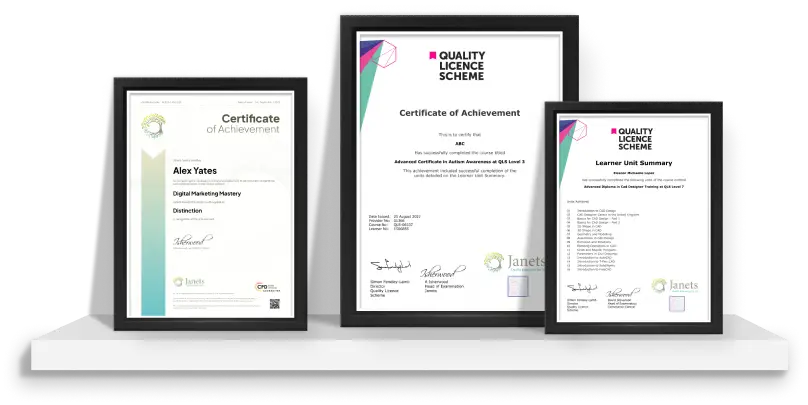
Uncover the complexities of mental health! The QLS endorsed Level 5 Diploma in Mental Health and Psychiatric Disorders equips you with knowledge of various conditions, communication skills, and an understanding of support systems. Launch a career in mental health support or pursue further studies in psychology or social work.

Course Curriculum
| Module 1: Introduction to Mental Health | |||
| Introduction to Mental Health | 00:19:00 | ||
| Module 2: Childhood And Adolescent Psychiatric Disorders | |||
| Childhood And Adolescent Psychiatric Disorders | 00:24:00 | ||
| Module 3: Stress and Anxiety Disorders | |||
| Stress and Anxiety Disorders | 00:31:00 | ||
| Module 4: Schizophrenia | |||
| Schizophrenia | 00:25:00 | ||
| Module 5: Personality Disorders | |||
| Personality Disorders | 00:41:00 | ||
| Module 6: Mood Disorders | |||
| Mood Disorders | 00:21:00 | ||
| Module 7: Eating and Sleeping Disorders | |||
| Eating and Sleeping Disorders | 00:43:00 | ||
| Module 8: Self-Harm and Suicide | |||
| Self-Harm and Suicide | 00:19:00 | ||
| Module 9: Medication and Therapy in the Treatment of Mental Illness | |||
| Medication and Therapy in the Treatment of Mental Illness | 00:31:00 | ||
| Module 10: Social Attitudes To Mental Illness | |||
| Social Attitudes To Mental Illness | 00:12:00 | ||
| Module 11: Mental Health Legislation and Services | |||
| Mental Health Legislation and Services | 00:28:00 | ||
| Module 12: Mental Health In The Workplace | |||
| Mental Health In The Workplace | 00:22:00 | ||
| Mock Exam | |||
| Mock Exam – Mental Health and Psychiatric Disorders | 00:20:00 | ||
| Final Exam | |||
| Final Exam – Mental Health and Psychiatric Disorders | 00:20:00 | ||
| Assignment | |||
| Assignment – Mental Health and Psychiatric Disorders | 2 weeks, 1 day | ||
| Order Your Certificate | |||
| Order your Certificate QLS | 00:00:00 | ||

Original price was: £319.£25Current price is: £25. ex Vat
SAVE 92% - OFFER ENDS IN

 14-Day Money-Back Guarantee
- Personal
- Team
Quantity:
Total:
50% discount for orders of 10+ courses
60% discount for orders of 50+ courses
70% discount for orders of 100+ courses
For more personalised package, contact us

Frequently asked questions
Can’t find the anwser you’re looking for ? Reach out to customer support team.
Mental disorders and psychiatric disorders are terms often used interchangeably. Both refer to a wide range of conditions affecting mental health, mood, thinking, and behavior. However, "psychiatric disorder" typically implies a diagnosis and treatment by a psychiatrist, emphasizing a medical approach.
Mental Health: Refers to a state of well-being where individuals realize their abilities, can cope with normal stresses, work productively, and contribute to their community. Mental Health Problems: General term encompassing various issues affecting mental well-being, including temporary reactions to stress or life events. Mental Illness: Refers to diagnosable conditions that significantly affect a person's thinking, feeling, mood, ability to relate to others, and daily functioning, such as depression, anxiety disorders, and schizophrenia.
Mental Health: Focuses on the emotional, psychological, and social well-being of individuals, impacting how they think, feel, and act. Psychiatry: A branch of medicine specializing in diagnosing, treating, and preventing mental illnesses. Psychiatrists are medical doctors who can prescribe medication and offer various forms of therapy.
The term used depends on the context: Mental Health: Refers to overall well-being and the absence of significant mental problems. Mental Disorder: Refers to diagnosable conditions affecting mental health.
Use Mental Health when referring to general well-being and emotional, psychological, and social aspects. Use Mental Illness when referring to specific diagnosable conditions like depression, anxiety, and bipolar disorder.
ADHD (Attention Deficit Hyperactivity Disorder) is classified as a neurodevelopmental disorder. It affects attention, impulse control, and hyperactivity and is often considered a mental disorder.
Autism Spectrum Disorder (ASD) is a developmental disorder affecting communication, behavior, and social interaction. It is not typically classified as a mental health disorder but as a neurodevelopmental disorder.
Psych: Informal term often used to refer to psychiatry or psychological aspects. Mental: Refers broadly to the mind and its functions, including thoughts, emotions, and behaviors.
Mental health refers to a state of well-being where individuals can cope with normal stresses, work productively, realize their abilities, and contribute to their community. It encompasses emotional, psychological, and social well-being.
Yes, PTSD (Post-Traumatic Stress Disorder) is classified as a mental illness. It is a condition triggered by experiencing or witnessing a traumatic event, leading to symptoms like flashbacks, severe anxiety, and uncontrollable thoughts about the event.
Yes, anxiety disorders are classified as mental illnesses. They include conditions like generalized anxiety disorder, panic disorder, social anxiety disorder, and specific phobias, characterized by excessive fear or worry.
Determining whether you have a mental illness or are experiencing a temporary reaction to stress can be challenging. Persistent, severe symptoms that interfere with daily life may indicate a mental illness. Consulting a mental health professional is crucial for an accurate diagnosis and appropriate support.
Narcissistic Personality Disorder (NPD) is classified as a mental illness. It involves a pattern of grandiosity, a need for admiration, and a lack of empathy.
Yes, Bipolar Disorder is classified as a mental illness. It involves extreme mood swings, including emotional highs (mania or hypomania) and lows (depression).
A psychiatric disorder is a mental health condition diagnosed by a psychiatrist that significantly affects a person's thinking, feeling, mood, or behavior. Examples include: Depression Anxiety disorders Schizophrenia Bipolar disorder PTSD Obsessive-Compulsive Disorder (OCD)