- Home
- Career Guide
- How to Become a Teaching Assistant with No Experience
How to Become a Teaching Assistant with No Experience

You don’t need years of classroom experience to start a career as a teaching assistant. Some UK schools consider beginners who have the right skills, attitude and qualifications for their vacancies.
If you’re wondering how to become a teaching assistant with no experience, there are several possible routes. Volunteering, apprenticeships, transferable skills and suitable entry-level vacancies can all help you get started.
Relevant training can also build your confidence before applying. For example, Janets’ Teaching Assistant Complete Course (TA, SEN, Autism, ADHD & Dyslexia) – CPD Certified covers classroom support, special educational needs (SEN), autism, ADHD and dyslexia.
However, completing an online course does not guarantee employment or replace any qualifications required by a school.
The important first step is understanding what employers expect and how to demonstrate your suitability without previous school employment.
Become a Confident Teaching Assistant
Build your knowledge of classroom support, SEN, Autism, ADHD and Dyslexia through flexible online learning.
Can You Become a Teaching Assistant With No Experience?
Yes, you can become a teaching assistant without previous school experience. Some employers consider applicants from different professional and personal backgrounds, provided they meet the vacancy’s requirements.
Teaching assistants support teachers with classroom activities, help pupils understand tasks and contribute to a positive learning environment. They may also provide additional support to individual pupils or small groups.
Figuring out how to become a teaching assistant with no experience starts with recognising that schools consider more than previous job titles.
For example, experience in retail, childcare, hospitality or care work may demonstrate patience, communication and organisational skills.
However, entry requirements vary. Some schools welcome beginners, while others require relevant qualifications or experience supporting children.
Your suitability ultimately depends on the individual position.
What Do Schools Expect From Teaching Assistant Applicants?
Schools generally look for people who communicate clearly, work well with children and can follow instructions from teachers.
According to the National Careers Service teaching assistant profile, schools set their own entry requirements. Applicants will usually need GCSEs in English and maths at grades 9–4 (A*–C), or equivalent qualifications.
Some employers may also prefer a Level 2 or Level 3 qualification in supporting teaching and learning.
When reading job advertisements, pay attention to two terms:
• Essential requirements: Qualifications, skills or experience applicants must demonstrate.
• Desirable requirements: Additional qualities the employer would prefer but may not make compulsory.
For instance, a vacancy might require good English and maths skills while listing previous classroom experience as desirable.
If you meet the essential criteria, lacking a desirable qualification or experience does not necessarily prevent you from applying.
For more detail, see Do You Need Qualifications to Be a Teaching Assistant?
How to Become a Teaching Assistant With No Experience: Five Practical Routes
There is no single route into teaching assistant work. Your existing skills, qualifications and available opportunities will influence the most suitable approach.
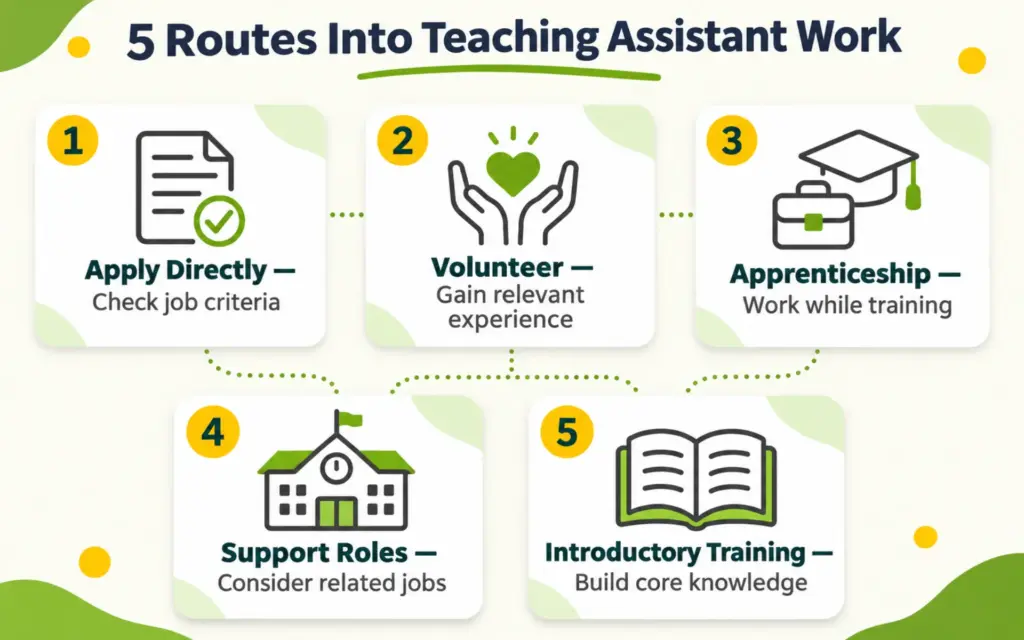
For anyone researching how to become a teaching assistant with no experience, these five options offer practical starting points.
1. Apply Directly for Suitable Teaching Assistant Roles
You may not need to complete a course or placement before submitting your first application.
Some schools recruit applicants who demonstrate suitable communication skills, reliability and an interest in supporting children’s education.
Start by checking vacancies at local schools, academy trusts and education recruitment agencies.
Read each person specification carefully. If previous school experience is desirable rather than essential, consider applying when you meet the remaining requirements.
Be specific about your transferable skills. Simply stating that you enjoy working with children is less persuasive than describing a situation where you supported someone, explained instructions or handled a difficult conversation.
2. Gain Experience Through Volunteering
Volunteering can provide useful experience when you have never worked in a classroom.
Contact local schools or community organisations to ask whether they offer appropriate volunteering opportunities.
Depending on the organisation, opportunities may include:
• Supporting organised reading activities.
• Helping with supervised children’s activities.
• Assisting with community youth programmes.
• Supporting educational or extracurricular events.
Volunteering can help you become familiar with routines, professional boundaries and communicating with children.
However, schools are not obliged to offer placements. Any opportunity must also follow the organisation’s safeguarding procedures and relevant checks.
Keep a simple record of what you actually did. Specific examples can strengthen future job applications.
3. Consider a Teaching Assistant Apprenticeship
An apprenticeship combines paid employment with structured training.
In England, the Level 3 Teaching Assistant apprenticeship standard is approved for delivery. Its published typical training duration is 18 months, followed by an assessment period.
Apprentices work towards occupational knowledge and skills while gaining relevant workplace experience.
This route may suit someone who wants structured preparation alongside employment.
However, apprenticeships have their own entry requirements, and vacancies are not automatically available to everyone. Check individual employers’ criteria before applying.
4. Consider Related School Support Opportunities
Your first position does not necessarily need to have the exact title teaching assistant.
Related vacancies may include:
• Classroom assistant.
• Learning support assistant.
• School support worker.
• Pupil support assistant.
• Entry-level educational support roles.
Some positions involve helping with classroom routines, supporting pupils or assisting teachers with learning activities.
Others, particularly specialist SEND positions, may require additional qualifications or experience.
Do not assume that a role is suitable for beginners simply because its title includes the word assistant.
For a broader overview of training routes and progression, see how to become a teaching assistant in the UK.
5. Build Foundational Knowledge Through Relevant Training
Introductory teaching assistant training can help you understand classroom responsibilities before applying for jobs.
Useful topics include child development, classroom communication, supporting learning activities, behaviour awareness and special educational needs.
Janets’ Teaching Assistant Complete Course covers these areas alongside autism, ADHD and dyslexia.
The course includes online assessments, with CPD-accredited and Quality Licence Scheme (QLS)-endorsed certificate options described on the course page. Certificate arrangements and fees should be checked before enrolling.
CPD training and QLS course endorsement are not automatically equivalent to a regulated teaching assistant qualification.
For beginners, introductory training can supplement other preparation, but employers decide which qualifications and experience they accept.
What Skills Can Help You Become a Teaching Assistant Without Experience?
You may already have skills that are useful in a classroom, even if your previous responsibilities were unrelated to education.
An important part of becoming a teaching assistant with no experience is recognising these transferable skills and explaining them convincingly.
Teaching assistants commonly need:
Communication: Explaining information clearly and listening carefully.
Patience: Supporting people who need additional time or reassurance.
Organisation: Managing tasks and following established routines.
Teamwork: Working cooperatively with teachers and other staff.
Adaptability: Responding appropriately when situations change.
Basic literacy and numeracy: Supporting everyday classroom activities.
Consider how previous responsibilities might demonstrate these qualities.
| Previous Experience | Transferable Skill | Classroom Relevance |
|---|---|---|
| Retail | Communication | Explaining instructions clearly |
| Hospitality | Teamwork | Cooperating during busy activities |
| Caregiving | Patience | Responding sensitively to individual needs |
| Office administration | Organisation | Following procedures and managing information |
| Youth volunteering | Group support | Helping with structured activities |
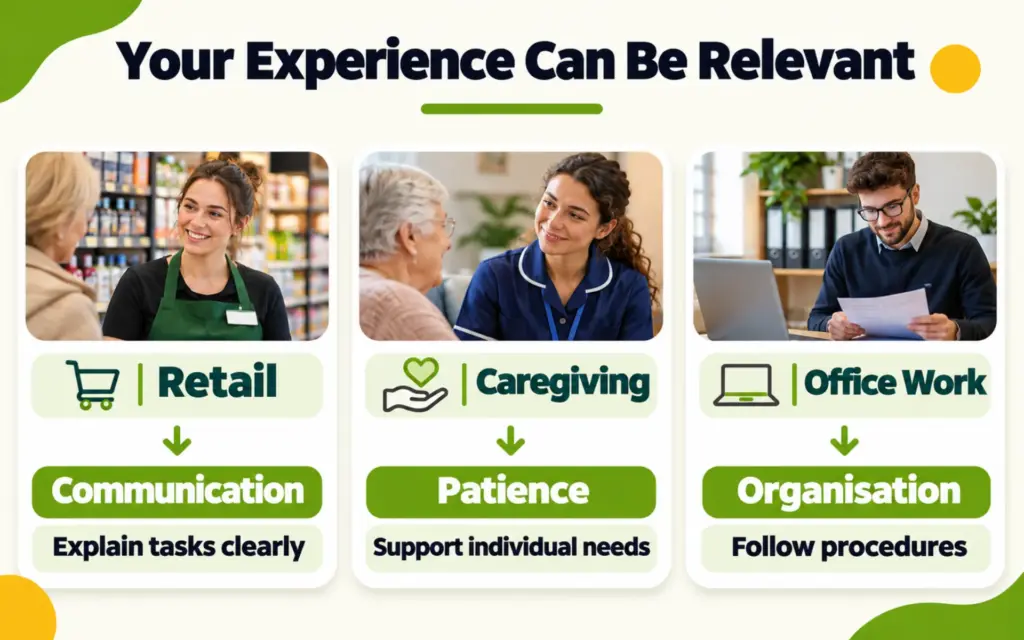
For example, someone who trained new colleagues in a restaurant may have experience explaining tasks, checking understanding and remaining patient.
These skills do not replace formal requirements, but they provide useful evidence of potential suitability.
How to Write a Teaching Assistant CV With No Experience

A strong CV can help turn your interest in how to become a teaching assistant with no experience into a credible job application.
You do not need to invent classroom experience. Instead, demonstrate how your existing responsibilities relate to the position.
What to Include in Your First Teaching Assistant CV
Keep the information clear and relevant.
Your CV should generally include:
1. Personal profile: A short introduction explaining your interest in the position.
2. Relevant skills: Communication, organisation, teamwork and other qualities supported by examples.
3. Employment experience: Responsibilities from previous jobs that could transfer to school work.
4. Education and training: GCSEs, equivalent qualifications and relevant completed courses.
5. Volunteering: Any genuine experience supporting children or community activities.
Avoid describing yourself as an experienced teaching assistant if you have never held the position.
Instead, show what you can contribute.
How to Write a Supporting Statement Without School Experience
Schools may ask applicants to demonstrate how they meet the person specification.
A good supporting statement connects your previous experience with the responsibilities of the advertised role.
For example:
Generic statement:
“I am hardworking, patient and enjoy helping children.”
Stronger statement:
“In my previous customer service role, I regularly explained unfamiliar processes to customers and adjusted my communication when they needed additional support. I would bring the same patience and clear communication to a classroom support role.”
The second example provides evidence rather than simply listing qualities.
Use only experiences that genuinely apply to you.
If you’re invited to an interview, prepare further examples of teamwork, problem-solving and communication. Janets’ guide to teaching assistant interview questions can support that preparation.
Where Can You Find Teaching Assistant Jobs With No Experience?
Once you understand how to become a teaching assistant with no experience, the next challenge is finding vacancies that match your current skills.
A useful starting point in England is the government’s Teaching Vacancies service, which includes teaching assistant and other school support positions.
You can also check local authority recruitment websites, academy trust career pages and established education recruitment agencies.
Find Vacancies That Match Your Experience
Search using several relevant job titles rather than relying on one phrase.
Useful search terms include teaching assistant jobs, classroom assistant and learning support assistant.
Review the actual job description before applying.
A position advertised as entry-level may still require certain qualifications or experience.
Check the Vacancy Before Applying
Before submitting your application, check:
• Whether previous classroom experience is essential.
• Which qualifications are required.
• Whether the position is full-time, part-time or term-time only.
• What references and employment checks are required.
• Whether the school requests a CV, application form or supporting statement.
A carefully targeted application is generally more useful than sending identical information to every employer.
What Safeguarding Checks and UK Rules Should Beginners Know?

Working in a school involves responsibilities beyond helping pupils with classroom tasks.
Safeguarding is an essential part of protecting children and ensuring that concerns are handled appropriately.
Safeguarding and DBS Checks in England
Schools must follow relevant safer recruitment and safeguarding requirements.
The Department for Education’s Keeping Children Safe in Education 2026 guidance has applied in England since 1 September 2026.
School staff must read Part One of the guidance and follow their school’s safeguarding policies and procedures.
Teaching assistant roles will commonly be eligible for an enhanced Disclosure and Barring Service (DBS) check. Whether a Children’s Barred List check is required depends on the legal criteria for the role.
An important change took effect in September 2026.
The previous supervision exemption for regulated activity with children was removed. This means that some volunteers who are supervised but regularly teach, care for or supervise children now fall within regulated activity and require appropriate checks.
The government’s guidance on regulated activity with children explains the change.
If you’re arranging school volunteering, ask the organisation about its procedures before starting.
Do Requirements Differ Across the UK?
Yes. Although teaching assistant responsibilities can be similar, registration and safeguarding arrangements differ.
Wales: Relevant school learning support workers must register with the Education Workforce Council.
Scotland: Membership of the Protecting Vulnerable Groups (PVG) scheme is required for regulated roles, which can include classroom assistants. The Scottish Government provides regulated roles guidance.
Northern Ireland: Eligible roles involving work with children may require enhanced AccessNI checks.
Always confirm the arrangements relevant to the school and nation where you intend to work.
Become a Confident Teaching Assistant
Build your knowledge of classroom support, SEN, Autism, ADHD and Dyslexia through flexible online learning.
How Much Does a Teaching Assistant Get Paid in the UK?
The National Careers Service lists indicative annual teaching assistant salaries of approximately £19,000 for starters and £26,000 for experienced workers.
Actual earnings depend on the employer, location, working hours and contract.
Many teaching assistants work term-time only, so advertised full-time-equivalent salaries can be higher than the amount actually paid.
For a detailed breakdown, see teaching assistant salary UK.
Final Thoughts
Understanding how to become a teaching assistant with no experience is largely about identifying realistic opportunities and presenting the skills you already have.
Start by checking entry requirements, reviewing suitable vacancies and considering whether volunteering or additional training would help you prepare.
If you want to strengthen your understanding of classroom responsibilities and inclusive support, Janets’ Teaching Assistant Complete Course (TA, SEN, Autism, ADHD & Dyslexia) – CPD Certified offers relevant introductory training.
Previous school employment is not always essential. What matters is finding opportunities that match your qualifications, demonstrating your suitability and taking practical steps towards your first role.
Frequently Asked Questions
How Hard Is It to Become a Teaching Assistant?
It depends on the vacancy, your qualifications and the competition for positions. Previous classroom experience can help, but some employers consider beginners with suitable transferable skills. Building relevant experience and preparing a clear application can improve your readiness.
Can I Become a Teaching Assistant Without a Degree?
Yes. A university degree is not a universal requirement for general teaching assistant roles. Schools may instead specify GCSEs, relevant training or particular skills. Always check the individual job description before applying.
Does Parenting or Caring Experience Count When Applying?
Parenting or caring responsibilities can help demonstrate patience, communication and organisation. However, these experiences are not automatically equivalent to professional classroom experience or formal qualifications. Use specific examples to show how your skills relate to the position.
Can an Online Teaching Assistant Course Guarantee a Job?
No. Online training can help build relevant knowledge, but it does not guarantee employment. Schools assess applicants against their own requirements, including qualifications, experience, suitability and recruitment checks.
How Long Does It Take to Get Your First Teaching Assistant Job?
There is no fixed timeline. Some applicants may secure a suitable position relatively quickly, while others need additional preparation or experience. The availability of vacancies, application process and required checks can all affect the time involved.
Get a FREE Course