- Home
- Career Guide
- 50 Basic BSL Signs Every Beginner Should Learn First
50 Basic BSL Signs Every Beginner Should Learn First

Want to learn British Sign Language but aren’t sure where to begin? Start with everyday signs you can use for greetings, introductions, questions and simple conversations.
If you’d like structured learning alongside your practice, explore Janets’ British Sign Language (BSL) Level 1 & 2 course. It introduces essential BSL skills, including fingerspelling, everyday vocabulary and basic communication.
These 50 basic BSL signs give beginners a practical starting point. You’ll discover useful vocabulary, when to use it and how to practise at home.
If you’re completely new, our guide on how to learn British Sign Language explains the wider learning process.
Before You Start: How BSL Signs Work
British Sign Language (BSL) is a visual language with its own grammar and sentence structure. According to RNID’s explanation of British Sign Language, communication involves handshapes, movements, lip patterns and facial expressions.
Unlike English, BSL doesn’t simply follow spoken word order. A sign’s meaning can also depend on its context.
Before practising the vocabulary below, remember:
Watch accurate demonstrations rather than relying on written descriptions.
Pay attention to hand movements and facial expressions.
Learn to recognise signs as well as produce them.
You can find recorded demonstrations in UCL’s BSL SignBank dictionary. Search for each English word and watch the relevant sign carefully.
50 Basic BSL Signs for Beginners
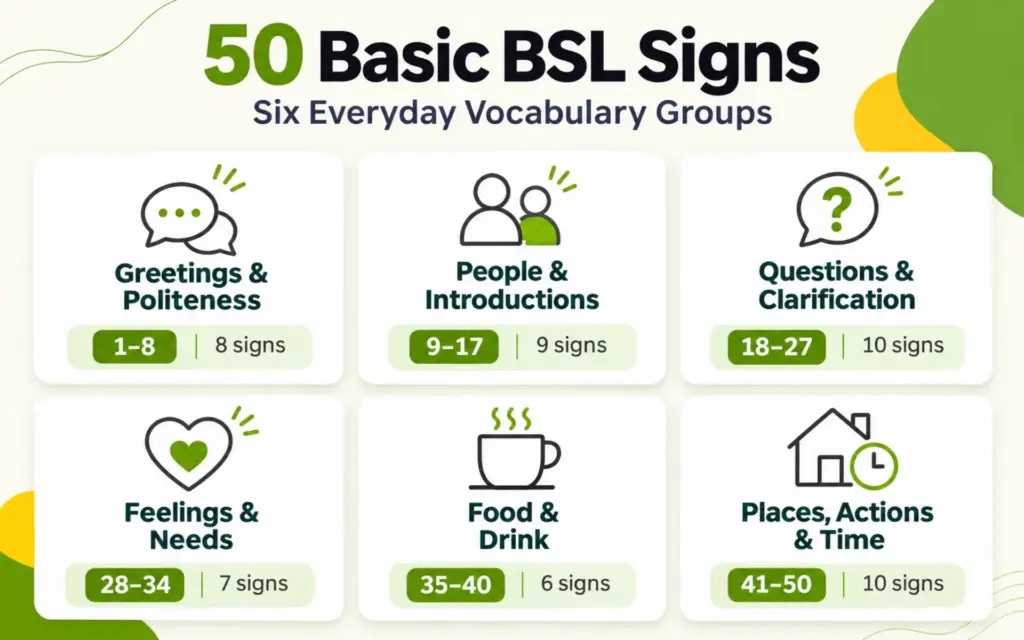
These 50 beginner BSL vocabulary items cover common situations you may encounter at home, at work or in everyday conversations.
The English words below are learning prompts, not instructions for making the signs. Use verified BSL videos to learn their correct movements and meanings.
1–8. Greetings and Polite Expressions
Greetings are among the most useful BSL signs for beginners. Start with these eight everyday expressions.
Hello: Greet someone when you first meet.
Goodbye: End a conversation or say farewell.
Thank you: Show appreciation when someone helps you.
Please: Make a polite request.
Sorry: Apologise when appropriate.
Good: Express a positive opinion or response.
Bad: Describe something negatively.
Morning: Refer to the beginning of the day.
Practice tip: Watch a fluent signer demonstrate these greetings, then try recognising them without looking at the English labels. Notice how facial expression contributes to the message.
9–17. People and Introductions
Once you’re comfortable with greetings, learn signs that help you introduce yourself and discuss other people.
Name: Ask or tell someone a name.
Me: Refer to yourself.
You: Refer to another person.
Friend: Talk about someone you know.
Family: Discuss relatives and family life.
Deaf: Refer to someone who is Deaf, where appropriate.
Hearing: Discuss hearing status.
BSL: Refer to British Sign Language.
Learn: Talk about learning something new.
Names are often communicated through fingerspelling. BSL uses a two-handed alphabet, which is particularly helpful when introducing people or spelling unfamiliar names.
Practice tip: Learn to fingerspell your name alongside these introductory signs. Focus on clear, consistent hand movements rather than speed.
18–27. Questions and Clarification
Learning to ask questions makes your beginner vocabulary more useful. These signs can also help when you need someone to explain or repeat something.
Who: Ask about a person.
What: Ask for information.
Where: Ask about a place or location.
When: Ask about timing.
Why: Ask for a reason.
How: Ask about a method or situation.
Help: Request or offer assistance.
Again: Ask for something to be repeated.
Understand: Discuss whether a message is clear.
Slowly: Request a slower pace.
Questions in BSL involve more than individual signs. Facial expressions and grammatical structures help communicate whether you’re asking, explaining or responding.
Practice tip: Pay particular attention to help, again and understand. These are practical concepts when communicating with someone while you’re still learning.
28–34. Feelings and Everyday Needs
Expressing feelings is another useful part of everyday communication. Begin with these common BSL vocabulary items.
Happy: Express happiness or enjoyment.
Sad: Describe feeling unhappy.
Tired: Communicate tiredness.
Hungry: Express a need for food.
Thirsty: Express a need for a drink.
Yes: Give an affirmative response.
No: Give a negative response.
Facial expressions are especially important when communicating emotions.
Practice tip: Watch how experienced signers express these feelings. Notice the relationship between facial expression, movement and meaning.
35–40. Food and Drink
Food and drink are familiar subjects, making this vocabulary useful for everyday learning.
Eat: Talk about eating.
Drink: Discuss drinking something.
Food: Refer to meals or food generally.
Water: Ask about or refer to water.
Tea: Talk about tea.
Coffee: Talk about coffee.
Practice tip: Look for these signs in videos featuring everyday conversations. Try identifying the vocabulary before checking the English meaning.
Recognising signs within a natural exchange is an important step beyond memorising individual movements.
41–50. Places, Actions and Time
Complete your first 50 BSL signs with vocabulary related to familiar places, activities and time.
Home: Talk about where you live.
School: Refer to a place of education.
Work: Discuss working or employment.
Bus: Refer to a common form of transport.
Go: Talk about going somewhere.
Come: Discuss movement towards someone or somewhere.
Wait: Ask someone to wait.
Toilet: Ask about an essential facility.
Today: Refer to the present day.
Tomorrow: Discuss the following day.
Remember that BSL signs can vary between regions. UCL’s BSL SignBank regional research documents variations in several vocabulary categories, including numbers, colours and UK place names.
Practice tip: Review these ten signs alongside earlier vocabulary. Instead of memorising English word sequences, practise recognising how fluent signers communicate complete ideas.
How to Practise Basic BSL Signs at Home
You don’t need to memorise all 50 signs immediately. Learning a smaller group accurately is more useful than rushing through the whole list.

Try these simple techniques:
Practise five signs at a time. Focus on their movement, meaning and facial expressions.
Watch reliable BSL videos. Observe fluent signers and repeat what you’ve learnt.
Record your practice. Compare your movements with the original demonstration.
Test your recognition. Watch signs without reading their English labels.
Get feedback. Where possible, practise with a fluent BSL signer or qualified tutor.
The National Deaf Children’s Society provides BSL videos and learning resources, including fingerspelling demonstrations.
For a structured practice routine, explore our guide on how to learn BSL at home.
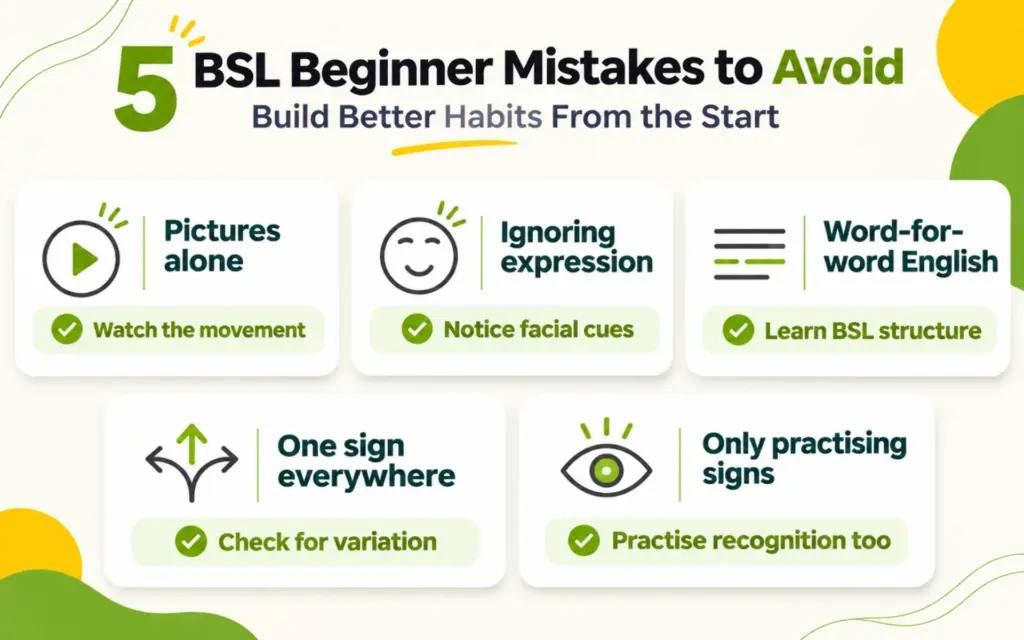
Common Beginner Mistakes to Avoid
When learning basic BSL signs, accuracy matters more than speed.
Learning only from pictures: Static images may not show the movement or orientation needed to understand a sign.
Ignoring facial expressions: Facial expressions can contribute to grammatical meaning, not just emotion.
Translating English word for word: BSL follows its own language structure.
Assuming every sign is identical across the UK: Some vocabulary has regional variations.
Practising without watching others: Understanding another person’s signing is an essential communication skill.
What to Learn After These 50 Signs
Once you recognise these everyday signs, begin developing your fingerspelling, vocabulary and ability to understand signed conversations.
If you’d prefer a more structured introduction, Janets offers a British Sign Language (BSL) Level 1 & 2 course.
The online course introduces BSL fundamentals, fingerspelling, greetings, personal information, family vocabulary, numbers and everyday communication. It also covers Deaf awareness and visual communication techniques.
Remember that learning introductory vocabulary or completing an online training course is not the same as achieving fluency or obtaining a regulated BSL qualification.
Start With the Basics and Build Your Confidence
These 50 basic BSL signs offer a useful starting point for learning everyday vocabulary. Practise them through accurate visual demonstrations, focus on understanding their meanings and gradually introduce new signs.
Consistent learning and opportunities to communicate will help you build a stronger foundation in British Sign Language.
Frequently Asked Questions
What Are the First BSL Signs Beginners Should Learn?
Start with greetings and practical vocabulary such as hello, thank you, name, help and understand. These are useful in everyday interactions. Learn them through reliable demonstrations, paying attention to movement, facial expression and context.
Can You Learn Basic BSL Signs at Home?
Yes. Beginners can develop introductory vocabulary using BSL videos, dictionaries and regular practice. However, practising with fluent signers or qualified tutors can help improve accuracy and understanding. Watching different signers also develops recognition skills.
Are BSL Signs the Same Across the UK?
Not always. BSL has regional variations, meaning some signs differ between communities. The language is shared, but particular vocabulary may vary. Using reliable learning resources can help you understand these differences.
How Long Does It Take to Learn 50 BSL Signs?
There is no fixed timeframe. Some learners remember individual signs quickly, while others need more repetition. Recognising 50 signs is also different from understanding and participating in BSL conversations.
For a broader explanation of learning progress, explore how long it takes to learn BSL.
Get a FREE Course