- Home
- Personal development
- Is BSL Difficult to Learn? Common Challenges Explained
Is BSL Difficult to Learn? Common Challenges Explained

Is BSL hard to learn? British Sign Language can feel challenging at first, especially for hearing adults who are used to spoken English. However, learning basic signs and fingerspelling is often more manageable than beginners expect. The bigger challenges usually involve grammar, facial expressions and understanding fluent signers.
If you want a structured introduction, Janets’ BSL Level 1 & 2 course covers everyday signs, fingerspelling, visual communication and Deaf awareness.
This guide explains what makes BSL difficult for beginners, which skills may feel easier and how to overcome common learning challenges.
Is BSL Hard to Learn for Hearing Adults?
BSL is different from spoken English, but that doesn’t mean hearing adults cannot learn it successfully.
According to RNID’s explanation of British Sign Language, BSL has its own grammar and uses hand movements, facial expressions, lip patterns and other visual features to communicate meaning.
For hearing adults who usually communicate through speech, learning to process information visually can take some adjustment.
You might find it relatively easy to remember a greeting but struggle to understand someone signing a complete sentence. That’s because recognising individual signs and following natural conversations require different skills.
The difficulty also depends on your previous experience, learning opportunities and practice.
If you’re starting from scratch, our guide on how to learn British Sign Language explains the wider learning process.
What Makes BSL Difficult at First?
Every learner has different strengths, but several challenges are particularly common when learning a visual language for the first time.
Understanding why these difficulties happen can make them easier to address.
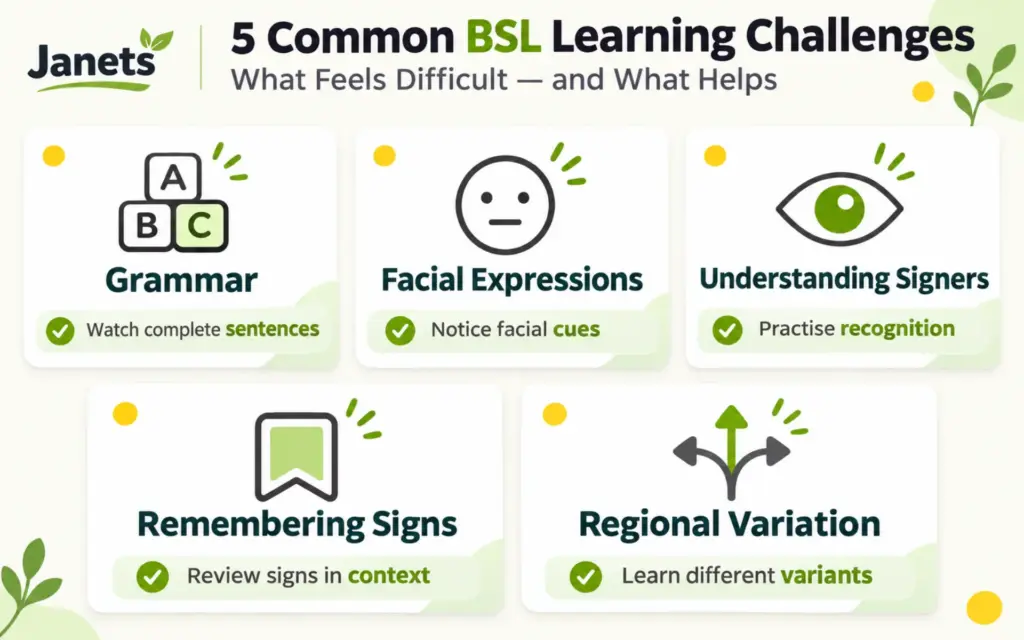
1. BSL Grammar Works Differently From English
One of the biggest challenges is realising that BSL isn’t simply English communicated through hand gestures.
BSL has its own grammatical structure. You cannot reliably translate an English sentence by replacing each spoken word with an individual sign.
For example, questions in BSL may introduce a topic before asking for specific information. Facial expressions and movement can also contribute to grammatical meaning.
How to improve: Watch complete sentences demonstrated by fluent BSL signers. Focus on how ideas are expressed rather than trying to copy English word order.
As you become familiar with natural BSL structures, forming sentences may begin to feel less unfamiliar.
2. Facial Expressions Are Part of Communication
When beginners think about sign language, they often concentrate on hand movements.
However, BSL also uses facial expressions, lip patterns, head movements and body positioning to communicate meaning.
Some hearing adults may feel self-conscious about using facial expressions more deliberately, particularly when practising in front of others.
Ignoring these features can affect how clearly a message is understood.
How to improve: Watch how fluent signers coordinate their hands, faces and bodies. Record a short practice session and compare it with a reliable demonstration.
Where possible, ask a qualified BSL tutor or fluent signer for feedback.
3. Understanding Fluent Signers Takes Practice
You might remember several signs perfectly but still struggle to follow someone using BSL naturally.
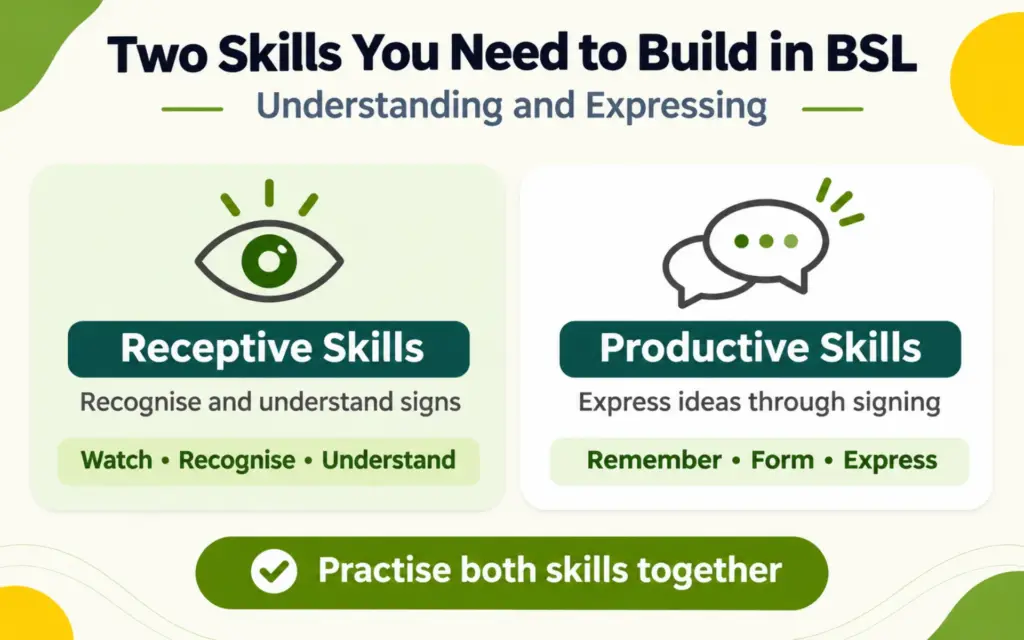
This is because producing signs and understanding them are different abilities.
Productive skills involve expressing yourself through signing. Receptive skills involve recognising and understanding another person’s signing.
During conversations, signs appear together with movement, facial expressions and grammatical information. Fluent signers may also use vocabulary you haven’t encountered.
How to improve: Watch short BSL videos featuring different fluent signers. Try recognising familiar signs before checking the meaning.
Start with clear, manageable examples, then gradually explore longer exchanges.
The goal is to develop understanding alongside your ability to produce signs.
4. Remembering Signs and Fingerspelling Can Be Tricky
BSL vocabulary involves more than remembering a hand gesture.
A sign may depend on handshape, palm orientation, movement and where it is produced. Beginners sometimes remember the general appearance but overlook important details.
Fingerspelling can also require practice, particularly when recognising letters signed by someone else.
How to improve: Learn a small group of signs and revisit them in meaningful situations. Practise recognising each sign as well as producing it.
For useful introductory vocabulary, explore our collection of basic BSL signs.
Remember that fingerspelling is helpful for names and unfamiliar words, but it doesn’t replace learning BSL vocabulary and grammar.
5. Some BSL Signs Vary Across the UK
You may learn a sign online and later notice someone using a different version.
That doesn’t necessarily mean either person is incorrect. Like spoken languages, BSL has regional variations.
UCL BSL SignBank’s regional sign research documents differences in categories such as numbers, colours and UK place names.
How to improve: Learn from reliable BSL resources and remain open to regional differences. When appropriate, ask fluent signers about the vocabulary used in their community.
What's Easier About Learning BSL Than You Might Expect?
Although BSL has its challenges, beginners can start developing useful skills without understanding complex conversations.
For example, you can begin with:
↪ Everyday greetings: Learn signs used when meeting people.
↪ Fingerspelling: Practise spelling names and unfamiliar words.
↪ Familiar vocabulary: Focus on family, food, numbers and daily activities.
↪ Visual recognition: Build confidence identifying signs in short demonstrations.
These introductory skills give you manageable goals while you become familiar with visual communication.
You also don’t need to understand every sign immediately to benefit from practising.
However, learning a few signs is different from communicating fluently. BSL remains a complete language that requires continued learning and real communication experience.
How to Make Learning BSL Easier
You don’t need an elaborate learning routine to begin improving. A few practical habits can help you work through the most common challenges.
↪ Start with useful communication
Choose vocabulary connected to your everyday life. Familiar situations make it easier to understand when a sign might be useful.
↪ Practise recognising signs
Don’t only repeat demonstrations. Watch videos without immediately checking the English meaning, and try identifying signs yourself.
↪ Review your movements
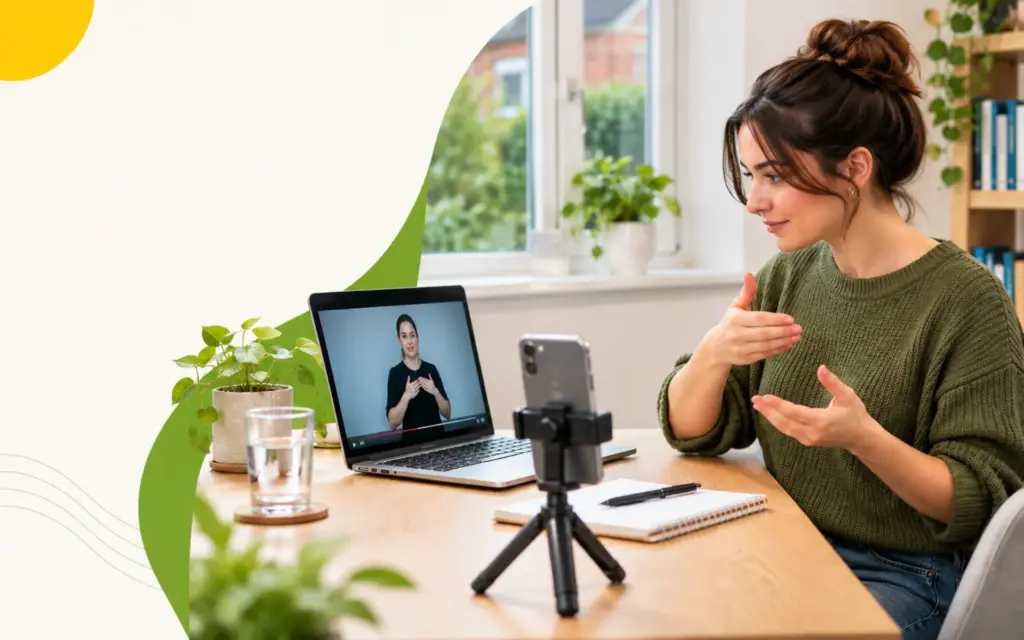
Record your signing and compare it with accurate demonstrations. Pay attention to handshape, movement and facial expression.
↪ Learn from fluent signers
Feedback and real interaction help you understand how BSL works beyond individual vocabulary.
In Sense’s BSL learning advice, Deaf BSL teacher Anne Lucas recommends learning with experienced teachers, engaging with the Deaf community and watching signed programmes.
For a more organised practice routine, explore our guide on how to learn BSL at home.
Can You Learn BSL Online as a Beginner?
Yes. Online learning can be a practical starting point, particularly if you need flexibility around work, family or other commitments.
Recorded lessons allow you to revisit unfamiliar signs, practise fingerspelling and review introductory vocabulary at your own pace.
However, BSL is a visual, three-dimensional language. Videos are useful learning resources, but feedback and opportunities to communicate with fluent signers remain important.
If you prefer structured learning, Janets’ British Sign Language (BSL) Level 1 & 2 course introduces essential vocabulary, greetings, personal information, sentence structures and Deaf awareness.
The online course supports introductory learning, but completing it does not automatically establish fluency or award a regulated BSL qualification.
Is BSL Difficult to Learn? The Key Is Consistent Practice
BSL can feel unfamiliar at first, particularly when you’re adjusting to visual grammar, facial expressions and understanding other signers.
However, these challenges can become more manageable with suitable learning resources, regular practice and feedback.
Start with useful vocabulary, develop your understanding gradually and focus on communicating accurately rather than signing quickly. Every new skill helps strengthen your foundation in British Sign Language.
Frequently Asked Questions
How Long Does It Take to Learn BSL Fluently?
Becoming fluent in BSL can take several years of regular practice, although progress varies. Fluency involves understanding grammar, facial expressions and natural conversations, not just remembering signs.
Why Was BSL Banned in the UK?
BSL was not banned nationwide by a single UK law. However, the 1880 Milan Conference promoted spoken-language teaching over signing, leading to widespread suppression of sign language in Deaf schools. Signing was discouraged or prohibited in many educational settings. UCL’s BSL history timeline explains this history.
Is BSL Level 1 Equivalent to GCSE?
A regulated BSL Level 1 qualification is at the same qualification level as GCSE grades 1–3 in England, but it is not the same qualification as a GCSE.
According to GOV.UK qualification levels, GCSE grades 4–9 are Level 2. Introductory courses labelled BSL Level 1 do not automatically award regulated qualifications.
Is ASL or BSL Harder?
Neither American Sign Language (ASL) nor British Sign Language (BSL) is universally harder. They are distinct languages with different vocabulary, grammar and fingerspelling systems.
BSL uses a two-handed fingerspelling alphabet, while ASL generally uses one hand. The difficulty depends on your learning experience, available resources and opportunities to practise.
Get a FREE Course