- Home
- Career Guide
- Do You Need Qualifications to Be a Teaching Assistant?
Do You Need Qualifications to Be a Teaching Assistant?

Thinking about becoming a teaching assistant but worried you don’t have the right qualifications? You might be closer to meeting the requirements than you think.
You do not always need a formal teaching assistant qualification to work in a UK school. Individual schools set their own entry requirements, and some accept applicants without a teaching assistant certificate. However, employers commonly expect GCSEs in English and maths, or equivalent qualifications. Relevant experience and training can also strengthen your application.
The important thing is knowing which requirements are essential, which are preferred and what you can do if you don’t meet them yet.
What Qualifications Do You Need to Be a Teaching Assistant?
There is no single qualification that every teaching assistant in the UK must hold. What you need depends on the school, the position and the responsibilities involved.
According to the National Careers Service, schools set their own entry requirements. They may consider GCSEs, relevant experience, childcare qualifications or previous work with children.
When reading a teaching assistant job advert, pay attention to two types of requirements:
Essential requirements: Qualifications, skills or experience the employer expects every successful applicant to have.
Desirable requirements: Additional credentials or experience that could strengthen an application.
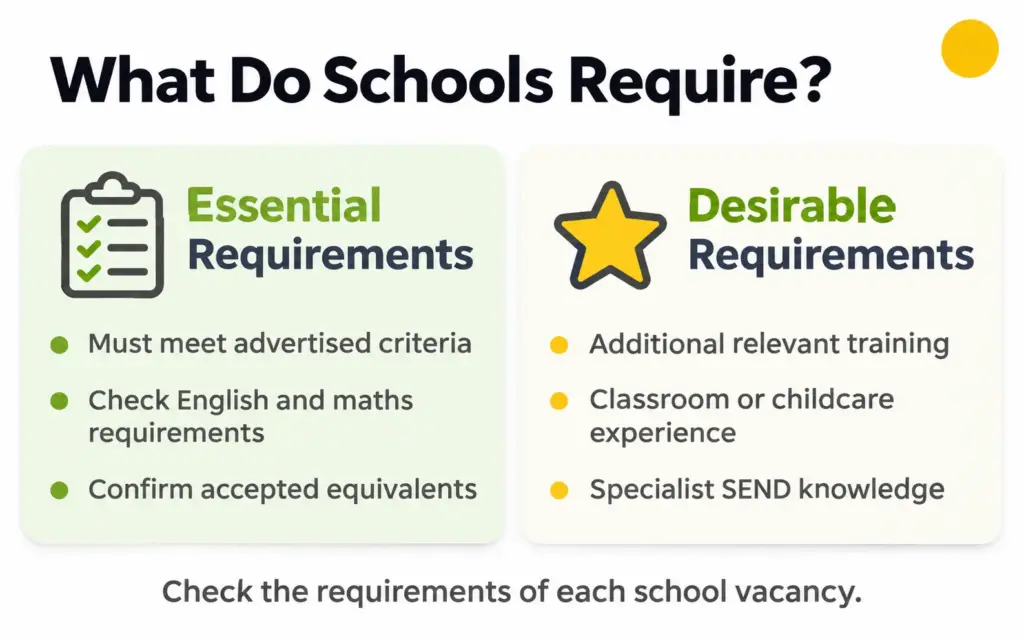
For example, a school might require English and maths GCSEs but list a Level 2 teaching assistant qualification as desirable.
A university degree is not generally necessary for an ordinary teaching assistant position, although individual employers can set additional criteria.
If you want to explore the wider career pathway, a guide on how to become a teaching assistant in the UK can help you understand the different routes into the profession.
Can You Be a Teaching Assistant Without Qualifications?
Yes, some schools consider applicants who have not completed a formal teaching assistant qualification.
However, having no teaching assistant certificate is different from having no qualifications at all. A school might accept someone without specialist training but still require English and maths qualifications.
Can you apply without a teaching assistant certificate?

You may be able to apply directly if you meet the advertised essential requirements.
Schools may value experience gained through:
• Working in childcare or early years settings.
• Supporting children through community activities.
• Coaching sports or supervising children’s clubs.
• Working in youth services or care environments.
• Volunteering in a school.
For example, someone who has helped run children’s activities may already have useful communication, patience and teamwork skills.
These experiences can strengthen an application, but they do not automatically replace qualifications listed as essential.
What if you have no school experience either?
You can still investigate entry-level vacancies and opportunities to gain experience.
Some employers provide training after recruitment, while others prefer candidates who already understand classroom routines.
If you’re starting without relevant work experience, Janets’ guide on how to become a teaching assistant with no experience in the UK explains how to approach that situation.
The key is to assess your qualifications and experience separately rather than assuming you need both before making any applications.
Do You Need GCSEs to Be a Teaching Assistant?
GCSE requirements are one of the most common concerns among people considering teaching assistant work.
Which GCSEs do schools usually expect?
The National Careers Service explains that schools usually expect applicants applying directly to have:
GCSE English at grades 9–4 (previously A*–C), or equivalent.
GCSE maths at grades 9–4 (previously A*–C), or equivalent.
These are common employer expectations, not a universal statutory qualification requirement for every teaching assistant position.
Some vacancies may specify additional qualifications, while others may consider alternative evidence of relevant skills.
Always check the school’s person specification before assuming you are eligible or ineligible.
Can you become a teaching assistant without GCSEs?
Possibly. It depends on what the employer accepts.
If you haven’t achieved the requested GCSE grades, you could investigate whether the school accepts an equivalent qualification.
For example, Functional Skills Level 2 in English or maths may be relevant, but you should not assume every employer or training provider will accept it as a substitute.
Before applying, ask the school:
✓ Are equivalent English and maths qualifications accepted?
✓ Is the stated GCSE requirement essential or desirable?
✓ Would the employer consider someone currently working towards the required qualification?
A clear answer from the school is more useful than enrolling on a course based on assumptions.
Teaching Assistant Complete Course
Explore teaching assistant responsibilities and develop your understanding of SEN, Autism, ADHD and Dyslexia.
Get Started Now → CPD Certified · Flexible Online StudyEVERY
LEARNER
TEACHING ASSISTANT TRAINING
Level 2, Level 3 and Other Teaching Assistant Qualifications
Although formal teaching assistant qualifications are not compulsory for every vacancy, relevant training can help applicants develop classroom knowledge and meet particular employer requirements.
The most relevant routes include Level 2 qualifications, Level 3 qualifications and apprenticeships.
Level 2 teaching assistant qualifications
Level 2 qualifications in Supporting Teaching and Learning can introduce learners to working in educational settings.
Depending on the qualification, topics may include classroom communication, child development, learning activities and supporting teachers.
This type of training may be useful for someone seeking an entry-level classroom support position.
However, completing Level 2 does not automatically qualify someone for every teaching assistant job. Schools may ask for other credentials or practical experience.
Level 3 teaching assistant qualifications
Level 3 qualifications generally involve more detailed learning about educational support and classroom practice.
Some regulated Level 3 Supporting Teaching and Learning qualifications require evidence of practical competence in a real educational setting.
This matters when comparing courses. A programme assessed through classroom observations and workplace evidence is not necessarily equivalent to an online knowledge course assessed through multiple-choice questions.
Level 3 may be required or preferred for particular vacancies, but it is not a universal requirement for ordinary teaching assistant work.
Teaching assistant apprenticeships
In England, the Level 3 Teaching Assistant Apprenticeship provides another route.
It combines paid employment with structured learning and assessment. The Teaching Assistant apprenticeship standard is published by Skills England.
Employers determine apprenticeship entry requirements, and applicants should check the conditions of the specific opportunity.
Here is how the main training routes differ:
| Training route | What it involves | What to check |
|---|---|---|
| Level 2 qualification | Foundation knowledge and, depending on the award, practical skills | Regulation status and assessment requirements |
| Level 3 qualification | More detailed classroom support knowledge and potentially workplace assessment | Exact qualification title and placement requirements |
| Level 3 apprenticeship | Employment combined with training and assessment | Employer entry criteria and apprenticeship eligibility |
Before enrolling, verify the exact award and awarding organisation. GOV.UK provides a Register of Regulated Qualifications covering England and Northern Ireland, with links to separate services for Wales and Scotland.
What Do UK Schools Look for Besides Qualifications?
Qualifications are only part of a teaching assistant application. Schools also need people who can communicate clearly, work with teachers and support children appropriately.
Essential and desirable requirements in job adverts
Consider this hypothetical teaching assistant vacancy:
Essential requirements:
● English and maths GCSEs at grade 4 or above, or accepted equivalents.
● Good communication and teamwork skills.
● Ability to work effectively with childre
Desirable requirements:
● A Level 2 or Level 3 teaching assistant qualification.
● Previous classroom or childcare experience.
● Knowledge of special educational needs and disabilities (SEND).
An applicant without a teaching assistant certificate might still meet the essential criteria in this example.
The important distinction is that desirable qualifications can improve an application without necessarily being compulsory.
Different schools may use different criteria, so always read the full person specification.
Skills, SEND experience and safeguarding
Schools may also value patience, organisation, adaptability and the ability to support pupils with different learning needs.
For specialist SEND roles, employers might request relevant experience or additional training in areas such as autism, ADHD or learning difficulties.
Safeguarding is another important consideration. In England, Keeping Children Safe in Education 2026 sets out statutory safeguarding and safer recruitment guidance for schools and colleges.
Relevant recruitment checks, including DBS checks where legally appropriate, are separate from academic qualifications.
Schools elsewhere in the UK follow their respective safeguarding and criminal-record checking arrangements.
Do Online Teaching Assistant Courses Count as Qualifications?
Online teaching assistant courses can support professional development, but not every certificate has the same status.
Regulated qualifications versus CPD training
A regulated qualification is formally recognised within the relevant national qualifications system and must meet applicable regulatory requirements.
CPD training, meanwhile, focuses on developing or updating professional knowledge and skills.
A CPD-accredited certificate or Quality Licence Scheme (QLS) endorsed certificate is not automatically an Ofqual-regulated vocational qualification.
Before choosing training, check what the course awards and whether the school you’re interested in accepts it.
Developing classroom and SEN support knowledge
If you want to develop relevant knowledge, Janets offers the Teaching Assistant Complete Course.
The online course covers teaching assistant responsibilities, SEN support, autism, ADHD and dyslexia.
After successfully completing the final assessment, learners can obtain a CPD-accredited certificate or apply for a QLS-endorsed certificate of achievement, subject to the certificate options and additional fees stated on the course page.
This course is not an Ofqual-regulated qualification or a guaranteed route into employment. It is an option for professional development, not a substitute for a regulated qualification where an employer specifically requires one.
How to Check If You Meet Teaching Assistant Entry Requirements

Before applying for a teaching assistant vacancy, use this straightforward checklist.
1. Read the full job description. Check the position’s responsibilities and whether it involves specialist support.
2. Identify essential qualifications. Look for GCSE requirements, equivalent qualifications and any specified teaching assistant awards.
3. Check accepted alternatives. Contact the school if you have different qualifications or are currently studying.
4. Review your relevant experience. Consider childcare, volunteering, youth activities and transferable workplace skills.
5. Check recruitment conditions. Understand the employer’s safeguarding and pre-employment requirements.
6. Ask questions before applying. If a requirement is unclear, request clarification from the recruiting school.
For example, if Level 3 appears under desirable rather than essential criteria, you may still be eligible without it, provided you meet the school’s mandatory requirements.
This approach helps you make informed applications without assuming every vacancy has identical conditions.
Final Thoughts
So, do you need qualifications to be a teaching assistant? Not always. Some UK schools accept applicants without formal teaching assistant training, while others specify GCSEs or relevant vocational qualifications.
The best starting point is the actual job advert. Check the essential requirements, consider your existing skills and choose further training only when it supports your needs and career plans.
Frequently Asked Questions
Do you need a degree to become a teaching assistant?
No, a university degree is not generally required for an ordinary teaching assistant position. Schools usually focus on their advertised entry requirements, which may include GCSEs, relevant experience and vocational training. Always check individual vacancies because employers can specify different criteria.
Can you become a teaching assistant at 40 or 50?
Yes. Being 40 or 50 does not prevent someone from applying for teaching assistant work. Applicants changing careers can demonstrate relevant skills from previous employment, volunteering or caring responsibilities. They still need to meet the employer’s essential criteria and recruitment requirements.
Do SEN teaching assistants need extra qualifications?
Not necessarily. Some SEN teaching assistant vacancies request specialist qualifications, practical SEND experience or knowledge of particular learning needs. Others may provide additional training. Requirements depend on the responsibilities and the school, so check the individual job description.
Are online teaching assistant qualifications recognised by schools
Recognition depends on the specific award. A regulated vocational qualification is different from a CPD certificate or course completion certificate. Schools decide whether particular training satisfies their recruitment criteria. Check the award’s regulatory status and confirm acceptance with the employer before enrolling.
Get a FREE Course