- Home
- Career Guide
- Teaching Assistant Salary UK: What Do TAs Actually Earn in 2026?
Teaching Assistant Salary UK: What Do TAs Actually Earn in 2026?

Thinking about becoming a teaching assistant but unsure what you could earn? Or perhaps you’re already working in a school and wondering whether your salary matches your responsibilities.
The teaching assistant salary in the UK typically ranges from £19,000 for starters to £26,000 for experienced staff, according to the National Careers Service. However, these are general career estimates, not fixed national pay bands.
Your earnings depend on your job grade, location, responsibilities and contract. A school advertising £28,000 full-time equivalent (FTE), for instance, may pay considerably less for term-time-only hours.
This guide examines current 2026 pay scales, salaries by role and region, and what teaching assistants actually receive.
Become a Confident Teaching Assistant
Build your knowledge of classroom support, SEN, Autism, ADHD and Dyslexia through flexible online learning.
Teaching Assistant Salary in the UK: 2026 Pay at a Glance
Teaching assistant salaries vary considerably between schools. The National Careers Service’s £19,000–£26,000 guidance provides a useful starting point, but individual vacancies may advertise figures outside that range.
The following examples illustrate how different roles and contracts affect earnings.
| Role or salary measure | 2026 salary information |
|---|---|
| Starting teaching assistant | £19,000 annual career guide |
| Experienced teaching assistant | £26,000 annual career guide |
| Level 2 TA, Sheffield | £19,966–£20,740 actual annual salary |
| Level 3 TA, Rotherham | £27,709–£29,071 FTE; £22,784–£23,903 actual |
| Specialist Level 2 TA, Stockton-on-Tees | £26,847–£27,274 FTE; £9,161–£9,307 actual |
The vacancy figures are examples from the Department for Education’s Teaching Vacancies listings, checked in November 2026. They are not national averages.
The difference between FTE and actual pay is particularly important. Two teaching assistants on similar salary scales can receive very different annual earnings because they work different hours.
Teaching Assistant Salary by Level and Role
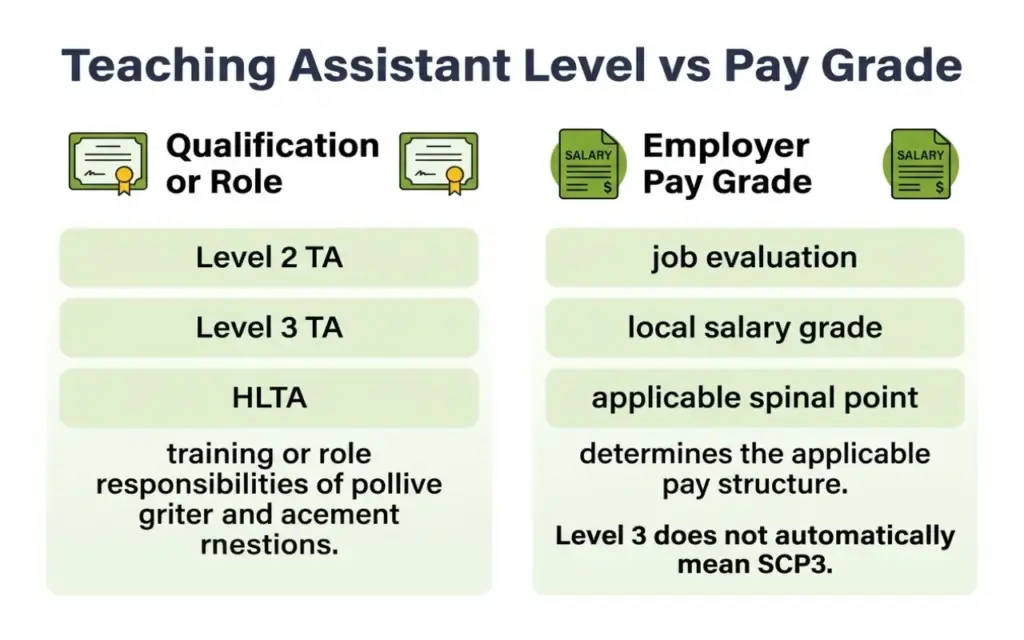
Teaching assistant responsibilities often become more demanding as staff gain experience. However, Level 1, Level 2 and Level 3 qualifications do not correspond to one nationally fixed salary structure.
Level 1 and Level 2 Teaching Assistant Salary
Level 1 and Level 2 teaching assistants generally support classroom activities, prepare learning resources and help pupils follow lessons.
A Level 2 vacancy at Beck Primary School in Sheffield advertised £19,966–£20,740 actual annual pay in November 2026.
Starting salaries depend on the employer’s grading system and the hours offered. Someone entering the profession without classroom experience may begin in a general support position before applying for roles with additional responsibilities.
If you’re new to the profession, there are practical ways to start as a teaching assistant without experience and build the skills schools look for.
Level 3 and Senior Teaching Assistant Salary
Level 3 teaching assistants may undertake more independent pupil support, contribute to assessment activities or assist with specialist interventions.
For example, a Level 3 vacancy at Waverley Primary Academy in Rotherham advertised £27,709–£29,071 FTE, with actual annual pay of £22,784–£23,903.
Importantly, holding a Level 3 qualification does not automatically place an employee on a higher salary grade. Pay usually reflects the responsibilities and grading of the position.
If you’re unsure what schools expect, it’s worth checking which qualifications you need to become a teaching assistant before applying for higher-level roles.
Higher-Level Teaching Assistant (HLTA) Salary
Higher-level teaching assistants typically take on broader classroom responsibilities, which may include supporting learning activities under a teacher’s direction.
HLTA vacancies can offer higher salary grades than general teaching assistant positions. However, earnings still depend on the employer, responsibilities and contract.
When comparing HLTA vacancies, check both the advertised FTE and actual annual salary. A higher pay grade does not necessarily produce a higher annual income if the role involves fewer hours.
SEN Teaching Assistant Salary
Some specialist roles offer higher pay because of additional responsibilities. Others use salary bands similar to general teaching assistant posts.
Schools may value knowledge of autism, ADHD, dyslexia and inclusive classroom approaches. For those considering specialist work, Janets also offers SEN Support Training for Teaching Assistants courses focused on developing relevant knowledge.
These courses support professional learning; they do not guarantee a higher salary or appointment to a specialist position.
How Does the Teaching Assistant Pay Scale Work in 2026?
Many council-maintained schools use pay arrangements connected to the National Joint Council (NJC) framework.
NJC Pay Scale and Spinal Column Points
The NJC framework uses spinal column points (SCPs), which represent different salary values. Employers assign jobs to grades based on their responsibilities and local evaluation arrangements.
Here are selected figures from the 2026–27 school support staff pay scales.
| NJC spinal point | April 2026 annual FTE |
|---|---|
| SCP3 | £25,614 |
| SCP5 | £26,427 |
| SCP8 | £27,709 |
| SCP11 | £29,071 |
| SCP15 | £31,015 |
These are pay-spine values, not guaranteed salaries for particular teaching assistant levels.
For example, a Level 3 TA is not automatically paid at SCP3. Similarly, an academy trust may operate its own pay arrangements.
Are Teaching Assistants Getting a Pay Rise in 2026?
Yes, teaching assistants employed under applicable NJC arrangements are covered by the agreed 3.3% pay award for 2026–27, effective from 1 April 2026.
The settlement was agreed on 24 August 2026, and SCP2 was removed from the national scale.
However, not every teaching assistant works under the same arrangements. Actual implementation, eligibility and any backdated payment depend on the employer and applicable employment terms.
Teaching Assistant Salary by Region and School
Where you work can make a noticeable difference to your salary. London has separate pay arrangements, while schools elsewhere may use local grading systems.
London and the South East
London teaching assistant salaries are often higher on comparable pay scales.
The following 2026 NJC figures demonstrate the differences at SCP3.
| Pay area | SCP3 annual FTE |
|---|---|
| National NJC scale | £25,614 |
| Outer London | £29,562 |
| Inner London | £31,224 |
These are comparable spinal-point values rather than average teaching assistant salaries. Actual earnings may be lower for part-time or term-time contracts.
Some areas near London also have fringe allowances. Employees should check the arrangements their employer actually uses.
England Outside London
Schools in Manchester, Birmingham, Leeds, Sheffield and other areas may offer different salaries for similar roles.
The differences can reflect local job grading, responsibilities and employment contracts.
Council-maintained schools commonly use local authority arrangements, whereas academy trusts may have separate employment policies. Independent schools can also set their own salary structures, subject to applicable employment law.
This means comparing the actual salary and job description is more useful than comparing job titles alone.
Scotland, Wales and Northern Ireland
Pay arrangements vary across the four UK nations.
In Scotland, pupil support and classroom assistant roles commonly follow Scottish local government employment arrangements.
In Wales, the government announced that existing Level 1 teaching assistants would move into Level 2 roles from September 2026, subject to local consultation. The change could increase pay by up to £1,350 for affected workers.
Northern Ireland uses classroom assistant classifications, including specialist SEN grades. Although the 2026 NJC award was nationally agreed, the NEU reported in November 2026 that Education Authority implementation still awaited ministerial approval.
These differences make it important to check country-specific and employer-specific salary information rather than relying on one UK-wide pay table.
Hourly Pay, Term-Time Contracts and Actual Earnings
One of the most common misunderstandings about teaching assistant salaries concerns the difference between advertised and actual pay.
What Is a Teaching Assistant's Hourly Rate?
A teaching assistant’s hourly rate depends on the employer’s pay structure and contracted hours.
For context, the National Living Wage from April 2026 is £12.71 per hour for eligible workers aged 21 and over.
This is a statutory minimum, not the average teaching assistant hourly rate.
When comparing job advertisements, calculate the hourly rate using the employer’s stated salary basis and full-time working hours.
Do Teaching Assistants Get Paid During School Holidays?
Many teaching assistants work term-time-only contracts. Their annual salary is calculated around contracted working hours and the applicable paid holiday entitlement.
Some employers divide that annual amount into 12 monthly payments. This allows employees to receive a regular salary during school holidays, even though their contract does not involve working throughout the entire year.
Other contracts may use different arrangements.
The important point is that receiving monthly pay during holidays does not necessarily mean being paid a full-year salary.
FTE Salary vs Actual Salary: A Worked Example
Suppose a school advertises a teaching assistant position with:
Annual FTE salary: £28,000
Contracted hours: 32.5 per week
Full-time hours: 37 per week
Illustrative paid-weeks equivalent: 45.8
The estimated annual gross salary would be:
£28,000 × (32.5 ÷ 37) × (45.8 ÷ 52.14) = approximately £21,600
That works out to approximately £1,800 gross per month if distributed equally across 12 months.
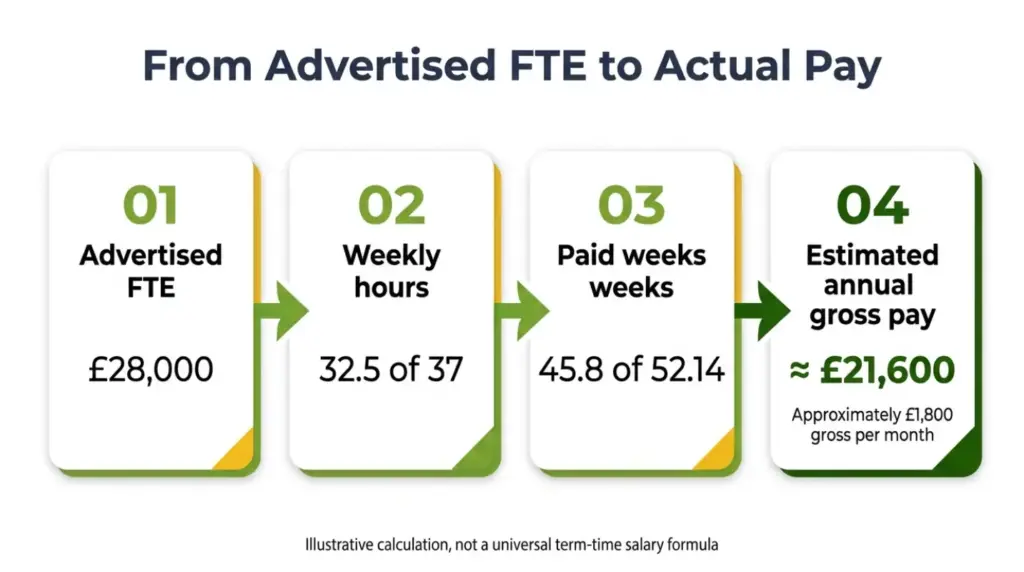
This is an illustrative calculation. Employers may use different paid-week calculations depending on annual leave, working patterns and contract terms.
It also represents gross pay, not take-home pay after tax, National Insurance and pension deductions.
Whenever possible, ask the school to confirm the actual annual gross salary before accepting an offer.
What Affects a Teaching Assistant's Salary?
Several factors influence how much a teaching assistant earns.
Experience: Staff with additional experience may qualify for positions involving greater responsibilities.
Job grading: Employers evaluate positions and assign salary grades based on their requirements.
School type: Academies, maintained schools, specialist schools and independent schools may use different arrangements.
Specialist responsibilities: SEN support, individual interventions or additional classroom duties may influence the grade of a particular role.
Working hours: Part-time and term-time contracts usually produce lower annual earnings than equivalent full-year positions.
Qualifications and additional training may strengthen applications for certain positions, but they do not automatically change an employee’s salary.
If you’re applying for a better-paid role, it also helps to prepare examples of your classroom experience and responsibilities.
How Can Teaching Assistants Increase Their Earning Potential?
Increasing your earnings usually involves taking on a position with greater responsibilities, moving to a higher-graded vacancy or developing relevant specialist knowledge.
Experience, Specialist Responsibilities and Higher-Graded Roles
Teaching assistants may progress towards senior support positions, specialist SEN roles or HLTA responsibilities.
However, salary increases are not automatic. Employers consider the requirements of the position, experience and their pay policies.
Before pursuing additional training, reviewing local vacancies can help you identify the skills and qualifications schools actually request.
Developing Teaching Assistant and SEN Support Skills
Professional development can help teaching assistants strengthen their classroom knowledge and prepare for different responsibilities.
Janets offers a Teaching Assistant Complete Course covering TA, SEN, Autism, ADHD and Dyslexia.
The course introduces teaching assistant responsibilities, classroom learning support, SEN teaching approaches and strategies relating to autism, ADHD and dyslexia. It includes an online assessment and certificate options described on the course page.
For learners interested in additional needs, Janets also offers TA, SEN, Autism, ADHD & Dyslexia and SEN Teaching courses.
These are professional-development options. They should not be confused with regulated teaching assistant qualifications or guaranteed routes to HLTA status, employment or higher pay.
Become a Confident Teaching Assistant
Build your knowledge of classroom support, SEN, Autism, ADHD and Dyslexia through flexible online learning.
What Should You Check Before Accepting a TA Salary Offer?
Before accepting a teaching assistant position, check the following details:
- Actual salary: Is the advertised amount FTE or the amount you will receive annually?
- Pay grade: Which grade or spinal point applies?
- Working hours: How many hours are contracted each week?
- Contract: Is the position term-time-only, part-time or full-year?
- Additional payments: Are any applicable allowances or extra responsibilities included?
- Progression: Does the employer offer incremental progression or opportunities to apply for higher-graded roles?
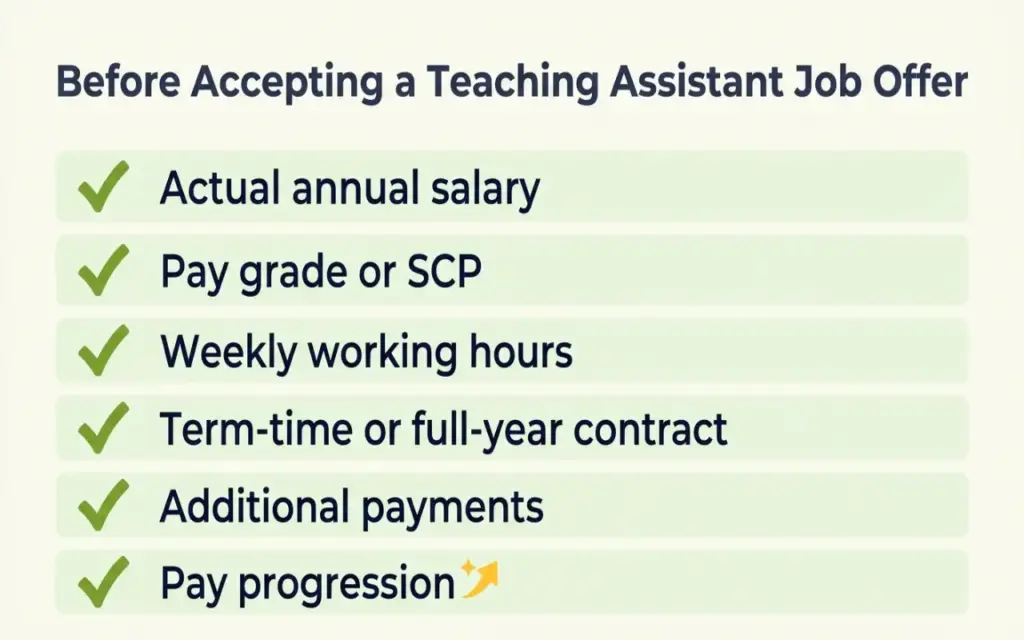
These questions can help you compare positions fairly.
If you’re at the beginning of your career, our guide to becoming a teaching assistant in the UK explains the steps you can take to enter the profession.
Frequently Asked Questions
How Much Does a Level 3 SEN Teaching Assistant Earn?
There is no single national salary for Level 3 SEN teaching assistants. Earnings depend on the school’s job grade, specialist responsibilities, location and contracted hours. Check actual salaries in current vacancies rather than assuming a fixed Level 3 pay rate.
Do Teaching Assistants Get Paid for Lunch Breaks?
Payment depends on the employment contract and whether the break counts as working time. An unpaid lunch break may reduce contracted paid hours. Check your contract and timetable rather than assuming all breaks are paid.
How Many Hours a Day Does a Teaching Assistant Work
Hours vary between schools and positions. Some teaching assistants work most of the school day, while others work shorter sessions or part-time schedules. The National Careers Service gives a typical weekly range of 16–37 hours during term time.
Does a Level 3 Qualification Automatically Increase Teaching Assistant Pay?
No. Completing a Level 3 qualification does not automatically increase your salary. Higher earnings usually require appointment to a higher-graded position or progression under the employer’s pay arrangements.
Get a FREE Course