- Home
- Career Development
- Property Manager Skills and Responsibilities: UK Guide
Property Manager Skills and Responsibilities: UK Guide

Property management is not simply collecting rent or arranging repairs. It involves protecting residents’ interests, coordinating property services and keeping reliable records for owners and organisations. Property Manager Skills and Responsibilities span tenancy administration, communication, maintenance, budgeting and legal awareness. The balance changes between private lettings, social housing and residential blocks. Someone managing an individual rented home may face different decisions from someone overseeing communal facilities in a block of flats.
This guide explains what property managers actually do, which abilities matter most and where UK legal requirements differ. It also shows how the work fits together in a typical repair situation, with practical ways to develop the knowledge employers value.
What Does a Property Manager Do in the UK?
A property manager coordinates the day-to-day operation of property on behalf of an owner, landlord, housing organisation or management company. Their job is to keep services organised, respond to problems, maintain records and act within agreed responsibilities. The precise scope depends on the property, management contract and relevant laws.
The Skills England housing and property management occupational standard describes a customer-facing occupation involving successful tenancies, property matters and legal compliance. In a residential block, managers may also handle communal repairs, service-charge budgets and contractor arrangements. The Leasehold Advisory Service’s explanation of property managers makes clear that a block manager’s authority comes from the management agreement.
These related jobs can overlap, but their main emphasis differs:
| Role | Typical emphasis |
|---|---|
| Property manager | Ongoing property operations, residents, maintenance and records |
| Letting agent | Marketing rentals, finding tenants and arranging lettings; sometimes ongoing management |
| Estate agent | Marketing and negotiating property sales, and sometimes lettings |
A job title alone does not determine legal authority. A manager might organise a repair but need the owner’s approval before authorising expenditure. Likewise, working with financial records does not necessarily mean providing professional accounting advice.
What Are the Main Responsibilities of a Property Manager?
Managing Tenancies and Property Documentation
Accurate tenancy administration helps avoid disagreements about dates, payments and obligations. A manager may coordinate signed agreements, inventories, contact details, permitted occupants and documents that must be provided to tenants. They may also monitor tenancy changes and keep an organised record of communications and decisions.
Managers should know which tasks they have authority to perform and when to refer unusual issues to an experienced colleague or legal professional. Teams also need a reliable version history.
A simple document checklist can reduce missed actions. It might cover agreement dates, deposit information, safety documentation, repair history and records of agreed access.
Communicating With Tenants and Landlords
Property managers often translate practical concerns into clear actions. A resident might report persistent noise, while a landlord wants to understand likely costs and available options. Both need accurate information and realistic expectations, even when their priorities differ.
Effective communication means listening without promising an outcome prematurely, explaining the next step and confirming important decisions in writing. Complaints should follow the organisation’s procedure, with serious concerns escalated promptly.
Record the issue, agreed action, responsible person and review date.
Organising Maintenance, Repairs and Safety Checks
Maintenance work ranges from routine servicing to urgent hazards. Depending on their authority, managers may arrange inspections, gather quotations, appoint qualified contractors, monitor progress and update residents. They should distinguish immediate safety concerns from jobs that can be scheduled without unnecessary disruption.
The landlord’s underlying legal responsibilities are not transferred automatically simply because an agent coordinates the work. GOV.UK guidance on landlord responsibilities covers matters including safe accommodation, gas and electrical safety and applicable fire precautions in England. Requirements for other UK nations must be checked separately.
Consider a recurring heating fault. The manager’s role may involve checking previous repair records, confirming the seriousness of the problem, arranging an appropriate specialist and recording any decision about replacement parts. It does not mean carrying out gas work or electrical repairs without the required competence and authorisation.
Monitoring Rent Payments and Arrears
Where rent administration falls within the management agreement, staff may track payments, reconcile records and identify balances needing attention. Contacting someone early can clarify whether a payment was misallocated, delayed or genuinely missed. Managers should communicate sensitively, particularly where a resident faces financial vulnerability.
Accurate arrears records show amounts due, payments received, contact attempts and agreed next steps. These details help an organisation respond consistently and avoid making decisions from incomplete information. Social housing teams may have additional support and tenancy-sustainment responsibilities.
Non-payment does not create an automatic right to remove a tenant. Formal recovery or possession action depends on the applicable legal process. Managers should escalate such cases rather than improvising threats, fees or deadlines.
Managing Property Budgets and Financial Information
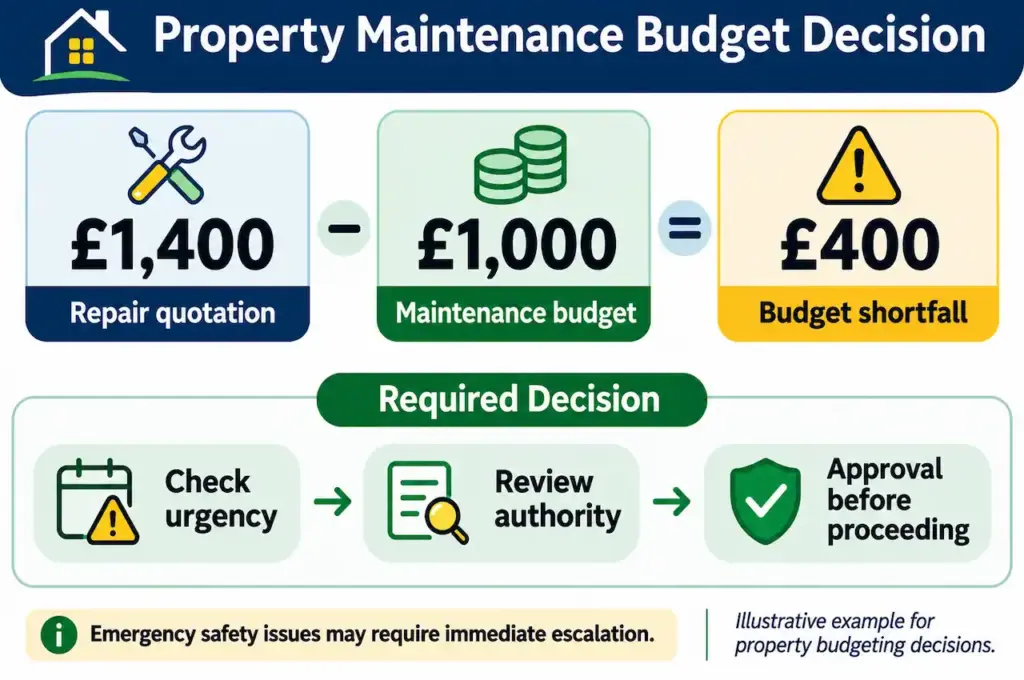
Financial oversight connects everyday decisions with longer-term property condition. Managers may examine maintenance allocations, supplier invoices, planned expenditure and cash-flow forecasts. Their responsibility is usually to provide accurate information and seek approvals within agreed spending limits, not to act as an independent accountant.
For example, suppose a contractor quotes £1,400 for a repair. The authorised maintenance budget has £1,000 available. The manager should identify the shortfall, check whether the work is urgent and obtain appropriate approval before committing additional spending. A forecast can flag future costs, but it cannot replace a signed-off budget.
In leasehold blocks, budgets may also involve service charges and reserve funds. Those arrangements are governed by leases and relevant rules, so they should not be confused with ordinary rental income or a landlord’s personal expenses.
Preparing Reports and Protecting Property Records
A useful property report does more than list completed tasks. It explains what happened, what remains outstanding, who is responsible and whether a decision is needed. Depending on the role, reports may cover repairs, contractor performance, arrears, expenditure or resident complaints. Figures should be dated, reconciled where appropriate and presented without hiding uncertainty.
Professional Report Writing is therefore a relevant skill-development topic within the wider property-management programme. Clear headings, concise summaries and well-labelled tables make a report easier for landlords and colleagues to use.
Records also contain sensitive information. The Information Commissioner’s Office guidance for property and land services identifies activities involving tenancy agreements, resident records and electronic communication. Managers should follow their organisation’s data-protection procedures, limit unnecessary access and use secure methods for sharing personal details.
What Skills Does a Good Property Manager Need?
Responsibilities describe the work; skills explain how someone handles it well. An excellent checklist cannot resolve a dispute on its own, and a detailed budget is ineffective if its implications cannot be communicated. The following abilities connect operational tasks with reliable judgement.
Communication and Conflict Resolution
Residents, landlords and suppliers may interpret the same problem differently. Managers need to ask precise questions, listen calmly and explain decisions in plain language. They must also know when a complaint needs a formal response rather than an informal conversation.
Imagine a tenant believes a repair has been repeatedly ignored. A helpful manager acknowledges the history, checks the evidence and provides a clear update. They should not promise that a contractor will attend before the booking is confirmed. Respectful, specific communication reduces misunderstanding without guaranteeing agreement.
Organisation, Prioritisation and Problem-Solving
An inspection might coincide with an invoice query, a contractor delay and a resident’s urgent safety concern. Managers need reliable task systems and a method for assessing urgency, impact and authority.
Use a shared action register where appropriate, with deadlines, ownership and documented updates. Separate routine tasks from serious hazards and escalate risks promptly. Solving the immediate problem matters, but identifying repeated failures can prevent the same issue returning.
Property management brings together legal awareness, resident communication and financial decisions. For readers exploring structured study, Janets’ Property Manager Training pathway brings these related subjects into one broader programme. It can complement workplace experience, but does not replace regulated qualifications or licensing.
Financial Literacy and Analytical Thinking
Managers do not need to be accountants to recognise a missing invoice or an unexplained budget variance. They should read basic financial information, understand the difference between planned and actual expenditure and ask sensible questions when figures conflict.
A cheaper initial price may not cover the same work, materials or follow-up service. Analytical thinking helps managers explain trade-offs rather than choosing figures without context.
Legal Awareness and Professional Judgement
Property work involves contracts, housing standards, access rights and complaint processes. Good judgement starts with knowing the limits of one’s role. Managers should identify when a decision involves legal interpretation, a vulnerable resident or a potential safety breach and seek appropriate advice.
A familiar practice may be outdated after a legal change. The strongest professionals verify requirements before issuing notices or making commitments. They also distinguish what the owner wants from what the law and management agreement allow.
Digital Organisation and Accurate Reporting
Spreadsheets, scheduling tools and property management systems can help maintain payment histories, maintenance records and task deadlines. The value comes from disciplined use, not the software brand. Incomplete entries and inconsistent naming can create errors even in sophisticated systems.
Managers should check dates, distinguish estimates from confirmed costs and apply appropriate permissions to records. A concise written summary may be more useful than a complicated dashboard if the recipient needs a decision.
Legal Responsibilities of Property Managers Across the UK
England’s Property Management Rules in 2026
England introduced significant private-renting changes on 1 May 2026. Under the Renters’ Rights Act reforms, existing assured shorthold tenancies transitioned to assured periodic tenancies, while new qualifying tenancies use the periodic model. The rules also changed how landlords increase rent and seek possession. See the official Renters’ Rights Act guidance for landlords for the applicable procedures and exceptions.
Property managers need current notices, tenancy records and staff guidance rather than relying on old fixed-term templates. They should check whether a property or tenancy falls within a particular rule before advising a landlord.
Another change is approaching. The English rental-property registration service guidance sets out a regional rollout beginning in the West Midlands on 15 December 2026. It would be inaccurate to suggest that the whole of England had already entered its registration period in November 2026.
Differences Between England, Wales, Scotland and Northern Ireland
UK-wide job titles do not mean UK-wide tenancy rules. In Wales, Rent Smart Wales licensing requirements apply to landlords and agents carrying out specified letting or management activities. Scotland requires those undertaking letting agency work to register and follow a professional code, as explained by mygov.scot’s letting agent registration guidance.
Northern Ireland operates its own private-landlord registration system. The nidirect landlord registration guidance explains that private landlords must register, but this should not be described as identical to agent licensing elsewhere. Managers working across borders must check local rules before using standard forms or processes.
Registration, Client Money and Professional Boundaries
Property Law knowledge helps managers recognise lease terms, statutory responsibilities and matters requiring specialist advice. However, general online study is not proof of registration, a professional licence or an approved qualification.
In England, letting or property management agents holding qualifying client money must join an approved protection scheme. GOV.UK’s client money protection guidance also distinguishes that protection from tenancy deposit schemes. Relevant agents may additionally need an approved redress scheme. The exact obligations depend on the service and jurisdiction. Before acting, managers should check which organisation holds client funds, whose authorisation is required and whether the activity falls within the relevant scheme. Written agreements help establish those boundaries.
Property Management in Practice: Handling a Repair Request
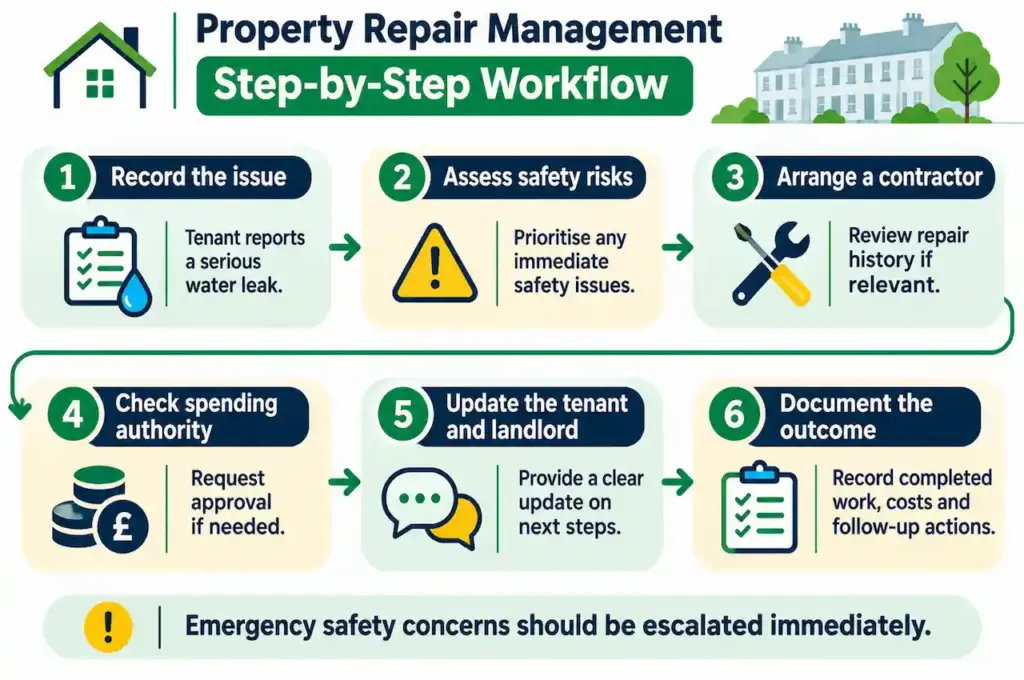
A tenant reports water dripping through the kitchen ceiling. The manager first records the location, reported timing and immediate concerns, asking whether electrics or occupied rooms may be affected. They follow the organisation’s emergency procedure and escalate any apparent danger without delaying for routine paperwork.
Next, they check previous reports and arrange an appropriately qualified contractor. The tenant receives a realistic update about access and expected next steps. If the initial quotation exceeds the manager’s spending authority, approval is requested from the responsible person. Urgent action still follows the applicable emergency and safety procedures.
Once the contractor has attended, the manager checks what was completed, records costs and confirms whether further investigation is needed. The landlord receives a concise report with the issue, action, expenditure and outstanding decisions. The tenant receives a separate update that does not disclose unrelated financial or personal information.
The example demonstrates several skills working together: prioritisation, communication, budget awareness, recordkeeping and proportionate judgement. It also shows why a property manager coordinates specialist repairs rather than undertaking technical work without the necessary competence.
How to Develop Property Manager Skills in the UK
Build Relevant Experience
Entry routes vary. Work in letting administration, housing support, customer service or facilities coordination can provide useful exposure to enquiries, records, contractors and deadlines. Beginners can develop confidence by observing how experienced colleagues document decisions and deal with residents respectfully.
Ask for feedback on communication and accuracy rather than simply collecting tasks completed.
Develop Knowledge Through Appropriate Training
Formal learning can provide a framework for tenancy responsibilities, housing operations, budgeting and professional communication. It should be complemented by current legislation and relevant workplace experience. The training route must suit the job and location: general development programmes cannot automatically satisfy statutory licensing or approved-training requirements.
Some employers value professional qualifications or apprenticeships. Others prioritise relevant experience alongside a willingness to learn. Check the requirements of actual vacancies before choosing a study route, especially where particular qualifications are mandatory.
Assess and Improve Your Competencies
Compare job descriptions with your present abilities. Identify where you need more confidence, whether interpreting an invoice, writing an update or recognising when to escalate a legal issue. Select achievable improvements and review them regularly.
For example, practise turning a messy repair history into a dated, accurate summary. Ask a supervisor to check its usefulness. Keep up with legislative changes using official sources, and seek supervised experience where opportunities exist. Strong development means making sounder decisions, not just memorising more property terminology.
Frequently Asked Questions About Property Management
Can a Property Manager Enter a Tenant's Home Without Notice?
Routine access to inspect or carry out repairs in England normally requires at least 24 hours’ notice. Emergencies may justify immediate access, but notice does not remove the tenant’s wider rights. Managers should follow lawful procedures and consider the circumstances. GOV.UK’s guidance on property repairs and access explains the general position in England. Rules elsewhere may differ.
Does Property Management Include Responsibility for Service Charges?
Sometimes. Residential block managers may prepare service-charge budgets, collect contributions, coordinate communal repairs and provide expenditure information. Their powers depend on the lease and management agreement. These tasks are not automatically part of managing an individual private rental. Service-charge accounting can require specialised expertise and appropriate oversight.
Is Client Money Protection the Same as Tenancy Deposit Protection?
No. Client money protection concerns qualifying money held by property agents and helps protect clients if funds cannot be repaid. Tenancy deposit protection applies to eligible tenant deposits and uses statutory schemes. The GOV.UK tenancy deposit protection overview explains the deposit rules.
Get a FREE Course