- Home
- Career Guide
- What Is BSL Level 1 Equivalent To? GCSE, RQF & CV VALUE
What Is BSL Level 1 Equivalent To? GCSE, RQF & CV VALUE

If you’re considering learning British Sign Language, you might wonder whether BSL Level 1 counts as a GCSE or adds value to your CV. The answer depends on the qualification you achieve.
A regulated BSL Level 1 Award is at the same qualification level as GCSE grades 1–3 (formerly D–G). However, it isn’t a GCSE and cannot automatically replace one.
Understanding this difference can help you choose suitable training, recognise what your certificate represents and describe your skills accurately to employers.
Table of Contents
What Is BSL Level 1 Equivalent To?
An officially recognised BSL Level 1 Award sits at Level 1 of the Regulated Qualifications Framework (RQF). It introduces learners to basic British Sign Language communication, including everyday vocabulary and simple conversations.
According to GOV.UK qualification levels, Level 1 qualifications are comparable in difficulty to GCSE grades 1–3.
| Qualification | Qualification Level |
|---|---|
| Regulated BSL Level 1 Award | RQF Level 1 |
| GCSE grades 1–3 (D–G) | Level 1 |
| GCSE grades 4–9 (A*–C) | Level 2 |
This comparison explains the qualification’s level, not whether it covers the same knowledge or skills as a GCSE.
BSL Level 1 generally focuses on introductory signing, comprehension and everyday communication. For more detail about its learning content and assessments, see BSL Level 1 explained .
Is BSL Level 1 the Same as a GCSE?
No. Although a regulated BSL Level 1 Award shares the same framework level as certain GCSE grades, the qualifications assess different subjects and abilities.
The Regulated Qualifications Framework explained by Ofqual makes this distinction clear: qualifications at the same level are not necessarily directly equivalent.
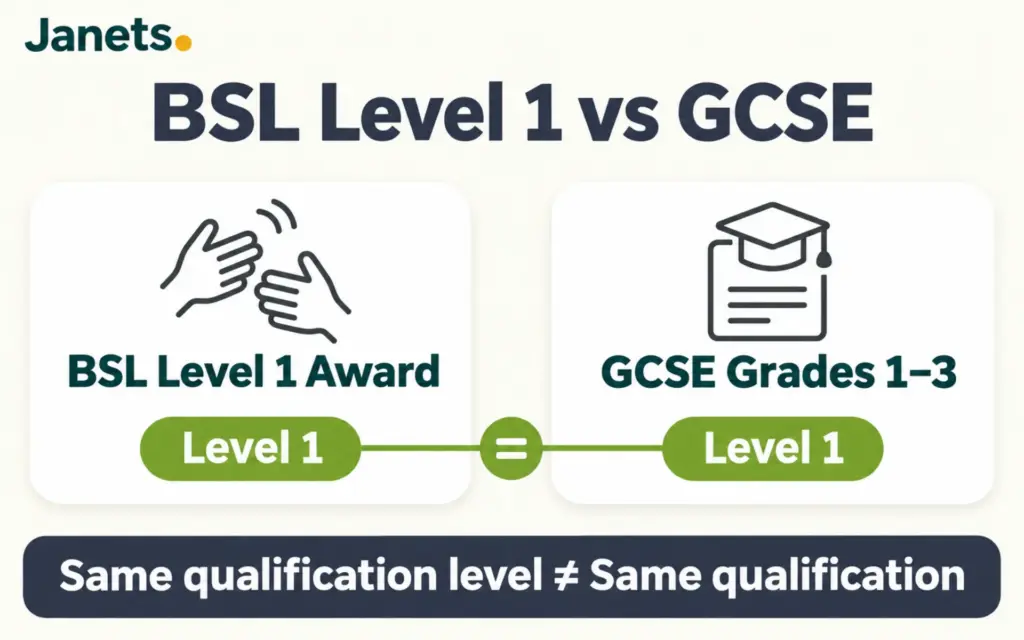
For example, a recognised BSL Level 1 Award demonstrates introductory sign language skills. A GCSE in English assesses different knowledge and abilities.
Therefore, if an employer or college specifically requires GCSE English or Maths, a BSL Level 1 Award would not automatically satisfy that requirement.
How Does a BSL GCSE Differ from a Level 1 Award?
A GCSE in British Sign Language is a separate qualification being developed for school and college education.
In a September 2026 parliamentary update, the Department for Education confirmed that awarding organisations could develop GCSE specifications, which would need Ofqual accreditation before delivery.
The important distinction is that an existing BSL Level 1 Award is not the same qualification as a GCSE in British Sign Language.
Is BSL Level 1 a Recognised Qualification?
BSL Level 1 can be a formally recognised qualification, but not every course labelled “BSL Level 1” awards one.
Recognition depends on the exact qualification, awarding organisation and assessment arrangements.
Regulated BSL Awards vs Online Course Certificates
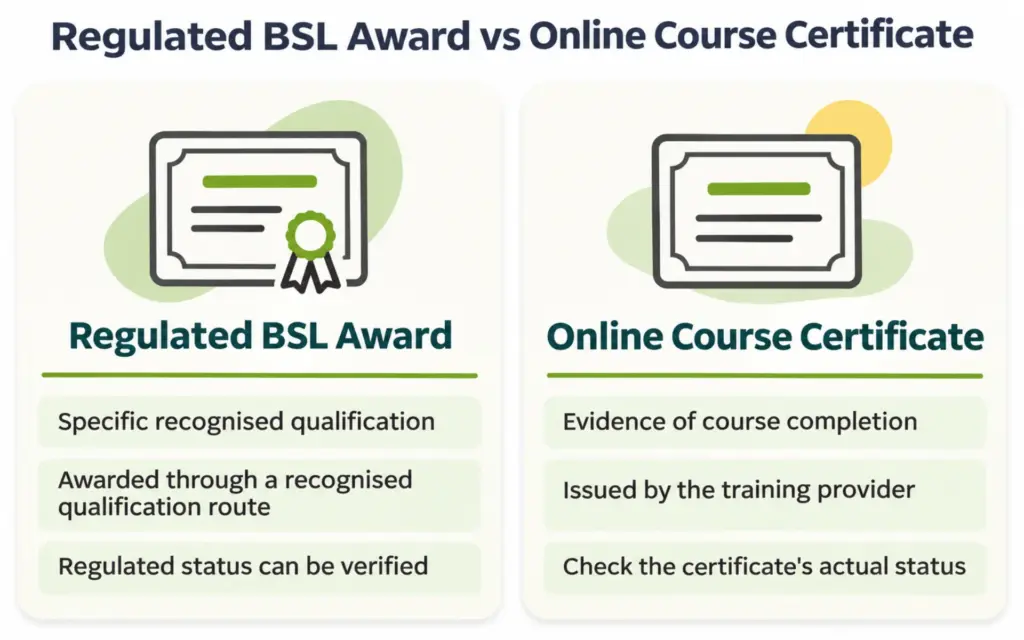
For example, the Signature Level 1 Award in British Sign Language (RQF) is a regulated qualification. Its official listing identifies Signature as the awarding organisation and confirms its Level 1 status. You can check these details in the Department for Education’s qualification listing.
However, an online BSL course may provide a CPD-accredited or course-completion certificate instead.
These certificates can demonstrate learning and professional development, but they should not be described as regulated RQF qualifications unless that recognition is specifically confirmed.
If you’re considering a BSL certificate online, understanding these differences is essential. Our guide to types of BSL certificates online explains the distinctions further.
How Can You Check Whether a BSL Qualification Is Regulated?
Before enrolling, follow three simple steps:
1. Check the full qualification title and awarding organisation.
2. Look for an official qualification number.
3. Search the Register of Regulated Qualifications to confirm its recognition.
For qualifications in Wales or Scotland, consult the relevant national regulator.
This helps you understand exactly what you’ll receive after completing your training.
How to Put BSL Level 1 on Your CV
Learning BSL can add a useful communication skill to your CV, particularly when applying for roles involving public contact, education or support services.
However, the wording should reflect whether you’ve achieved a regulated qualification, completed a training course or developed practical signing skills.
How to List a BSL Qualification or Course Certificate
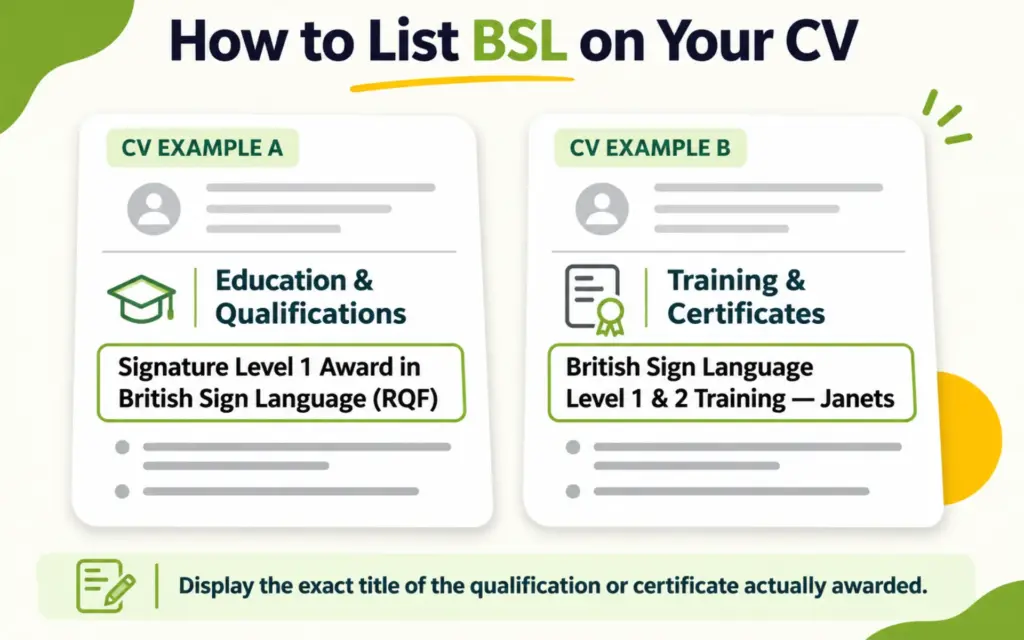
If you’ve achieved a regulated qualification, include the exact title under Education and Qualifications.
Example: Regulated qualification
Signature Level 1 Award in British Sign Language (RQF) — 2026
If you’ve completed an online training course, you can list it under Professional Development or Training and Certificates.
Example: Online course certificate
British Sign Language Level 1 & 2 Training — Janets, CPD-accredited Certificate of Achievement — 2026
These examples should only be used when you have actually earned the stated qualification or certificate.
The National Careers Service CV guidance recommends clearly presenting your qualifications and tailoring your CV to the job you’re applying for.
How to Describe Your Practical BSL Skills
Your CV can also highlight specific skills, provided you can demonstrate them.
For example:
• Basic BSL fingerspelling and everyday vocabulary.
• Understanding simple signed questions and instructions.
• Using introductory signs in familiar conversations.
A suitable skills-section entry might read:
Basic British Sign Language skills, including fingerspelling, everyday greetings and introductory communication.
For a customer service role, you could mention how these developing communication skills complement your existing experience.
Avoid describing yourself as fluent or professionally qualified unless your actual competence supports that claim.
Does BSL Level 1 Help with Jobs?

BSL Level 1 knowledge can complement existing workplace skills, especially in roles involving communication with different members of the public.
Potentially relevant workplaces include schools, healthcare settings, community organisations and customer service teams.
For example, a teaching assistant with introductory BSL knowledge may find those skills useful alongside their existing communication and support responsibilities.
However, BSL Level 1 alone does not qualify someone to work as a professional interpreter.
The National Careers Service BSL interpreter profile explains the advanced language qualifications, interpreting training and professional registration involved in that career.
Learners interested in developing more advanced skills can explore BSL Level 1 vs Level 2 vs Level 3 to understand how the learning stages differ.
What Should You Do After BSL Level 1?
After developing introductory BSL skills, regular practice can help you improve your confidence and communication.
You might practise everyday conversations, engage respectfully with the Deaf community or explore more advanced learning.
If you’re still building foundational knowledge, Janets offers British Sign Language (BSL) Level 1 & 2 Training. The online course covers everyday signing and introductory communication skills, with a CPD-accredited Certificate of Achievement available after successfully completing the final assessment.
This is a skills-development option, not a regulated Signature qualification.
Before choosing training, consider your learning goals, preferred study format and budget. For a closer look at fees, read BSL course costs in the UK.
Final Thoughts
A regulated BSL Level 1 Award sits at the same qualification level as GCSE grades 1–3, but it is not a GCSE or an automatic substitute for one.
Its value depends on the qualification you’ve earned, the communication skills you’ve developed and how those skills relate to your goals.
Whether you’re learning BSL for personal interest or professional development, understanding your certificate and describing your abilities accurately will help you make informed decisions about further training and employment.
Frequently Asked Questions
Can I Put BSL on My CV Without a Certificate?
Yes. You can mention British Sign Language under your skills if you can genuinely demonstrate the abilities described. However, you should not claim to hold a qualification or certificate you haven’t earned.
Does BSL Level 1 Count as a GCSE for Job Applications?
A regulated BSL Level 1 Award shares the same qualification level as GCSE grades 1–3, but it isn’t a GCSE. Whether an employer accepts it depends on the specific job requirements.
Does BSL Level 1 Give You UCAS Points?
No. UCAS Tariff points generally apply to Level 3 qualifications in England, rather than Level 1 awards. The UCAS Tariff guidance explains which qualification levels are eligible.
Is BSL Level 1 Suitable for Complete Beginners?
Yes. BSL Level 1 is designed to introduce learners to basic sign language communication. Many introductory courses require no previous BSL experience, although entry and assessment requirements vary between providers.
Get a FREE Course