- Home
- Career Guide
- How Long Does It Take to Learn BSL? Realistic Timelines by Level
How Long Does It Take to Learn BSL? Realistic Timelines by Level
You might learn to fingerspell your name in an afternoon. Following a lively conversation between experienced British Sign Language (BSL) users is another matter entirely. Both count as learning, but they demand very different amounts of time.
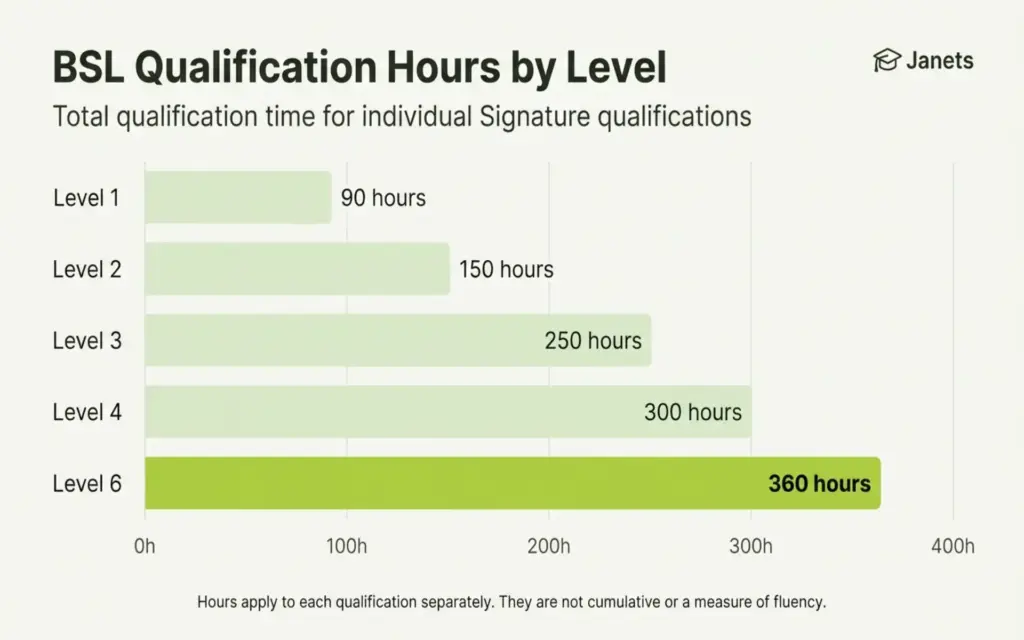
You can begin learning basic BSL signs within days or weeks, while developing simple conversational skills commonly takes months of regular practice. More advanced communication may take years. For a useful UK benchmark, Signature’s regulated Level 1 qualification specifies 90 hours of learning; Level 2 specifies another 150 hours. Those are qualification commitments, not promises of fluency.
The best timeline depends on what you want to communicate, how often you practise, and whether you can learn from people who use BSL confidently. Here is how to set realistic expectations at each stage.
What Does It Mean to ‘Learn’ BSL?
Imagine meeting a Deaf neighbour. Knowing how to sign your name, say hello and ask a simple question is a promising start. But what happens when they answer with a phrase you have never seen before?
That is the difference between remembering signs and communicating in a language. British Sign Language has its own grammar, sentence structures, and regional variations. Meaning comes not only from hand movements but also from facial expressions, body positioning and the context of a conversation.
Basic Signs Versus Everyday Conversation
At the beginning, progress is easy to notice: you recognise a number, remember a greeting or successfully fingerspell someone’s name. Everyday conversation asks more of you. You need to respond without searching for every sign, follow another person’s pace and recognise meaning even when the signing differs slightly from your lessons.
Your understanding of other people’s signing (receptive skills) may develop at a different speed from your ability to sign yourself (productive skills). Neither can be measured by vocabulary size alone.
Does Completing a BSL Level Mean You Are Fluent?
Not necessarily. A qualification assesses specified skills at a particular level. Fluency is about communicating comfortably and accurately across situations, including ones you cannot rehearse in advance. Level 1 is an introduction, not a declaration of fluency.
If you are still choosing where to begin, our guide to getting started with British Sign Language explores the wider learning options.
How Long Does Each BSL Level Take?
In the UK, formal BSL qualifications provide a useful point of reference. Signature publishes both guided learning hours (timetabled teaching, feedback and assessment) and additional study hours (such as homework and independent practice). Together, they make up the Total Qualification Time (TQT).
| Signature qualification | Guided learning | Additional study | Total qualification time |
|---|---|---|---|
| Level 1 | 64 hours | 26 hours | 90 hours |
| Level 2 | 100 hours | 50 hours | 150 hours |
| Level 3 | 150 hours | 100 hours | 250 hours |
| Level 4 | 180 hours | 120 hours | 300 hours |
| Level 6 | 180 hours | 180 hours | 360 hours |
BSL Level 1: Basic Communication
Level 1 introduces the foundations: everyday vocabulary, familiar information, simple questions and short conversations. A learner might practise introducing family members, discussing hobbies or following basic directions.
Signature’s 90 hours give a more meaningful qualification benchmark than a claim that everyone can finish Level 1 in a few weekends. At five hours a week, 90 hours works out to 18 weeks on paper. However, you cannot assume that every approved centre offers an 18-week schedule, or that practice time alone meets the assessment requirements.
BSL Level 2: More Varied Conversations
Level 2 builds on that foundation. Learners work towards longer exchanges about everyday experiences and preferences, while strengthening their receptive and productive skills. They also become more familiar with regional variations.
Signature allocates 150 hours to Level 2. These are hours for that qualification on top of the knowledge needed to enter it. Someone who is still struggling to follow basic signed questions may need further consolidation before moving on, regardless of how quickly they completed earlier lessons.
BSL Level 3: Sustained Communication
Level 3 places greater demands on grammar, understanding and the ability to contribute to conversations on different subjects. Rather than relying on familiar introductions, learners are expected to handle more developed signed communication.
The published benchmark is 250 hours for Level 3 itself. This stage often matters to people who regularly use BSL in social or workplace settings, but its requirements should not be mistaken for a guaranteed occupational qualification.
BSL Levels 4 and 6: Advanced Language Use
At Level 4, the focus expands to extended discussions, less familiar topics and more sophisticated language. Signature specifies 300 hours. Level 6 requires 360 hours and assesses the ability to understand and use complex BSL across varied settings.
These stages generally require substantial prior knowledge. Signature’s listed BSL route moves from Level 4 to Level 6 without a separate Level 5 qualification. Neither a Level 6 language qualification nor a shorter introductory certificate automatically qualifies someone to work as a registered interpreter; that profession has separate requirements.
What Can You Realistically Learn in One, Three or Six Months?
A calendar is helpful only when paired with a learning goal. Three months of occasional video watching will look very different from three months with regular tuition, revision and signing practice. The following are illustrative possibilities, not official milestones or guaranteed outcomes.
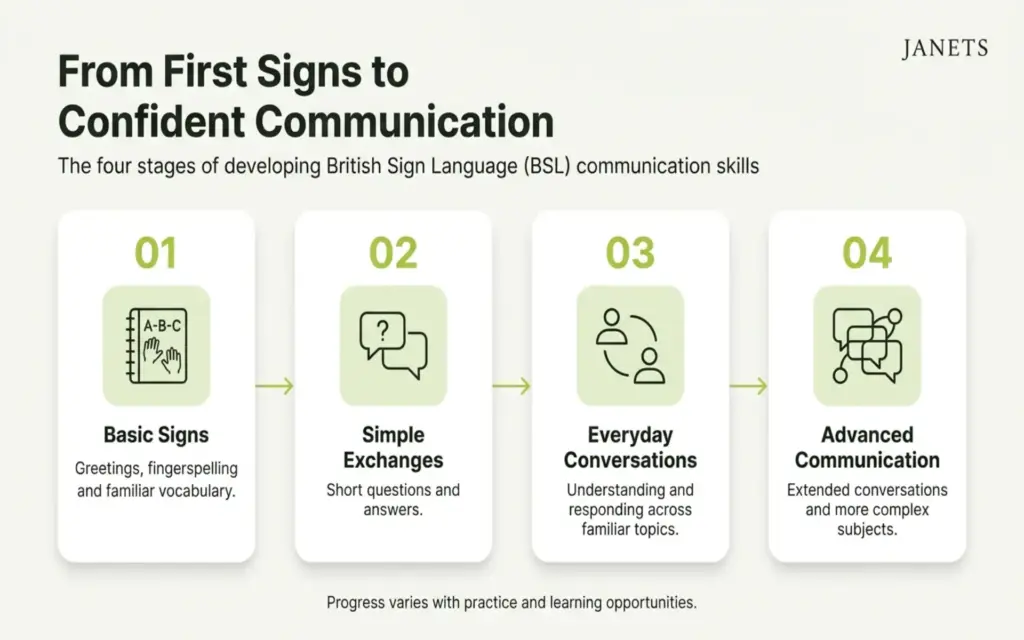
In Your First Month: Familiar Signs and Introductions
You may start recognising greetings, numbers, colours and fingerspelling patterns. With repetition, you could introduce yourself, ask a familiar question and identify a few signs in a slow demonstration.
A good first goal is not memorising hundreds of isolated signs. It is being able to use a small collection accurately and recognise them when somebody else signs them. For a practical starting point, explore essential BSL signs for beginners.
After Three Months: Simple Exchanges
With steady learning and feedback, some beginners may be able to exchange basic personal information, discuss familiar routines, and ask for clarification when they miss something. Others will still be concentrating on recognising signs at normal conversational speed.
If your goal is to communicate with a Deaf friend or family member, practising relevant everyday topics may be more useful than rushing through unrelated vocabulary.
After Six Months or a Year: Broader Confidence
Continued practice may help you follow longer exchanges, use more varied vocabulary and respond with less hesitation. But unfamiliar signers, regional differences and fast-moving conversations can still be challenging.
Instead of asking only, “Have I been learning for six months?”, ask, “Can I understand a new question, respond appropriately and keep the conversation going?” That tells you far more about your progress.
What Affects How Quickly You Learn BSL?
Two people might spend the same number of hours learning and reach different levels of confidence. The quality and variety of those hours matter.
Consistency and Useful Feedback
A short session several times a week can make it easier to revisit signs before you forget them. It also creates opportunities to notice recurring mistakes. A teacher or skilled signer can help you improve handshape, movement and facial expression in ways a static vocabulary list cannot.
Understanding Other Signers
Producing a rehearsed sentence is one skill; understanding an unexpected reply is another. Videos from different fluent signers, conversations and opportunities to ask for clarification can broaden your receptive skills. Respectful interaction with Deaf BSL users also gives you the cultural and conversational context that isolated exercises often lack.
If recognising unfamiliar signs is slowing you down, read more about common challenges hearing adults face when learning BSL.
How Many Hours a Week Should You Spend Learning BSL?
There is no single weekly target that suits everyone. A parent learning to communicate with their child, a busy professional studying after work, and someone preparing for an assessed qualification may have very different needs.
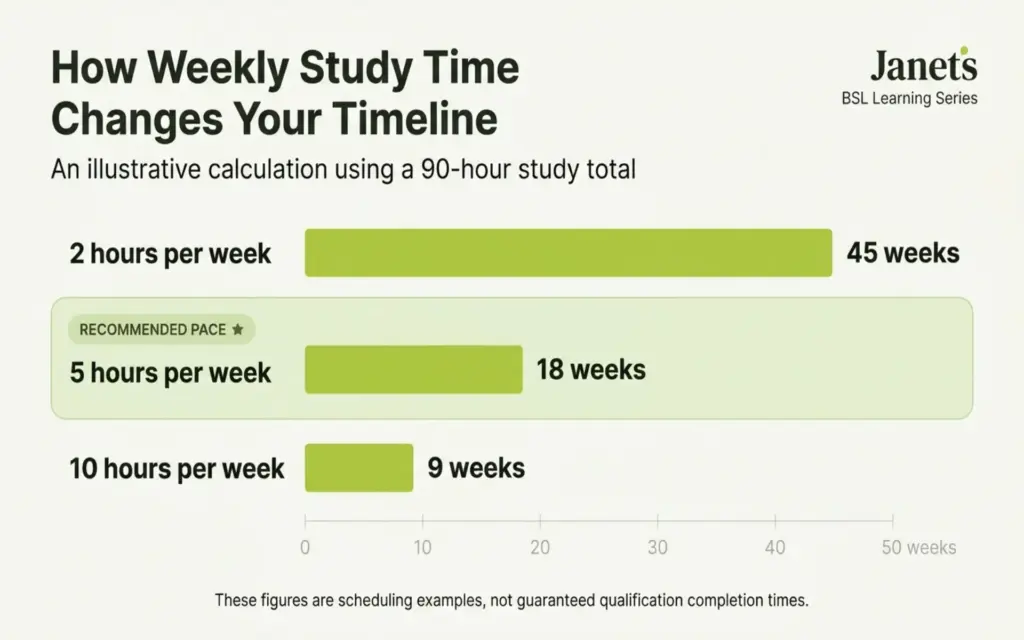
The table below shows how a 90-hour total would spread across three hypothetical schedules, using Signature’s Level 1 qualification time purely as a planning reference.
| Time available | Weeks to allocate 90 hours | Approximate calendar time |
|---|---|---|
| 2 hours a week | 45 weeks | About 10 months |
| 5 hours a week | 18 weeks | About 4 months |
| 10 hours a week | 9 weeks | About 2 months |
This is a calculation, not a promise that you can earn Level 1 in nine weeks. Guided hours may require scheduled classes, and an awarding body’s assessments cannot simply be replaced with independent revision. You might also need more practice than the stated qualification time to feel comfortable in real conversations.
A practical routine combines different activities: watching signed material, practising your own signing, reviewing previously learned expressions and trying to understand unfamiliar questions. If you can study only twice a week, consistency and a manageable goal still count.
Rather than building a detailed daily plan into this article, try a structured 30-day BSL practice plan when you are ready to turn that commitment into specific activities.
Can a Short Online BSL Course Help You Learn Faster?
A structured course can make the early stages feel less scattered. Instead of piecing together unrelated videos, you follow a sequence of topics and return to areas that need revision. Online learning can also be convenient if you are studying around work or family commitments.
Janet’s British Sign Language Level 1 & 2 training is self-paced and requires no previous BSL knowledge. Its advertised content duration is 9 hours and 23 minutes, covering topics such as fingerspelling, everyday vocabulary and signing in familiar situations. The course page describes a CPD-accredited Certificate of Achievement after successful completion of its final assessment.
That content duration is not equivalent to Signature’s regulated Level 1 and 2 qualification hours. Nor does completing the lessons demonstrate fluency. Think of short, structured training as one way to begin or reinforce your learning, with continued practice and interaction still essential.
Frequently Asked Questions
Can You Learn BSL in Three Months?
You may learn useful signs and begin simple exchanges in three months if you practise regularly. Whether you can hold a conversation comfortably depends on your study time, feedback and the complexity of the discussion. Three months is not an official fluency threshold.
How Long Does It Take to Become Fluent in BSL?
There is no universal deadline. Advanced language use can take years, particularly if you have limited chances to communicate with fluent signers. Fluency also involves understanding unfamiliar people and responding naturally, not simply finishing a set number of lessons.
Is BSL Level 1 Equivalent to GCSE?
A regulated Level 1 qualification sits at the same framework level as GCSE grades 1–3 in England, Wales and Northern Ireland, according to GOV.UK’s qualification levels. It is not itself a GCSE, nor the same as a GCSE graded 4 or above. A short course with “Level 1” in its title does not automatically award a regulated Level 1 qualification.
Can You Learn BSL Without a Formal Qualification?
Yes. You can study signs, take lessons and practise conversations without enrolling for formal assessment. A regulated qualification may be useful for structured progression or specific professional goals, but it is not a prerequisite for every personal learning journey.
Get a FREE Course