- Home
- Career Development
- How to Become a Recruitment Consultant in the UK
How to Become a Recruitment Consultant in the UK

You can become a recruitment consultant in the UK through trainee vacancies, an apprenticeship, a graduate programme or progression from recruitment administration and resourcing. Employer requirements vary, so start by comparing actual vacancies rather than assuming that a degree or previous recruitment experience is always necessary.
The work combines understanding people with meeting business needs. Depending on the employer, you may support candidates, develop client relationships, negotiate fees and work towards commercial targets. Knowing which responsibilities appeal to you helps you choose a suitable starting point.
This guide explains the main entry routes, skills to demonstrate, application preparation and questions to ask about salary, commission and support. It also introduces the responsibilities behind fair and professional recruitment.
To explore the knowledge behind candidate sourcing, client relationships and recruitment processes, consider Recruitment courses.
What Does a Recruitment Consultant Do?
Match candidates with employers
A recruitment consultant helps employers find suitable people and helps candidates explore relevant opportunities. In an agency setting, the hiring organisation is the client purchasing recruitment services, while the candidate is the person being considered for work.
The recruitment cycle can include clarifying a vacancy, advertising, searching for candidates, reviewing applications, screening, arranging interviews and supporting an offer. The consultant needs to understand both the employer’s requirements and the candidate’s expectations.
The University of Law recruitment consultant career guide describes this combination of matching, communication, client development and negotiation. www.law.ac.uk
Understand the commercial side
Agency recruitment can involve finding new clients, explaining services and negotiating fees alongside candidate support. An interest in helping people is useful, but applicants should also understand the commercial expectations of their chosen role.
Ask whether you would develop new business, manage existing accounts or mainly deliver candidates for another consultant’s vacancies. Those differences can substantially change your working day.
Compare recruitment settings
An agency serves external hiring organisations. An in-house recruitment team recruits for its own employer, although particular arrangements vary.
A job advert describing “360 recruitment” usually means involvement across both winning or managing client business and recruiting candidates. Other roles divide those activities between colleagues. Treat terminology as a starting point: read the responsibilities and ask what you would actually own.
Entry Routes and Recruitment Consultant Qualifications
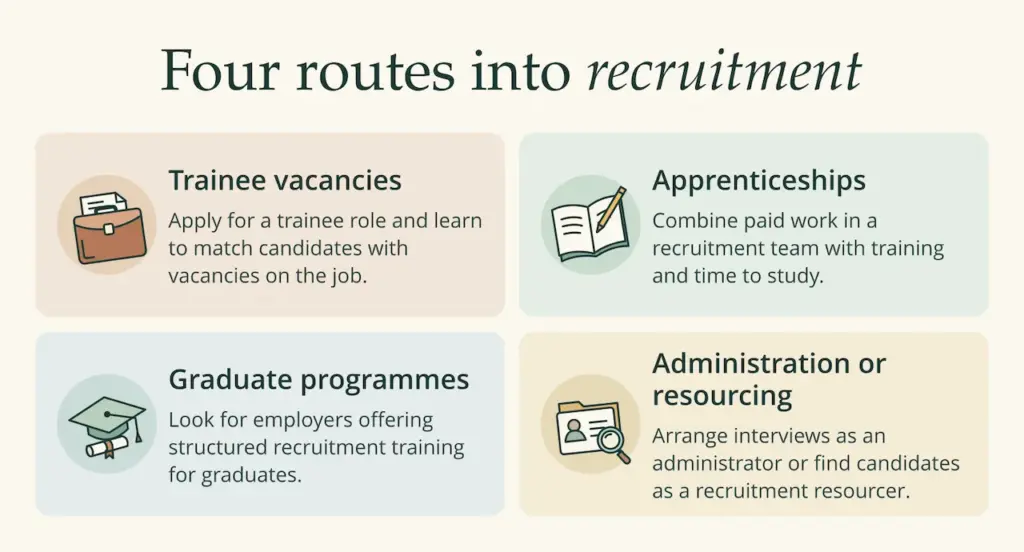
Apply for trainee positions
Search for trainee recruitment consultant and junior recruiter vacancies, then separate essential criteria from desirable experience. Some employers recruit for potential and transferable skills; others expect previous sales, customer service or sector experience despite using “trainee” in the title.
Search employer careers pages and reputable job platforms. Compare location, working pattern, basic pay and initial responsibilities. If an essential requirement is unclear, ask before assuming you are ineligible.
Consider an apprenticeship
In England, the Skills England Recruiter apprenticeship standard is Level 3 and approved for delivery. It lists a typical training duration of 18 months, followed by a typical three-month end-point assessment period. Assessment tests occupational competence after the training and relevant gateway requirements have been completed. skillsengland.education.gov.uk
These periods describe the apprenticeship, not how long finding an employer will take. Approval of the standard does not mean a suitable vacancy is available locally.
Check the employer’s entry criteria, provider arrangements, eligibility and current English and maths requirements. Scotland, Wales and Northern Ireland have their own apprenticeship arrangements; England’s standard should not be treated as a UK-wide scheme.
Explore graduate and support-role routes
Graduate programmes offer another route, with degree subjects, classifications and selection methods determined by the employer. A degree can support an application, but is not a universal requirement for recruitment consultancy.
Recruitment administration or resourcing may suit someone who wants to learn processes before taking wider responsibility. Check whether the position offers useful work and development in its own right, alongside any progression opportunities.
Distinguish Training from Employer Requirements
| Your Starting Point | Route Worth Investigating | Question to Ask |
|---|---|---|
| Relevant sales or customer-facing experience | Trainee consultant vacancy | Will the employer develop recruitment-specific skills? |
| Preference for employment with structured learning | Apprenticeship | Is there a suitable vacancy and provider arrangement? |
| Graduate seeking an organised development programme | Graduate scheme | What are this employer’s selection criteria? |
| Interest in coordination or candidate support first | Administrator or resourcer role | What responsibilities and development opportunities are available? |
Supplementary study can support any route by explaining terminology and processes. It is preparation, rather than an employment route itself. A completion certificate is not automatically a regulated qualification, apprenticeship or professional experience. Check content, assessment and credential status against your learning needs.
Skills You Need to Become a Recruitment Consultant
Communication, listening and relationship building
Recruitment conversations should establish what someone needs, rather than simply fill a silence. Ask a clear question, listen to the answer and check your understanding before moving on.
With employers, this might mean distinguishing an essential skill from something they could teach. With candidates, it might involve clarifying availability, interests and expectations. Reliable follow-up matters too: explain the next step and avoid promising an outcome you cannot control.
Relationship building is about useful, consistent contact. You do not need to present yourself as a particular personality type to demonstrate it.
Sales, negotiation and resilience
Commercial roles require you to explain value, handle objections and discuss terms professionally. Negotiation involves understanding priorities and seeking an agreed outcome within your authority, rather than winning every exchange.
Resilience means responding constructively when plans change. A candidate may decline an offer or an employer may pause hiring. Consider how you organise follow-up, ask for feedback and adjust your approach without becoming persistent in ways that disregard another person’s wishes.
Organisation and digital confidence
Recruiters can handle several vacancies and conversations simultaneously. Clear notes, accurate dates and agreed next actions help prevent missed commitments.
An applicant tracking system records applications and recruitment stages. A customer relationship management system, or CRM, helps organise contact and relationship information. Employers may combine these functions in one platform.
You need not know every product before applying. Instead, demonstrate that you can learn a process, maintain accurate information and explain a simple report.
| Skill | Evidence an Applicant Could Provide |
|---|---|
| Communication | Explaining a service clearly |
| Relationship building | Maintaining contact with clients or members |
| Organisation | Coordinating tasks and deadlines |
| Negotiation | Reaching an agreed outcome |
| Digital confidence | Maintaining accurate records or reports |
Use this table to identify real situations from your background. Choose evidence that shows your actions, not simply that you worked in a customer-facing team. A specific example is more useful than describing yourself as having “excellent people skills”.
How to Get Into Recruitment With No Experience
Identify your transferable experience
Having no recruitment experience does not mean having no relevant evidence. Sales, retail, hospitality, administration, customer service and volunteering can involve communication, coordination and handling expectations. Specialist industry experience can also help you understand the roles being recruited for.
Consider a hypothetical customer service applicant who regularly rearranged appointments. They checked availability, updated records and told colleagues about changes. Those actions demonstrate scheduling, accuracy and follow-up, all relevant to coordinating recruitment interviews.
Their CV could describe the actual appointment work, while their interview explanation connects those skills with recruitment. They should not claim to have managed candidate interviews. This distinction helps a career changer demonstrate relevance while being clear about what they still need to learn.
Choose a realistic starting point
Compare trainee consultant, recruitment administrator and recruitment resourcer vacancies. A resourcing role may concentrate on finding and screening candidates, while an administrator may support records and coordination. Actual duties vary.
Compare the balance of candidate contact, administration and client development. Choose vacancies where your evidence matches the essential criteria and you can explain why the responsibilities interest you.
Build a small sample of relevant work
Optional preparation exercises can help you practise explaining your thinking. Using a fictional employer, fictional candidates and invented contact details, you could:
- Draft a vacancy advert with clear duties and selection criteria.
- Prepare screening questions tied to those criteria.
- Write a brief, professional introduction to a prospective client.
- Create a vacancy tracker showing stages and next actions.
For a fictional customer adviser vacancy requiring enquiry handling and prioritisation, screening questions could include:
- What experience do you have of handling customer enquiries?
- How would you prioritise an urgent enquiry alongside routine requests?
- Which working arrangements and start dates could you consider?
Explain how each question relates to the vacancy. Label the work as independent practice, not professional experience or an activity included in the bundle. Use fictional data and avoid confidential information from previous employment.
Learn the market you want to recruit in
Review relevant vacancies and employer websites to understand common job titles, skills and hiring needs. Research unfamiliar terminology and compare what different employers describe as essential. Use your findings to prepare informed questions about that market.
For structured learning across recruitment processes and complementary business skills, explore the Recruitment Consultant Career Bundle.
Apply for Your First Recruitment Job

Tailor your CV to the vacancy
Use the job description to select relevant responsibilities and achievements. A sales-focused vacancy needs evidence of commercial conversations; a coordination role may put more weight on accuracy and managing deadlines.
Organise your CV around relevant employment, volunteering and learning. For each example, identify the task, your action and the outcome. Use figures only where you can substantiate them; a clear explanation does not need invented percentages or revenue claims.
In a short covering message, explain why this employer and its recruitment market interest you. Refer to something specific in the vacancy and connect it with evidence from your background. Check names, dates and contact details before submitting, and retain a copy of the application for interview preparation.
Prepare for interviews and practical exercises
Prepare examples involving listening, competing priorities, setbacks and relationship building. Explain the situation, your decisions, the result and what you learnt. Be ready to discuss the sales element where it appears in the vacancy.
An employer might use a role-play, written task or presentation, but selection methods differ. Ask what to expect and prepare around the advertised responsibilities.
For a hypothetical exercise, imagine a client asks for “someone experienced who can start quickly”. Clarify the actual duties, essential capabilities, pay range, location, working pattern and decision process before proposing a search. This demonstrates questioning and judgement without assuming information you have not been given.
Assess the employer as carefully as the role
Use the interview to ask:
- How are new starters trained and supported?
- What responsibilities will I have initially?
- How are targets set?
- How does commission work?
- What does progression depend on?
Ask for concrete explanations. Who reviews your work? How are difficult situations escalated? What changes as you gain competence? Answers help you distinguish a clear development plan from general promises about rapid success. Ask how targets balance commercial results with candidate service, and how managers respond when activity does not produce an immediate placement.
Before accepting an offer, compare the written terms with what was discussed. Consider the commute, working hours, responsibilities and support alongside pay. If an important condition remains unclear, request clarification rather than filling the gap with an assumption.
Recruitment Consultant Salary, Commission and Working Conditions
Understand published salary ranges
The National Careers Service recruitment consultant profile currently gives an indicative annual range of £25,000 for starters to £40,000 for experienced consultants. This is career guidance, not a guaranteed offer. Location, employer, responsibilities and experience can affect actual pay. Apprenticeship vacancies have their own advertised pay and should be assessed separately. nationalcareers.service.gov.uk
The profile does not explain whether commission is included. Treat it as an indicative career range, rather than a statement of basic pay. Check current vacancies and written offers for the actual package.
Separate basic salary from OTE
Basic salary is the fixed pay stated in the employment terms. Commission and bonuses are additional payments subject to the applicable scheme.
On-target earnings, or OTE, describe expected total earnings if specified performance conditions are met. OTE is conditional, not guaranteed pay.
For a hypothetical vacancy offering £26,000 basic salary and £34,000 OTE, the additional £8,000 depends on meeting the scheme conditions. These figures illustrate the calculation, not typical market pay.
Ask about thresholds, eligibility, payment timing and circumstances that could reduce or reverse commission. Check how targets apply during induction and whether quoted earnings reflect new starters or established consultants.
Consider the working pattern
The National Careers Service lists typical hours of 37–40 a week, with possible evening events or appointments. Check each vacancy’s arrangements rather than assuming fixed hours or remote working.
Ask how deadlines, targets and competing priorities are managed. Understanding the pace and available support helps you judge whether the role fits your circumstances.
Understand Responsible Recruitment Before You Start
Treat candidates fairly
Use relevant selection criteria, assess evidence consistently and avoid assumptions about suitability based on personal characteristics. Ask how the employer supports accessibility and handles requests for adjustments.
Acas recruitment guidance explains fair recruitment and discrimination considerations in Great Britain. Northern Ireland has a separate legal framework and the Labour Relations Agency provides employment-relations guidance there. Follow the guidance applicable to the role’s jurisdiction. www.acas.org.uk
Handle personal information carefully
CVs, interview notes and candidate records contain personal information. Use authorised systems, limit access and follow the organisation’s instructions on collecting, sharing and retaining it. Do not move candidate details into personal accounts or public tools without authorisation.
The ICO’s employment guidance includes recruitment and selection material currently labelled draft. That material is under review following the Data (Use and Access) Act 2025. Organisations need an appropriate lawful basis for processing; consent is not the only possible basis. ico.org.uk
Follow the rules applying to the agency
The government overview of the Conduct Regulations covers England, Scotland and Wales; Northern Ireland has separate arrangements.
Employment agencies introduce people for employment by hirers, while employment businesses supply temporary workers. Work-finding fees generally cannot be charged to work-seekers, with specific entertainment and modelling exceptions. These are organisational obligations: a trainee should learn the procedures relevant to their duties and escalate uncertainty, rather than assume responsibility for every compliance decision. www.gov.uk
Career Progression and Choosing a Specialism
Experience may lead towards specialist recruitment, account management, business development or management. The available direction depends on your employer, performance, interests and opportunities, rather than a universal promotion timetable.
A specialism might reflect previous industry knowledge, the candidates you enjoy working with or a market you want to understand deeply. Investigate the actual work before deciding that a particular sector is right for you. Consider the roles recruited for, client relationships and knowledge you would need to maintain.
Ask what changes at the next level. Would you handle more complex vacancies, larger accounts, mentoring or team leadership? Compare those responsibilities with the skills you want to develop, rather than choosing solely by job title.
Agency ownership is a separate future undertaking requiring preparation in business management, finance and applicable obligations. It should not be treated as an automatic next step after becoming a successful consultant.
Take Your Next Step Towards a Recruitment Consultant Career

Start by comparing suitable vacancies and noting their responsibilities, entry criteria and support. Choose opportunities that match both your current evidence and the work you want to learn.
Next, identify truthful examples of transferable skills. Prepare to explain your contribution, what happened and what you would do differently. Use optional practice exercises to explore unfamiliar tasks without presenting them as employment experience.
Finally, prepare informed questions about induction, targets, pay and progression. A clear understanding of the role helps you make a considered application and assess an offer confidently.
To strengthen your understanding before applying, explore Recruitment Consultant Career Bundle.
Frequently Asked Questions
Do I need a degree to become a recruitment consultant?
No, a degree is not required for every recruitment consultant vacancy. Trainee roles, apprenticeships and progression from support positions offer alternative routes. Graduate programmes have their own criteria, and specialist employers may value related qualifications or industry knowledge. Check the actual requirements rather than assuming one educational route applies everywhere.
Can I become a recruitment consultant without sales experience?
Potentially, particularly where an employer accepts transferable skills and provides suitable development. Prepare truthful examples of influencing decisions, explaining value, handling objections or maintaining relationships. These can come from other settings. Check how much prospecting, business development and target-based work the role involves, rather than assuming recruitment is purely candidate support.
How long does it take to become a recruitment consultant?
There is no single timescale. Finding a suitable vacancy depends on opportunities and your application readiness. An apprenticeship has a defined training and assessment structure, while employer induction varies. Starting a job is also different from becoming independently competent: ask what development, supervision and assessment the employer provides as responsibilities increase.
Is recruitment consultancy a stressful job?
It can involve pressure from targets, deadlines and decisions outside your control, such as changing hiring plans. Experiences vary between roles and employers. Ask about workload, management support, realistic expectations and boundaries. Consider how you respond to uncertainty and follow-up demands, rather than judging suitability from stereotypes about the profession.
What is the difference between a recruitment resourcer and a consultant?
A resourcer typically focuses on identifying candidates, checking suitability and supporting recruitment activity. A consultant may also manage clients, negotiate terms and develop business. There is overlap, and employers divide responsibilities differently. Compare the actual duties, decision-making authority and targets instead of relying on the job title to explain the difference.
Get a FREE Course