- Home
- Career Guide
- Teaching Assistant Course Cost: UK Prices Explained
Teaching Assistant Course Cost: UK Prices Explained

Thinking about becoming a teaching assistant but unsure how much training will cost? You might find online courses advertised for less than £30 alongside regulated qualifications costing several hundred pounds. At first glance, both may look suitable, but they can offer very different learning outcomes.
The teaching assistant course cost depends on the qualification level, course provider, assessment requirements and certificate options. Understanding these differences can help you avoid paying for training that does not match your goals.
Here’s what teaching assistant courses cost in the UK, what additional fees to check and how to find an option that suits your budget.
How much does a teaching assistant course cost in the UK?
Teaching assistant course costs vary considerably. Introductory online CPD courses may cost around £25, while regulated qualifications can cost several hundred pounds. For example, Janets lists a Level 3 Award at £280 excluding VAT. Certificate fees, assessments and funding eligibility can also affect your final cost.
How Much Do Teaching Assistant Courses Cost in the UK?
Teaching assistant training prices depend on what the course includes and the type of certificate or qualification you receive.
A short online programme introducing classroom support skills will usually have a different fee structure from a regulated qualification requiring formal assessment.
The following examples show how prices differ across training options.
| Course type | Example advertised price | What to consider |
|---|---|---|
| Introductory online CPD course | £25 excluding VAT at Janets | Develops knowledge; not automatically a regulated qualification |
| Level 2 teaching assistant training | Varies by provider | Check whether it is CPD training or an RQF qualification |
| Regulated Level 3 Award | £280 excluding VAT at Janets | Check assessment and qualification requirements |
| Level 4 HLTA-related Certificate | £350 excluding VAT at Janets | Check workplace experience and assessment requirements |
Prices are examples from Janets course listings checked in November 2026, not UK-wide averages. Offers and fees may change.
Online Teaching Assistant Courses and CPD Training
Online teaching assistant courses can be an affordable starting point for people exploring classroom support.
These programmes commonly cover responsibilities such as assisting teachers, supporting pupils, understanding school policies and recognising different learning needs.
For example, Janets offers a Teaching Assistant Complete Course covering teaching assistant responsibilities, SEN support, autism, ADHD and dyslexia.
The course is advertised at £25 excluding VAT and offers CPD certificate options. It also lists an optional Quality Licence Scheme-endorsed certificate for an additional charge.
This type of training may suit someone developing introductory knowledge or expanding existing skills. However, it should not be confused with a regulated teaching assistant qualification.
Level 2 and Level 3 Teaching Assistant Course Fees
When comparing Level 2 and Level 3 teaching assistant course costs, the qualification’s purpose matters as much as its price.
Level 2 learning may introduce classroom support responsibilities and foundational knowledge. Level 3 qualifications can involve more advanced study, although their assessment requirements and size vary.
A Level 3 Award is not automatically equivalent to a Level 3 Certificate or Diploma. Courses at the same level can have different learning hours, assessment methods and intended outcomes.
Janets, for instance, lists its Focus Awards Level 3 Award in Supporting Teaching and Learning in Schools at £280 excluding VAT.
If you are deciding between these levels, compare the qualification type, learning outcomes and assessment requirements alongside the fee. Our guide to Level 2 vs Level 3 teaching assistant qualifications explains the differences in more detail.
Higher Level Teaching Assistant Course Costs
Experienced teaching assistants may also consider training related to Higher Level Teaching Assistant (HLTA) responsibilities.
Janets offers a Level 4 Certificate for Higher Level Teaching Assistants, advertised at £350 excluding VAT.
Before enrolling, check whether the qualification requires relevant workplace experience, practical evidence or assessment in an educational setting.
Completing an HLTA-related course does not automatically guarantee appointment to an HLTA position. Schools may have additional recruitment and experience requirements.
Start Your Teaching Assistant Journey for Less
Build classroom support knowledge with Janets’ Teaching Assistant Complete Course.
- Covers TA duties, SEN, autism, ADHD and dyslexia
- Self-paced online study with online assessments
- CPD certified, with optional certificate choices
Why Do Teaching Assistant Course Prices Vary?
Two courses can share similar names yet have significantly different fees.
The difference often comes down to what learners receive, how their work is assessed and whether the programme leads to a regulated qualification.
CPD Courses Versus Regulated Qualifications
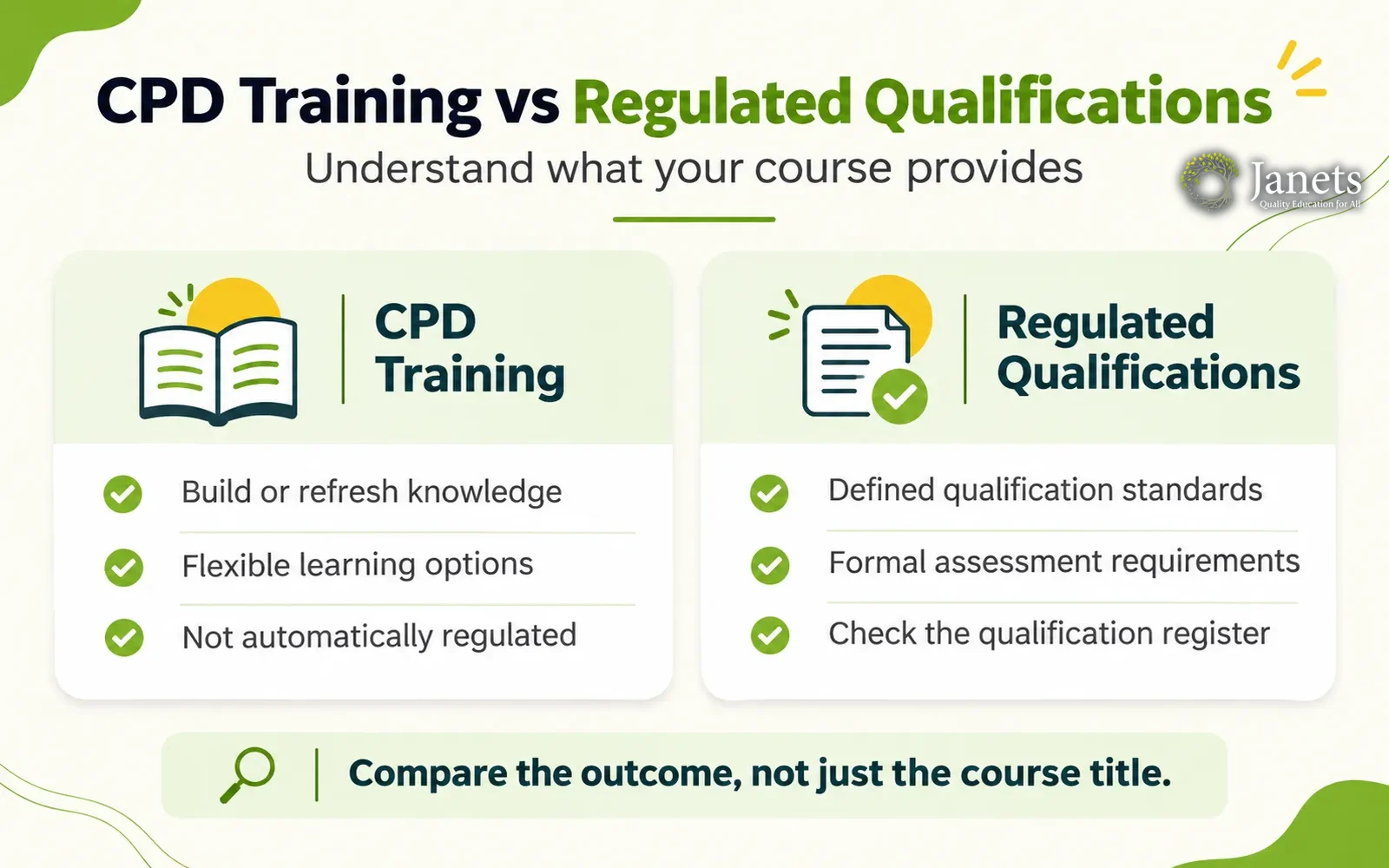
Continuing Professional Development (CPD) courses are generally designed to help learners build or update professional knowledge.
A regulated qualification, by contrast, has defined requirements relating to its content, level and assessment.
In England and Northern Ireland, you can check whether a qualification is officially recognised through the government’s Register of Regulated Qualifications.
This distinction matters when comparing affordable online courses with qualifications intended to demonstrate formally assessed learning.
A course described as “Level 3 CPD” should not automatically be treated as equivalent to an Ofqual-regulated Level 3 Award, Certificate or Diploma.
Understanding what each course awards helps you make a meaningful comparison rather than choosing based on the level stated in its title.
Tutor Support, Study Format and Assessment Requirements
Course delivery can influence the price.
Self-paced online programmes may provide recorded lessons and automated assessments. Other programmes involve tutor feedback, written assignments, workplace observations or structured practical assessments.
Before paying, check whether the advertised fee includes tutor guidance, assessment opportunities, learning materials and any required workplace evidence.
The most appropriate option depends on the support and assessment you need, not simply the number of features included.

What Extra Costs Should You Check Before Enrolling?
The advertised course fee is not always the final amount you will spend.
Additional charges may be optional, required for a particular qualification or already included in the quoted price.
Certificate, Assessment and Registration Fees
Some online training providers charge separately for certificates.
For example, Janets’ Teaching Assistant Complete Course lists the following optional certificate charges:
- CPD PDF certificate: £9.99.
- CPD printed certificate: £15.99.
- Quality Licence Scheme-endorsed certificate: £119.
These are different certificate options, and learners should check which one meets their needs.
An optional CPD or QLS certificate is not the same as an RQF qualification certificate. For regulated qualifications, confirm which qualification certificate is awarded and whether its cost is included in the fee.
You should also check whether registration, assessments, resits and awarding-organisation charges are included.
VAT deserves attention too. If a provider advertises a price excluding VAT, confirm the final amount payable before purchasing.
Placement, Course Access and Payment Costs
Some qualifications require practical experience or evidence gathered in a school.
Even if the teaching materials are delivered online, learners might need suitable workplace access. Travel expenses and time commitments can therefore affect the overall cost.
Check how long you can access the learning materials and whether extensions involve charges.
If a provider offers instalments, compare the total amount payable with the upfront price.
A practical cost checklist
Before enrolling, establish:
- The final course fee, including applicable VAT.
- Whether assessments, resits and registration are included.
- Whether certificates cost extra.
- Any school placement or workplace observation requirements.
- The course access period and potential extension fees.
- The total payable amount if using instalments.
These checks make it easier to compare courses on their actual costs rather than advertised prices alone.
Can You Get a Free or Funded Teaching Assistant Course?
Paying for training yourself is not always the only option.
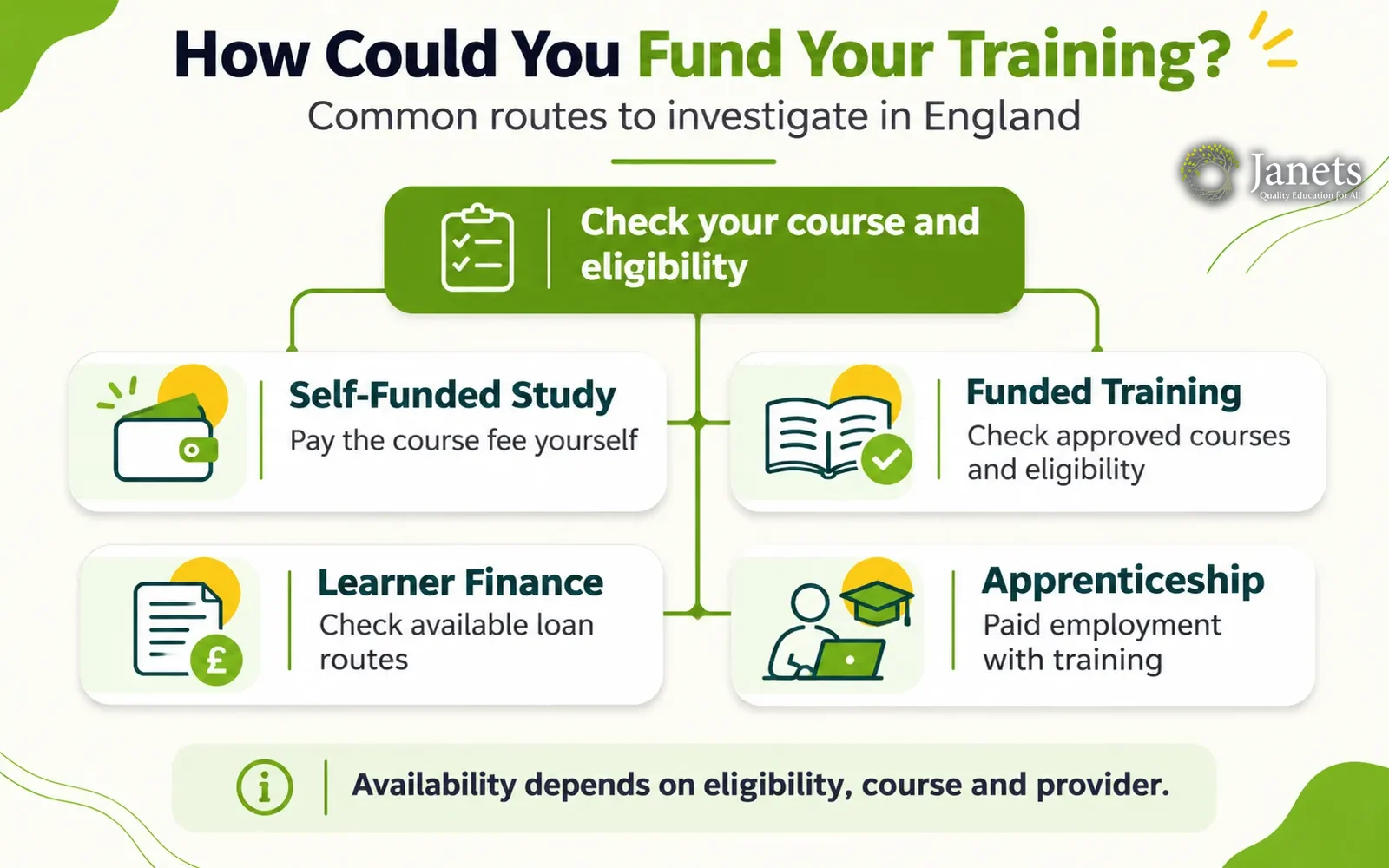
Depending on your circumstances, you may be eligible for government-funded training, an apprenticeship or other support.
However, funding arrangements differ across the UK, and not every teaching assistant course qualifies.
Free and Government-Funded Training in England
In England, the government’s Free Courses for Jobs scheme provides access to approved qualifications for eligible adults.
The Free Courses for Jobs guidance explains that some adults aged 19 or over may qualify for fully funded training, including approved Level 3 qualifications.
Eligibility depends on your circumstances, the qualification and the funding arrangements in your area. The 2026–27 Adult Skills Fund rules set the national low-earnings threshold at £26,800, although eligibility and local funding arrangements can differ.
Certain learners aged 19–23 may also qualify for funded training through their first full Level 3 entitlement.
Importantly, a qualification being regulated does not automatically make it government-funded.
You must check that both the course and training provider meet the applicable funding requirements.
England’s schemes should not be assumed to apply unchanged in Scotland, Wales or Northern Ireland.
Advanced Learner Loans and Teaching Assistant Apprenticeships
An Advanced Learner Loan may help eligible adults cover the cost of approved training.
According to the government’s Advanced Learner Loan eligibility guidance, eligibility depends on factors including age, residency, qualification and training provider.
For certain Level 4–6 courses starting on or after 1 January 2027, eligible learners may need to apply through the Lifelong Learning Entitlement rather than an Advanced Learner Loan. Check the funding arrangements for the specific course and provider.
Another option is a teaching assistant apprenticeship.
Apprentices combine paid employment with structured training. In England, apprentices do not pay tuition fees for their apprenticeship training, as explained by Apprenticeships.gov.uk.
An apprenticeship is therefore different from purchasing a self-paced online course.
If affordability is your main concern, investigate funding eligibility before committing to privately funded training.
Compare Teaching Assistant Training Options at Janets
Choosing a course becomes easier when you compare its learning purpose rather than looking at price alone.
Janets offers introductory teaching assistant training alongside qualifications focused on school support and broader education and training.
These options are not interchangeable, so your intended outcome should guide the decision.
Introductory Teaching Assistant Training and Regulated Options
If you want to build foundational knowledge before deciding whether to pursue further training, a CPD-certified programme may be a sensible starting point.
Janets’ Teaching Assistant Complete Course introduces classroom support and different learning needs, with online assessments and optional certificate choices.
For readers specifically seeking an RQF qualification, Janets also offers the Focus Awards Level 3 Award in Supporting Teaching and Learning in Schools.
The course is advertised at £280 excluding VAT and covers areas related to supporting teaching, learning and pupil wellbeing.
Its assessment requirements and qualification certificate arrangements should be checked before enrolment.
The distinction matters: an introductory CPD course can help develop knowledge, while a regulated Award follows a different qualification framework.
Neither course guarantees employment in a school.
For learners considering more advanced classroom support, the Level 4 HLTA-related qualification discussed earlier provides another option to investigate.
Related Education and Training Qualifications
Teaching assistant training is not the only form of professional learning available in education.
Janets also offers a Level 3 Award in Education and Training, advertised at £250 excluding VAT.
This qualification introduces teaching and training responsibilities. It may suit adults interested in broader education or training roles rather than school-based teaching assistant work specifically.
Another option is the Level 4 Certificate in Education and Training, advertised at £380 excluding VAT.
This focuses on further development in education and training and should not be treated as a direct alternative to a teaching assistant qualification.
Before choosing either programme, review its entry requirements, assessment arrangements and intended learning outcomes.
All five Janets course prices quoted in this article were checked against published listings in November 2026 and exclude VAT. Current fees and qualification arrangements should be confirmed before purchase.
Ready for a Regulated Teaching Assistant Qualification?
Study the Focus Awards Level 3 Award in Supporting Teaching and Learning in Schools (RQF).
- Ofqual-regulated Focus Awards qualification
- Covers supporting teaching, learning and pupil wellbeing
- Check assessment requirements before you enrol
How to Choose a Teaching Assistant Course for Your Budget
A sensible training budget starts with knowing what you need from the course.
The cheapest option may be appropriate for someone exploring teaching assistant work. Someone seeking a particular regulated qualification may need a different programme.
Compare the Total Cost, Not Just the Course Fee
Start by identifying your learning goal.
Do you want to understand classroom support responsibilities, improve existing skills or work towards a specific qualification?
Once that is clear, consider:
- Learning outcome: Does the course provide CPD training or a regulated qualification?
- Assessment: Will you complete examinations, assignments or workplace evidence?
- Total cost: Have you included applicable certificates, assessments and practical expenses?
- Study flexibility: Does the access period and level of support suit your circumstances?
- Funding: Could you qualify for an approved funding route?
This approach gives you a more meaningful comparison than choosing a course solely because it is discounted.
Check What Schools Expect Before Paying
If your goal is employment, look at teaching assistant vacancies before selecting a qualification.
The National Careers Service teaching assistant guidance explains that individual schools set their own entry requirements.
Some employers may value relevant qualifications, classroom experience and the ability to support pupils with different needs.
If you are new to the profession, Janets’ guide on how to become a teaching assistant with no experience provides further background on potential entry routes and preparing for the role.
Checking job descriptions first can help you avoid paying for training that does not match your intended employer’s requirements.
Choosing the Right Teaching Assistant Course
The right teaching assistant course is not necessarily the cheapest or most expensive. It is the one that fits your budget, learning goals and any qualification requirements.
Compare the full costs, check what the course awards and consider whether the training supports your intended next step. Janets offers several options worth reviewing once you know what you need.
Teaching Assistant Course Cost FAQs
How Much Is an Online Teaching Assistant Course?
Online teaching assistant courses can cost around £25 for introductory CPD training, while regulated qualifications may cost several hundred pounds. Always check the final price, qualification type and any additional fees.
Are Cheaper Teaching Assistant Courses Worth It?
They can be worthwhile for developing knowledge or refreshing skills. However, a lower-priced CPD course may not provide the regulated qualification relevant to your intended role.
Can I Pay for a Teaching Assistant Course in Instalments?
Some training providers offer payment plans. Availability and terms vary, so check the total payable amount and whether instalments involve additional charges.
Do Teaching Assistant Courses Require a School Placement?
Not all courses require one. Some regulated qualifications involve practical assessment or workplace evidence, while introductory online programmes may be completed remotely. Check the specific requirements before enrolling.
Why Are Some Teaching Assistant Courses More Expensive?
Prices depend on qualification type, course length, tutor support and assessment requirements. Regulated qualifications may involve formal assessments or workplace evidence, while introductory CPD courses can offer more flexible learning arrangements.
Is a Level 3 Teaching Assistant Course Worth the Cost?
A Level 3 course may be worthwhile if its qualification and learning outcomes match your goals. Not all Level 3 courses award the same qualification, so check the awarding organisation, assessment requirements and relevant school vacancies.
Can I Get a Teaching Assistant Qualification for Free in the UK?
Some eligible learners can access funded training or teaching assistant apprenticeships. Availability depends on the qualification, provider, location and personal circumstances. Funding arrangements differ across the UK, so check the relevant eligibility rules before applying.
Get a FREE Course