


Course Library View the full range of courses
-
Accounting (145 courses)
- Xero Accounting and Bookkeeping Online
- Sage 50 Accounting & Payroll
- Project Finance
- Financial Modelling Training
- Tax Accounting
- Introduction to VAT
- Accounting and Finance Course for Managers
- Internal Compliance Auditor
- Financial Statement Analysis
- Payroll Administrator Level 3 Diploma
- View all Accounting courses
-
Language (67 courses)
- British Sign Language (BSL) Level 1 & 2
- Speech and Language Therapy Diploma
- TEFL (TESOL) Course
- English Spelling, Punctuation, and Grammar
- Child & Adult Speech & Language Disorders Training
- Teaching English as Foreign Language (TEFL) Certificate
- Mastering Spanish Language
- French Course for Beginners
- German Course for Beginners
- Body Language and Gesture Training
- View all Language courses
-
Teaching & Education (37 courses)
- Teaching Assistant Complete Course (TA, SEN, Autism, ADHD & Dyslexia) – CPD Certified
- EYFS Teaching Assistant Training Course
- Advanced Diploma in Coaching and Mentoring
- Level 3 Diploma in Teaching and Classroom Management
- Remote Teaching
- SENCO – Special Educational Needs Coordination
- Teaching English as Foreign Language (TEFL)
- Life Coaching
- Phonics Teaching Diploma
- View all Teaching & Education courses
-
Health and Social Care (138 courses)
- Health and Social Care Management
- Paediatric Nursing Assistant
- Mental Health Awareness Training
- Emergency Medicine – Paramedicine
- Level 3 Diploma in Adult Care
- Paediatric First Aid Training
- Safeguarding Children Level 3
- Level 3 Diploma in Anatomy and Physiology of Human Body
- Play Therapy
- The Care Certificate Preparation – Standards (1 to 15)
- View all Health and Social Care courses
-
Management (539 courses)
- Office Admin, Secretarial and PA Diploma
- Estate Agent and Property Management Training
- Diploma in Data Analysis Fundamentals
- Advanced Diploma in Stress & Anxiety Management
- Good Manufacturing Practice (GMP)
- Property Development and Management Course
- Diploma in Hotel Management
- Supply Chain Management
- Quality Assurance (QA) Manager
- Compliance and Risk Management
- View all Management courses
-
IT & Software (124 courses)
- Coding with Python 3
- Search Engine Optimisation (SEO) Training
- Cyber Security
- Motion Graphics with After Effects
- CompTIA A+ Core 1 (220-1101) Course
- Machine Learning for Aspiring Data Scientists
- Next.js Web Dev: Master this Powerful React Framework
- Learn 2D Animation with Adobe Animate
- GDPR Challenges in Education
- View all IT & Software courses
-
Employability (1043 courses)
- Office Administrator Skills
- Presentation Skills
- Legal Secretary and Office Skills
- Hospitality Management
- Estate Agent Diploma
- Hairdressing and Barbering
- Diploma in UK Employment Law
- Diploma in Data Analysis Fundamentals
- Building Surveyor Training
- Emotional Intelligence Training
- View all Employability courses
-
Personal Development (1439 courses)
- Productivity Habits
- Minute Taking Course
- Presentation Skills
- Excel: Top 50 Microsoft Excel Formulas in 50 Minutes!
- Critical Thinking and Problem Solving Skills
- Time Management
- Self Esteem and Confidence Building Course
- Essential IT Skills
- Legal Secretary and Office Skills
- Personality Development
- View all Personal Development courses


Mental Health First Aid Certification
197 Students (7 Reviews)
Become a mental health first aider! This QLS endorsed Level 5 Mental Health First Aid Certification Course equips you to identify mental health concerns, offer support, and guide individuals towards help. Empower yourself and others, and make a positive difference in your community.

Course Curriculum
| Module 1: Introduction to Mental Health | |||
| Introduction to Mental Health | 00:20:00 | ||
| Module 2: Overview of Mental Health First Aid | |||
| Overview of Mental Health First Aid | 00:12:00 | ||
| Module 3: Childhood and Adolescent Psychiatric Disorders | |||
| Module 04: Childhood and Adolescent Psychiatric Disorders | 00:25:00 | ||
| Module 4: Stress and Anxiety Disorders | |||
| Stress and Anxiety Disorders | 00:32:00 | ||
| Module 5: Schizophrenia | |||
| Module 06: Schizophrenia | 00:26:00 | ||
| Module 6: Personality Disorders | |||
| Personality Disorders | 00:42:00 | ||
| Module 7: Mood Disorders | |||
| Mood Disorders | 00:22:00 | ||
| Module 8: Eating & Sleeping Disorders | |||
| Module 09: Eating & Sleeping Disorders | 00:44:00 | ||
| Module 9: Self-Harm and Suicide | |||
| Self-Harm and Suicide | 00:20:00 | ||
| Module 10: Medication and Therapy in the Treatment of Mental Illness | |||
| Medication and Therapy in the Treatment of Mental Illness | 00:32:00 | ||
| Module 11: Social Attitudes to Mental Illness | |||
| Social Attitudes to Mental Illness | 00:13:00 | ||
| Module 12: Mental Health Legislation and Services | |||
| Mental Health Legislation and Services | 00:29:00 | ||
| Module 13: Mental Health in the Workplace | |||
| Mental Health in the Workplace | 00:23:00 | ||
| Module 14: Approach and React To People in Mental Health Crisis | |||
| Approach and React To People in Mental Health Crisis | 00:25:00 | ||
| Mock Exam | |||
| Mock Exam – Mental Health First Aid Certification | 00:20:00 | ||
| Final Exam | |||
| Final Exam – Mental Health First Aid Certification | 00:20:00 | ||
| Assignment | |||
| Assignment – Mental Health First Aid Certification | 2 weeks, 1 day | ||
| Order Your Certificate | |||
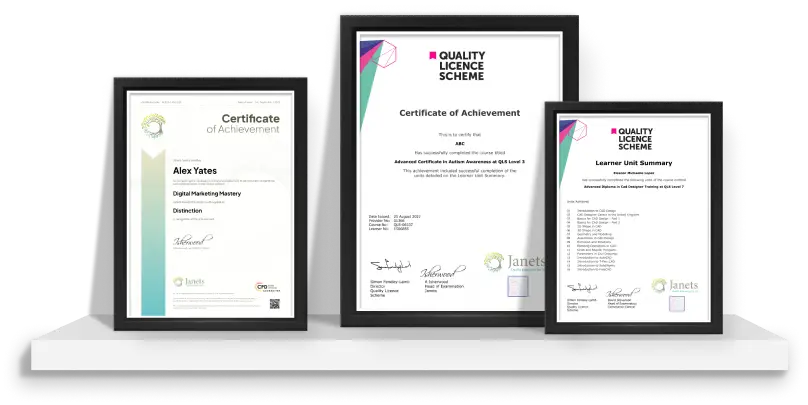
| Order your Certificate QLS | 00:00:00 | ||

Original price was: £319.£25Current price is: £25. ex Vat
SAVE 92% - OFFER ENDS IN

 14-Day Money-Back Guarantee
- Personal
- Team
Quantity:
Total:
50% discount for orders of 10+ courses
60% discount for orders of 50+ courses
70% discount for orders of 100+ courses
For more personalised package, contact us

Frequently asked questions
Can’t find the anwser you’re looking for ? Reach out to customer support team.
To become a mental health first aider: Enrol in a Course: Sign up for an accredited Mental Health First Aid (MHFA) course. These are often available through organisations like Mental Health First Aid England, Mental Health First Aid USA, or similar entities in your country. Complete the Training: Attend and complete the required training sessions, which typically include both theoretical and practical components. Receive Certification: Upon successful completion, you will receive a certification confirming you as a mental health first aider.
Yes, mental health first aid is worth it. It equips individuals with the skills to recognize signs of mental health issues, provide initial support, and guide someone towards professional help. It promotes mental health awareness and can significantly impact community well-being.
Psychological First Aid (PFA): PFA is a technique used in the immediate aftermath of a traumatic event to support individuals in distress, reduce initial symptoms, and promote long-term mental health. Mental Health First Aid (MHFA): MHFA is a broader training program that teaches individuals how to identify, understand, and respond to signs of mental health issues in others, providing support until professional help is available.
The 5 steps of Mental Health First Aid, often summarised as ALGEE, are: A: Approach, assess, and assist with any crisis. L: Listen non-judgmentally. G: Give reassurance and information. E: Encourage professional help. E: Encourage self-help and other support strategies.
The 5 R's of mental health typically refer to: Recognize: Identifying signs and symptoms of mental health issues. Respond: Offering immediate support and reassurance. Refer: Guiding the individual towards professional help. Review: Checking back to see if the person has accessed support and how they are doing. Reflect: Reflecting on the experience and what was learned.
First Aid: Deals with physical health emergencies, such as cuts, bruises, and fractures, providing immediate care until professional medical help is available. Mental Health First Aid: Focuses on mental health crises, such as panic attacks, suicidal thoughts, and severe anxiety, providing initial support and guiding the individual towards professional mental health services.
MHFA certification typically lasts for three years. After this period, a refresher course is recommended to keep skills and knowledge up to date.
No, Psychological First Aid (PFA) is not psychotherapy. It is a supportive intervention designed to help individuals in the immediate aftermath of a traumatic event, providing practical assistance and emotional support, rather than ongoing therapeutic treatment.
Psychological First Aid (PFA) in mental health is an approach used to support individuals after experiencing a traumatic event. It aims to reduce initial distress and promote coping and recovery through practical care, comfort, and support.
Criticisms of Mental Health First Aid include: Effectiveness: Some argue that there is limited evidence on the long-term effectiveness of MHFA training. Scope of Training: Concerns that the training may not be comprehensive enough to handle severe mental health crises. Misapplication: Risk of individuals applying MHFA techniques inappropriately without further professional support.
Yes, mental health first aid is considered a valuable skill. It involves understanding mental health issues, providing immediate support, and connecting individuals with appropriate professional help.
MHFA is generally effective in increasing awareness, reducing stigma, and providing individuals with the skills to support others experiencing mental health issues. However, its effectiveness can vary based on the training quality and the individual's ability to apply what they have learned.
"Level 6 Mental Health First Aid" is not a commonly recognized term in MHFA programs. MHFA training typically involves basic and advanced courses, but specific levels such as "Level 6" may refer to internal classifications within specific organisations.
The number of mental health first aiders varies by country and organisation. For example, Mental Health First Aid England reports training over 500,000 people. Globally, millions have been trained in MHFA.
A good mental health first aider is: Empathetic: Able to understand and share the feelings of others. Non-Judgmental: Provides support without bias or prejudice. Patient: Gives time for the individual to express themselves. Good Listener: Actively listens and responds appropriately. Reliable: Trustworthy and dependable in providing support. Knowledgeable: Well-informed about mental health issues and available resources.